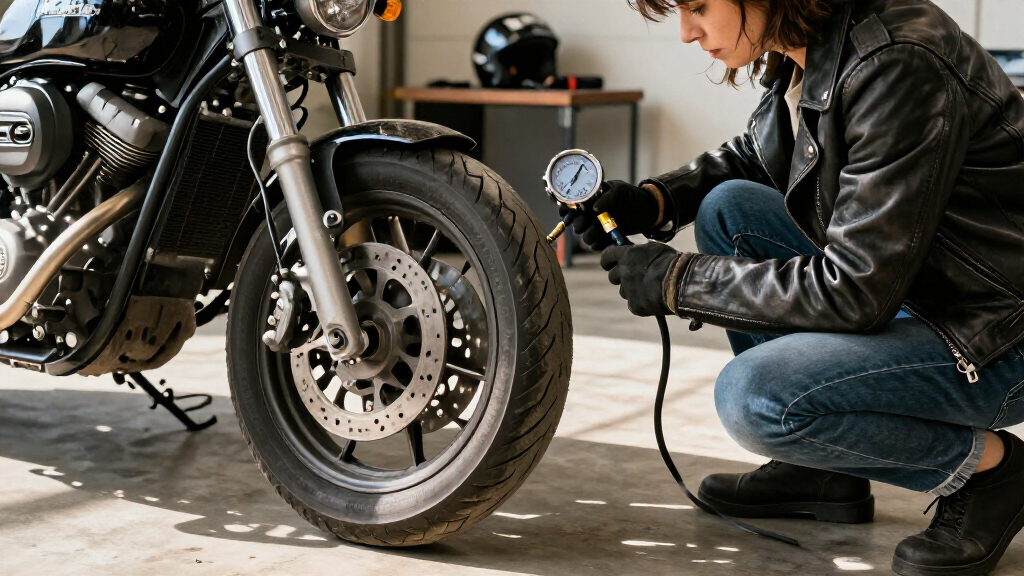

For most riders, the JACO ElitePro Digital Tire Pressure Gauge is the best overall motorcycle tire pressure gauge because its 100 PSI range suits typical motorcycle checks without the very broad scale of an inflator gauge. The PUIBERS 60 PSI gauge is a focused choice for riders who value a flexible hose and a motorcycle-oriented range, while the AstroAI T1 adds an inflator for garage use. Choosing between them means weighing easy valve access and readable measurements against a compact tool, a wider pressure range, or simpler analog construction. Read on for how all six options compare, including which tradeoffs matter for beginners and riders who check pressure often.

Get business pricing on garage and car supplies
- Business-only prices and quantity discounts
- Tax-exempt purchasing
- Multiple users, one account, clear invoices
Complete the kit


Key Takeaways
- JACO ElitePro is the strongest all-around fit: its 100 PSI ceiling covers routine motorcycle checks while avoiding the unusually broad range of an inflator-focused gauge.
- The PUIBERS stands out for awkward valve access: its flexible hose can make positioning easier, but its 60 PSI ceiling is less versatile for other vehicle or equipment uses.
- The AstroAI T1 serves a different garage role: its inflator function and 3–250 PSI range suit multi-purpose shop tasks, though that breadth is more than many motorcycle-only riders need.
- Analog options trade display features for simplicity: the Counteract dial and AstroAI pencil pair avoid digital readouts, but buyers must be comfortable reading a scale.
- The right pressure range beats the biggest number: the 150 PSI AstroAI digital gauge and 10–75 PSI pencil gauges offer different forms of flexibility, so match the tool to your motorcycle’s specified pressures and your other uses.
| JACO ElitePro Digital Tire Pressure Gauge, 100 PSI |  | Best for Precise Pressure Adjustments | Maximum pressure: 100 PSI | Accuracy: ±0.50% FS (0.50 PSI) | Readout resolution: 0.10 PSI | VIEW LATEST PRICE | See Our Full Breakdown |
| AstroAI T1 Digital Tire Pressure Gauge with Inflator, 3–250 PSI |  | Best for Compressor-Powered Inflation | Pressure range: 3–250 PSI | Accuracy: ±1 PSI | Calibration standard: ANSI B40.7 Grade 2A | VIEW LATEST PRICE | See Our Full Breakdown |
| PUIBERS 60 PSI Motorcycle Tire Pressure Gauge with Flexible Hose |  | Best Battery-Free Mechanical Pick | Pressure range: Up to 60 PSI | Dial size: 2 inches | Chuck: 90-degree right-angle chuck | VIEW LATEST PRICE | See Our Full Breakdown |
| Counteract MKPG-D Analog Tire Pressure Gauge for Motorcycle and ATV Tires |  | Best Compact Angled-Head Gauge | Pressure range: 5–50 PSI (50–300 kPa) | Head angle: 90 degrees | Material: Metal | VIEW LATEST PRICE | See Our Full Breakdown |
| AstroAI Digital Tire Pressure Gauge, 150 PSI |  | Best Compact Digital Gauge | Measurement range: 0–150 PSI | Accuracy: ±1 PSI | Measurement units: PSI, Bar, Kgf/cm², KPA | VIEW LATEST PRICE | See Our Full Breakdown |
| AstroAI Pencil Tire Pressure Gauge, 2 Pack 10-75 PSI Stainless Steel Body |  | Best Battery-Free Pick | Brand: AstroAI | Model: GL-1203 | Certification: ANSI B40.1 Grade B | VIEW LATEST PRICE | See Our Full Breakdown |
| motorcycle tire pressure gauge | Weight | Accuracy | Material | Pressure range |
|---|---|---|---|---|
| JACO ElitePro Digital Tire Pre | — | ±0.50% FS (0.50 PSI) | — | — |
| AstroAI T1 Digital Tire Pressu | 0.65 lbs | ±1 PSI | Brass | 3–250 PSI |
| PUIBERS 60 PSI Motorcycle Tire | 0.32 kg | — | Brass construction; rubber listed as material type | Up to 60 PSI |
| Counteract MKPG-D Analog Tire | 22.68 g | — | Metal | 5–50 PSI (50–300 kPa) |
| AstroAI Digital Tire Pressure | 50 g | ±1 PSI | — | — |
| AstroAI Pencil Tire Pressure G | 1.76 ounces | ±2% of span | Stainless steel | — |
More Details on Our Top Picks
JACO ElitePro Digital Tire Pressure Gauge, 100 PSI
The JACO ElitePro Digital is the strongest fit here for riders who want fine-grained readings and the ability to correct pressure at the valve. Its 0.10 PSI display resolution and built-in bleeder make small adjustments easier to track than with the analog Counteract MKPG-D, which has no stated readout resolution or bleeder. A 10-inch hose also gives the display some distance from the valve stem, useful when access is awkward. The tradeoff is that this is a checking and bleeding tool, not an inflator; the AstroAI T1 can add air when connected to a compressor. The JACO also needs two AAA batteries, while the PUIBERS mechanical gauge works without them. Its 100 PSI ceiling is ample for ordinary motorcycle checks, but less versatile than gauges with broader ranges.
Pros:- 0.10 PSI readout resolution supports close pressure monitoring
- Built-in bleeder lets riders release air while watching the reading
- Backlit LCD improves visibility in dim garages
- 10-inch hose helps keep the display accessible at the valve
Cons:- Requires two AAA batteries
- Does not inflate tires or connect to an air compressor as an inflator
- 100 PSI maximum is narrower than the AstroAI T1’s range
Best for: Motorcyclists who want fine digital readouts and controlled pressure release during routine tire checks
Not ideal for: Riders who want to inflate tires directly from a compressor or prefer a gauge that needs no batteries
- Maximum pressure:100 PSI
- Accuracy:±0.50% FS (0.50 PSI)
- Readout resolution:0.10 PSI
- Display:2.5-inch backlit LCD
- Hose length:10 inches
- Connection:1/4-inch NPT
- Power:2 AAA batteries included
- Warranty:Lifetime
Our verdict“Choose the JACO ElitePro if precise digital readings and on-the-spot bleeding matter more than compressor-powered inflation.”
AstroAI T1 Digital Tire Pressure Gauge with Inflator, 3–250 PSI
The AstroAI T1 earns a distinct place for riders who want one tool to check, inflate, and deflate tires at a compressor. Its 3–250 PSI range and four selectable units cover motorcycles as well as other vehicles, while the JACO ElitePro is more focused on detailed readings and pressure bleeding without inflation. The T1’s ±1 PSI accuracy is less fine than the JACO’s stated 0.50 PSI accuracy, so riders focused on small pressure changes may prefer the JACO’s 0.10 PSI resolution. This is also the only option here that combines inflation with measurement, but that advantage depends on having an air compressor nearby. At 0.65 pounds, it is heavier than the compact AstroAI 150 PSI digital gauge and is better suited to a garage kit than a minimal roadside pouch.
Pros:- Combines pressure measurement, inflation, and deflation
- 3–250 PSI range accommodates motorcycles and a wider set of vehicles
- Four pressure units support different measurement preferences
- Brass construction and anti-leakage connector are suited to compressor use
Cons:- Inflation and deflation functions require an air compressor
- ±1 PSI accuracy is less precise than the JACO ElitePro’s stated accuracy
- Heavier than the compact AstroAI 150 PSI digital gauge
Best for: Riders with an air compressor who want to measure, inflate, and deflate motorcycle tires with one tool
Not ideal for: Motorcyclists seeking a lightweight standalone gauge for roadside checks without compressor access
- Pressure range:3–250 PSI
- Accuracy:±1 PSI
- Calibration standard:ANSI B40.7 Grade 2A
- Pressure units:PSI, BAR, KPA, KG/CM²
- Material:Brass
- Weight:0.65 lbs
- Thread style:NPT
- Included components:Gauge with inflator, air hose, deflation valve, anti-air leakage connector
Our verdict“Pick the AstroAI T1 if you already have compressor access and want pressure checks and adjustments in one tool.”
PUIBERS 60 PSI Motorcycle Tire Pressure Gauge with Flexible Hose
The PUIBERS PB02 suits riders who prefer an analog gauge that is ready without batteries. Its 60 PSI ceiling covers routine motorcycle checks, and the flexible hose with a 90-degree chuck can help reach valve stems that are awkward to approach straight on. Unlike the digital JACO ElitePro, it has no electronic display or battery requirement; unlike the Counteract MKPG-D, it includes a flexible hose and pressure-holding and quick-release functions. That convenience comes with less numerical detail: the supplied data does not specify accuracy or dial graduations, so riders who want finely tracked changes may be better served by the JACO. Schrader-only compatibility also narrows its fit, and the 60 PSI limit is lower than the AstroAI digital models’ ranges.
Pros:- Mechanical operation requires no batteries
- Flexible hose and 90-degree chuck can ease access to tucked-away valves
- Pressure-holding and quick-release functions support checking and bleeding
- Luminous dial is designed for low-light readability
Cons:- Maximum reading of 60 PSI is lower than the AstroAI digital gauges
- Schrader valve compatibility limits where it can be used
- No accuracy or dial-resolution figure is provided
Best for: Riders who want a battery-free analog gauge with a flexible hose for routine checks at Schrader valves
Not ideal for: Riders who need documented fine-resolution readings, a higher pressure ceiling, or compatibility beyond Schrader valves
- Pressure range:Up to 60 PSI
- Dial size:2 inches
- Chuck:90-degree right-angle chuck
- Hose:Flexible
- Dial:Luminous
- Material:Brass construction; rubber listed as material type
- Valve compatibility:Schrader
- Weight:0.32 kg
Our verdict“Choose the PUIBERS if you want a battery-free analog gauge with a hose and angled chuck for everyday Schrader-valve checks.”
Counteract MKPG-D Analog Tire Pressure Gauge for Motorcycle and ATV Tires
The Counteract MKPG-D is the most focused choice for riders who mainly need a compact gauge that can reach difficult valve stems. Its 90-degree head gives it a different advantage from the PUIBERS PB02: the PUIBERS adds a flexible hose and luminous dial, while the Counteract keeps the tool simple and measures just 6 inches long. The 5–50 PSI range is aimed at motorcycle and ATV checks, but it leaves less headroom than the 60 PSI PUIBERS and far less than either AstroAI digital gauge. Its metal construction suits regular use, though the supplied product data does not state accuracy, display resolution, or warranty terms. I would favor it over the JACO when compact access matters more than a digital readout, but not for riders who want detailed measurement specifications.
Pros:- 90-degree head helps reach awkward motorcycle and ATV valve stems
- Compact 6-inch length fits easily into a small tool kit
- Metal construction offers a straightforward analog design
- 5–50 PSI range is tailored to routine motorcycle and ATV pressure checks
Cons:- 50 PSI maximum is lower than the PUIBERS PB02 and the digital alternatives
- No accuracy or readout-resolution figure is provided
- Warranty details require contacting the vendor
Best for: Motorcycle and ATV riders who need a short, angled analog gauge for hard-to-reach valve stems
Not ideal for: Riders who need a pressure range above 50 PSI, a flexible hose, or documented accuracy and resolution
- Pressure range:5–50 PSI (50–300 kPa)
- Head angle:90 degrees
- Material:Metal
- Color:Red head, black anodized body
- Dimensions:6 × 0.75 × 0.75 inches
- Weight:22.68 g
- Included components:Tire pressure gauge
Our verdict“Pick the Counteract MKPG-D if a compact angled head matters more than a hose, digital precision, or a broad pressure range.”
AstroAI Digital Tire Pressure Gauge, 150 PSI
The AstroAI 150 PSI Digital is a practical match for riders who want a small electronic gauge with useful low-light aids. Its backlit display and illuminated nozzle make valve placement and reading easier in dim conditions, while the compact 50 g body is simpler to carry than the compressor-oriented AstroAI T1. Compared with the JACO ElitePro, this model offers a broader 150 PSI range but gives ±1 PSI accuracy and does not list a built-in bleeder or flexible hose. That makes it a straightforward check-only option rather than a tool for controlled pressure adjustment. Four unit settings add flexibility, and automatic shutoff helps conserve its two AAA batteries. It fits standard Schrader valves only, so riders with other valve types should look elsewhere.
Pros:- Backlit display and illuminated nozzle aid low-light use
- Compact 50 g design is easy to carry
- Four measurement units allow readings in different formats
- Automatic shutoff after 30 seconds helps conserve battery power
Cons:- Compatible only with standard Schrader valves
- ±1 PSI accuracy is less precise than the JACO ElitePro’s stated accuracy
- No hose, bleeder, or compressor-powered inflation function is listed
Best for: Riders who want a compact digital gauge for Schrader-valve checks, including in dim garages or roadside conditions
Not ideal for: Riders who need a flexible hose, a built-in bleeder, compressor-powered inflation, or non-Schrader valve compatibility
- Measurement range:0–150 PSI
- Accuracy:±1 PSI
- Measurement units:PSI, Bar, Kgf/cm², KPA
- Valve compatibility:Standard Schrader valves
- Power:2 AAA batteries
- Auto-off:30 seconds of inactivity
- Dimensions:5.31 × 2.17 × 1.1 inches
- Weight:50 g
- Warranty:1 year
Our verdict“Choose the AstroAI 150 PSI if portability and low-light readability matter more than a hose, bleeder, or finer stated accuracy.”
AstroAI Pencil Tire Pressure Gauge, 2 Pack 10-75 PSI Stainless Steel Body
I’d choose this two-pack for riders who want a simple, battery-free gauge they can keep in a tool roll or garage. Its 10–75 PSI range covers many motorcycle tire checks, while the ANSI B40.1 Grade B certification specifies readings within ±2% of span. The stainless steel body, pocket clip, and included deflator valve make it more practical than a bare-bones pencil gauge, and having two means one can stay with the bike while the other stays at home.
Compared with the PUIBERS 60 PSI Motorcycle Tire Pressure Gauge, this AstroAI offers a higher ceiling but lacks a flexible hose, which can make access to awkward valve stems harder. Its small indicator bar is also less readable at a glance than a digital display. I’d skip it for tires that may exceed 75 PSI: going past its limit can permanently damage the gauge.
Pros:- ANSI B40.1 Grade B certification specifies accuracy within ±2% of span.
- Stainless steel construction resists rust and corrosion.
- Battery-free operation avoids dead batteries during routine checks.
- Two gauges, a deflator valve, pocket clip, and spare valve caps are included.
Cons:- The 75 PSI maximum excludes higher-pressure applications and exceeding the limit can damage the gauge.
- The compact indicator bar can be harder to read quickly than a digital screen.
- No flexible hose, so access to recessed or awkwardly positioned valves may be difficult.
Best for: Motorcycle owners who prefer a battery-free, pocketable gauge and want one for a tool kit plus a spare for the garage.
Not ideal for: Riders with tires requiring readings above 75 PSI or valve stems that are difficult to reach without a flexible hose.
- Brand:AstroAI
- Model:GL-1203
- Certification:ANSI B40.1 Grade B
- Measurement range:10–75 PSI (70–550 kPa, 0.7–5.5 BAR)
- Accuracy:±2% of span
- Material:Stainless steel
- Dimensions:6.89 × 1.18 × 0.71 inches
- Weight:1.76 ounces
- Pack quantity:2
Our verdict“Choose this two-pack if you want a certified, battery-free gauge for motorcycle pressures within 10–75 PSI and can work comfortably with a compact pencil display.”
How We Picked
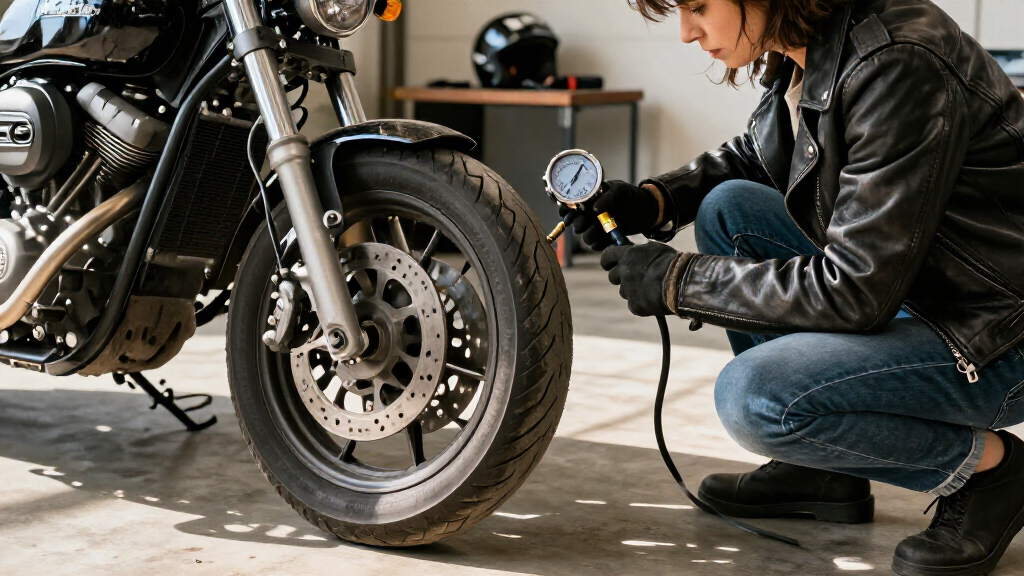
I ranked these motorcycle tire pressure gauges by how well their design fits routine motorcycle checks, not by the highest pressure limit or the number of functions. I compared each model’s stated range, display or scale format, valve access design, and whether it adds a garage function such as inflation. For motorcycles, a useful gauge needs a range suited to the bike, a reading the rider can interpret, and a connection that is practical around the wheel.
The JACO ElitePro leads as the most balanced dedicated gauge in this group. The PUIBERS follows for its flexible hose and motorcycle-focused range, while the AstroAI T1 ranks higher for riders who will use its inflator function beyond bikes. The remaining picks serve more specific priorities: a simple dial, a higher-range digital gauge, or a compact two-pack pencil format. I also weighed tradeoffs: a broad range can be less tailored to motorcycle use, and a specialized or simpler design may be less useful across different vehicles.
| motorcycle tire pressure gauge | Accuracy | Material |
|---|---|---|
| JACO ElitePro Digital Tire Pre | ±0.50% FS (0.50 PSI) | — |
| AstroAI T1 Digital Tire Pressu | ±1 PSI | Brass |
| PUIBERS 60 PSI Motorcycle Tire | — | Brass construction; rubber listed as material type |
| Counteract MKPG-D Analog Tire | — | Metal |
| AstroAI Digital Tire Pressure | ±1 PSI | — |
| AstroAI Pencil Tire Pressure G | ±2% of span | Stainless steel |
Factors to Consider When Choosing Motorcycle Tire Pressure Gauges
Before choosing among these gauges, I would match the tool to the bike’s specified cold tire pressure and the places where you can reach its valves. The right pick depends on more than digital versus analog: range, valve access, and whether you need one tool for a motorcycle or several vehicles all change the decision.
Match the pressure range to your motorcycle
Start with the pressure listed in your motorcycle manual or on the manufacturer’s label, rather than choosing a gauge because its maximum number looks impressive. A gauge’s range should comfortably include the pressures you need to check, while still giving you a readable scale around that working point. Very broad ranges can support other equipment, but they may add little value for a motorcycle-only toolkit. A 60 PSI ceiling may suit many motorcycle checks, yet it is less flexible if you also maintain equipment that calls for higher pressures. Avoid assuming that the maximum range tells you how easy a gauge is to read at lower pressures. Match both the stated range and display increments to your actual use.
Think about valve access before choosing a format
Wheel design can make the valve stem harder to reach than the pressure check itself. A flexible hose may let you position the gauge without putting as much strain on your wrist or the valve, especially near spokes or brake components. A short, direct connection can be quicker when the valve is easy to access, but awkward angles may make it harder to seat securely. Check whether your wheel uses straight or angled valve stems and consider how much room remains around the tire. Do not force a gauge onto a stem at an angle; a poor seal can cause an unreliable reading or let air escape. If possible, compare the tool’s connection style with your wheel before buying.
Choose a display you can read consistently
Digital displays can make a measurement straightforward to read, while analog dials and pencil scales avoid reliance on an electronic screen. The best format is the one you can read accurately in your usual lighting and at the angle your wheel allows. A small, crowded scale can be a poor match for riders who need quick checks, even if the gauge’s range is suitable. With analog tools, practice reading the scale and confirm which units are shown before relying on a value. With digital tools, check what power source or operating steps the product requires and whether that suits your storage habits. Consistent reading technique matters more than choosing a format based on appearance.
Decide whether inflation belongs in the same tool
A gauge with an inflator can combine pressure checking and adding air, which may be handy in a garage with compatible air equipment. That combination is less useful if you only need a portable gauge for roadside or pre-ride checks. A dedicated pressure gauge keeps the job focused and may be simpler to store with riding gear. Before choosing an inflator model, confirm that its connections suit the air source you plan to use; the product name alone does not establish compatibility with every compressor. Also think about whether you want one tool for several vehicles or a motorcycle-specific option. Paying for extra functions makes sense only when those functions fit your routine.
Balance portability with ease of handling
A compact pencil gauge is easy to keep in a small kit, and a two-pack can leave a spare available. That format may take more care to read and handle than a larger digital or dial gauge, particularly for riders with limited light or dexterity. A larger tool can be easier to grip and interpret, but it may be less convenient to carry on every ride. Decide where the gauge will live: in a tail bag, workshop drawer, or garage cabinet. If it travels on the motorcycle, consider whether its construction and storage method protect it from knocks and dirt. Portability is useful only if the gauge remains accessible and its reading is clear when needed.
Use a consistent checking routine
Even a suitable gauge can produce confusing results if the checking routine changes from one tire to the next. Follow the motorcycle manufacturer’s guidance on when to measure pressure, and use the same gauge where practical so readings remain comparable. Make sure the connector seats properly and note whether air escapes during attachment or removal. If a reading seems surprising, repeat the check rather than making a large adjustment from one uncertain measurement. Keep the gauge clean and store it in a way that protects its display, hose, or scale. These habits help separate a real pressure change from a connection or reading error.
Frequently Asked Questions
Is a 60 PSI gauge enough for a motorcycle?
It can be enough if the motorcycle’s specified tire pressures fall comfortably within that gauge’s range. Check the manual or manufacturer label before choosing, and leave room for readings above the normal target if you maintain other tires or equipment. A 60 PSI ceiling makes the PUIBERS a more motorcycle-focused choice than the 150 PSI AstroAI or 250 PSI AstroAI T1. Those higher-range options suit mixed garage use better, but their maximum figures alone do not make them more suitable for a bike. Prioritize readable measurements near your motorcycle’s required pressure.
Should I choose a digital gauge or an analog one?
Choose based on which display you can read reliably around your wheel, rather than assuming one format is always more accurate. Digital models such as the JACO ElitePro and AstroAI gauges show a numeric reading, while the Counteract dial and AstroAI pencil require interpreting a scale. Analog formats avoid dependence on an electronic display, but they may be harder to read quickly for some riders. If you are new to pressure checks, favor a display that makes it easy to repeat the same measurement. Whichever format you choose, a secure valve connection and consistent technique still matter.
Is an inflator gauge worth choosing for motorcycle use?
An inflator gauge is useful when you plan to check and add air with compatible garage equipment in the same session. The AstroAI T1’s broader range and inflator function give it a multi-purpose role, unlike a dedicated gauge such as the JACO ElitePro. If you mostly want a small tool for checking tires before a ride, the added function may not justify carrying or storing a larger setup. Confirm that the inflator connections work with your air source before buying. For motorcycle-only checks, valve access and a suitable range may matter more than combining tasks.
Will a flexible hose make checking my tire easier?
A flexible hose can help when the valve stem is difficult to reach or sits near wheel components that restrict hand position. The PUIBERS is the clearest fit in this roundup for that design priority. A hose does not automatically solve every access problem, since the connection still has to seat securely and the gauge must be held where its reading can be seen. If your valves are easy to reach, a direct or compact format may be simpler to store and use. Compare the gauge’s connection style with your wheel layout before deciding.
Can one pressure gauge work for my motorcycle and car?
Often, one gauge can serve both if its pressure range covers both vehicles’ specified pressures and its connection suits their valve stems. The AstroAI T1 and 150 PSI AstroAI offer broader stated ranges than the motorcycle-focused PUIBERS, while the JACO ElitePro sits between those approaches. Range alone is not the whole answer: check whether the scale is easy to read around each vehicle’s working pressure and whether the tool is practical to keep in both places. If you regularly maintain several vehicles, versatility may be worth more than a compact motorcycle-first design. Follow each vehicle maker’s pressure guidance rather than using the same target for every tire.
Conclusion
For the best overall, I recommend the JACO ElitePro for its balanced 100 PSI range and dedicated-gauge role. The best value in function is the AstroAI pencil two-pack for riders who want a compact, simple format and are comfortable reading a scale; choose it for portability rather than digital convenience. For a premium-style garage setup, the AstroAI T1 is the pick when its inflator function and broad range will see regular use. The best option for beginners is the JACO ElitePro, whose digital format can make readings more direct than the analog alternatives. For specific valve-access needs, choose the PUIBERS flexible-hose gauge; for a straightforward dial or a higher-range standalone digital tool, look at the Counteract or 150 PSI AstroAI respectively. Match your choice to your bike’s stated pressure and wheel layout, and skip extra range or functions you will not use.
Halloween Picks
halloween
As an affiliate, we earn on qualifying purchases.