
TL;DR

Get business pricing on garage and car supplies
- Business-only prices and quantity discounts
- Tax-exempt purchasing
- Multiple users, one account, clear invoices
AUTOBEST’s 2026 ECOBEST Challenge found that all 15 tested EVs continued moving after their dashboards showed zero remaining range or 0% charge. They traveled an average of 10 miles (16 km) before stopping, but the distance ranged from 0.6 miles for the Xpeng P7+ to 19.9 miles for the Leapmotor B10. The results do not establish a dependable reserve for everyday driving.
All 15 electric vehicles in AUTOBEST’s 2026 ECOBEST Challenge kept moving after their dashboards showed zero remaining range or 0% battery charge, traveling an average of 10 miles (16 km) before stopping. The results varied widely: the Leapmotor B10 went 19.9 miles (32 km), while the Xpeng P7+ managed just 0.6 miles (1 km), according to the test report.
The test measured distance from the point a car showed either zero remaining range or 0% charge until it could no longer move under its own power. AUTOBEST reported that the Model Y traveled 19.3 miles (31 km) after that threshold. The gap between the longest- and shortest-running cars shows why a dashboard’s “empty” warning cannot be treated as a uniform reserve across EVs.
Journalists drove production-spec cars in convoy on a route near Milan, Italy, using city streets, country roads and highways. A lead vehicle set the pace, and drivers switched cars every 19 miles (30 km) to reduce differences from individual driving styles. Each car carried only its driver, ran in standard rather than Eco mode, had climate control on and used recommended tire pressures. Temperatures were 68–77°F (20–25°C); the final part of the test took place at Quattroruote’s Vairano proving ground.
When a car stopped, a Zeekr 7GT support vehicle used its vehicle-to-load function to provide power and get it moving again. The report gives the distance each EV covered past the dashboard threshold, but not the usable energy remaining at that point or the speed maintained during the final stretch. Those omissions limit what the distances can say about each car’s battery reserve or performance in other conditions.
Why the Reserve Varies by Model
For drivers, the headline finding is that a displayed zero did not mean an immediate stop in this test, but the amount of additional travel was highly model-dependent. The difference between 19.9 miles and 0.6 miles could affect whether a driver reaches a nearby charger or needs roadside assistance. The test does not establish that any particular driver can safely count on the maximum distance recorded.
These figures are test results, not a driving recommendation. Remaining distance can depend on conditions such as speed, terrain, temperature, traffic and vehicle load; the published summary does not provide a controlled comparison of how those factors changed each car’s final range. Drivers should treat the zero warning as a signal to find a charger or stop safely, not as a promise of a specific extra-mile allowance.
Products Worth Considering

Autel Home EV Charger up to 50A J1772 Hardwired Level 2 Charger with 25 ft Cable

Autel MaxiCharger Level 2 EV Charger, 40A, 240V, 25-Foot Cable, NEMA 14-50 Plug

NOCO Boost GB250 5250A 12V Lithium Jump Starter
As an affiliate, we earn on qualifying purchases.
What an Empty Display Measures
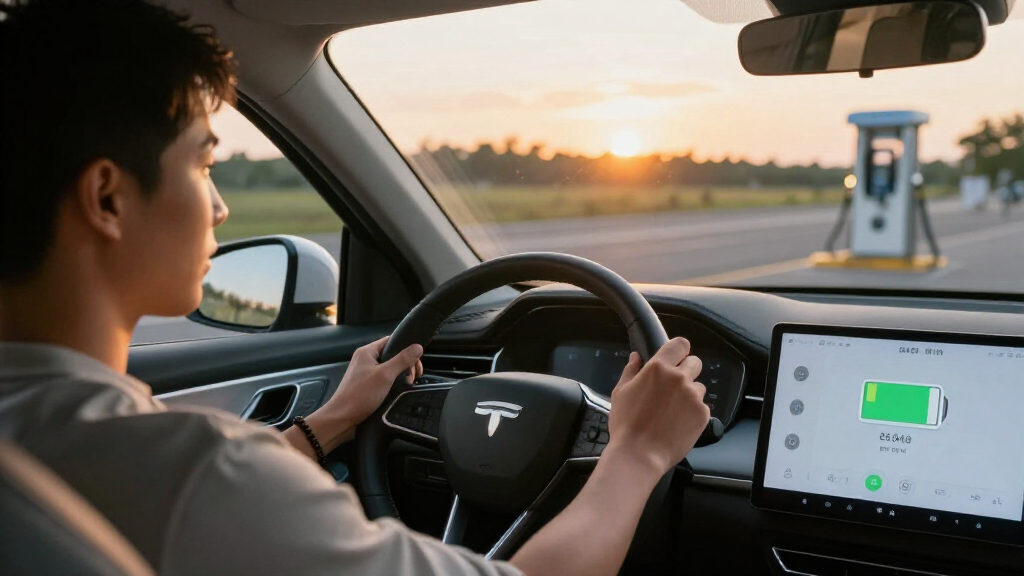
A dashboard’s range estimate and battery state-of-charge display are related but distinct. The range figure estimates how far the available usable energy may take the car, while the percentage indicates the vehicle’s estimate of remaining usable charge. They can reach zero at different times, so a car may display 0% while still showing some predicted range, or the reverse.
EVs also retain energy that the driver cannot use. According to the report’s explanation, a vehicle limits power before cell voltage falls too low, helping protect the battery. A displayed zero therefore does not mean the battery pack has been drained completely. In this test, the threshold was defined by what the dashboard showed, and the cars were driven until they could no longer move under their own power.
The InsideEVs report cites a separate range-test example in which a Tesla Model 3 still displayed two miles (3.2 km) when charge reached 0%, then traveled another 31 miles (50 km). That example is not part of the 15-car ECOBEST results and should not be used to infer a typical reserve. The comparison illustrates that zero charge and zero estimated range need not coincide.
“All 15 EVs that took part in the group test kept moving after their dashboards showed empty, averaging 10 miles (16 km) before they stopped.”
— AUTOBEST 2026 ECOBEST Challenge results, as reported by InsideEVs
What the Mileage Cannot Tell Us
The published results do not state how much usable energy remained in each vehicle when its display reached zero, or the speed each car maintained after that point. Without those details, the distance figures cannot show whether one model had a proportionally larger battery reserve or was simply using energy at a different rate. The report also does not establish how the cars would perform after zero in other weather, traffic or driving conditions.
The test grouped cars that reached either zero estimated range or 0% charge, even though those dashboard indicators can diverge. The available summary does not specify which threshold each individual vehicle reached first. It is also unclear from the results alone how repeatable each car’s distance would be across separate runs. Accordingly, the findings describe one reported test, not a guaranteed minimum or a universal measure of how far an EV can travel after “empty.”
How Drivers Should Use the Results
The report provides measured distances for the 15 vehicles but does not announce a further test or a timeline for additional data. More information on each car’s remaining energy, post-zero speed and repeat runs would help readers compare reserve behavior more precisely. Until such details are available, the reported rankings should be read as test observations rather than a forecast for a specific trip.
For drivers who see zero range or charge, the practical next step remains to seek a charging station or a safe place to stop instead of planning around the extra miles recorded in this test. AUTOBEST’s results confirm that the tested cars moved beyond their dashboard threshold; they do not confirm how far another vehicle, or the same model in different conditions, will go.
Key Questions
How far did the tested EVs go after showing empty?
The 15 cars traveled an average of 10 miles (16 km) after showing zero range or 0% charge. Individual results ranged from 0.6 miles (1 km) for the Xpeng P7+ to 19.9 miles (32 km) for the Leapmotor B10.
Can drivers count on 10 extra miles after the warning?
No. The 10-mile figure is the average in this specific test, not a guaranteed reserve for every EV or driving situation. The shortest result was 0.6 miles, and the report does not establish repeatable distances across conditions.
Does 0% mean an EV battery is completely drained?
No. The vehicle limits usable power before the battery cells reach levels that could damage them, so some energy can remain inaccessible after the display reaches zero. The test measured how far the cars moved, not how much energy remained in their packs.
Why might an EV show 0% but still display range?
Charge percentage and estimated range are different calculations and do not always reach zero together. The report notes that a vehicle may show 0% while still predicting some distance, or display zero range while charge remains.
What should I do when my EV shows zero range?
Do not rely on the test’s extra-mile figures as a personal safety margin. Look for a charger or a safe place to stop and arrange assistance if needed; the distance after zero varies sharply by vehicle and conditions.
Source: insideevs.com