TL;DR

Get business pricing on garage and car supplies
- Business-only prices and quantity discounts
- Tax-exempt purchasing
- Multiple users, one account, clear invoices
Thailand’s Board of Investment has approved Toyota’s 1.49 billion baht investment, reported as about €39 million, for a Hilux FCEV production line at its Ban Pho plant. Toyota expects production to begin in December 2027, initially for export markets; the company has outlined a target range above 400 kilometres and towing capacity of up to 2.5 tonnes, but final vehicle specifications and export volumes remain subject to confirmation.
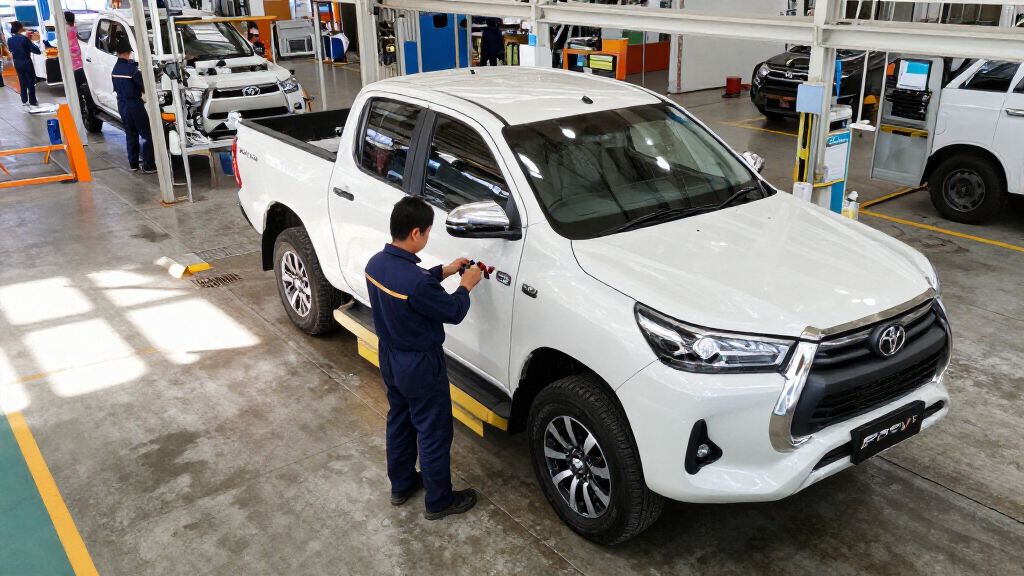
Thailand’s Board of Investment has approved Toyota’s 1.49 billion baht investment, reported as about €39 million, to build a production line for the hydrogen fuel-cell Hilux at the company’s Ban Pho plant. Toyota expects production of the Hilux FCEV to begin in December 2027, creating what the board describes as Thailand’s first domestically manufactured hydrogen fuel-cell vehicle.
The investment will fund a new line at Toyota’s factory in Ban Pho, Chachoengsao Province. The site already produces internal-combustion, mild-hybrid and battery-electric versions of the ninth-generation Hilux. Toyota also plans to build an on-site hydrogen refuelling station to support production and vehicle testing, according to the report by Electrive, which cited Thailand’s Board of Investment.
Toyota’s initial plan is to make the fuel-cell pickup for export rather than the Thai market. European countries, Australia and New Zealand are identified as priority destinations in a recent BoI announcement. The company plans annual production of 3,000 vehicles, a relatively limited volume that points to a specialist role for the model rather than high-volume production. The source material does not specify how those units will be divided among markets.
Toyota has said it is targeting a range of more than 400 kilometres and towing capacity of up to 2.5 tonnes. These are targets, not reported final production specifications. The company plans to launch the model in 2028, after the expected start of manufacturing in December 2027. The distinction matters: production timing and market launch are separate milestones, and the source does not provide a precise launch date or confirmed customer delivery schedule.
A New Export Role for Thai Production
The approval links Thailand’s vehicle manufacturing base to Toyota’s plan for a fuel-cell pickup intended for overseas buyers. The project adds a hydrogen vehicle to a plant already producing several Hilux powertrains, while the refuelling station would provide infrastructure for factory operations and testing. The Board of Investment calls the Hilux FCEV the first hydrogen fuel-cell vehicle to be manufactured in Thailand; that description concerns local production, not the first fuel-cell vehicle sold or operated in the country.
The planned capacity of 3,000 units per year sets the scale of the announcement. It is a modest target relative to mass-market vehicle production, and the source frames the model as a niche offering. For buyers in the named export regions, the plan signals a possible additional powertrain choice in a vehicle category often used for work and towing. Whether hydrogen refuelling access, vehicle price and operating costs will support demand is not established in the available information.
Products Worth Considering

Chemical Guys 14-Piece Arsenal Builder Car Wash Kit with Foam Blaster

Chemical Guys 16-Piece Arsenal Builder Car Wash Kit with Foam Cannon & Bucket

Chemical Guys HOL123 Car Cleaning Kit – 14-Item Interior & Exterior Detailing Set
As an affiliate, we earn on qualifying purchases.
Hilux FCEV Plans and Testing
Toyota has already introduced the battery-electric Hilux in Thailand, according to the source report, while the planned fuel-cell version would use hydrogen to generate electricity on board. The company showed teaser images of the FCEV at IAA Transportation 2026 the previous month. The images suggested some styling differences, including segmented daytime running lights and a more closed upper grille, but they did not establish the final design or technical package.
Toyota’s motorsport division, Gazoo Racing, is expected to test related technology in a hydrogen-powered DKR GR Hilux at the Dakar Rally’s Future Mission 1000 category in 2027, according to the report. That rally vehicle is described as having two fuel-cell stacks with a combined output of 400 kilowatts and four high-pressure tanks holding 8.4 kilograms of hydrogen. The rally vehicle is a test platform; its stated equipment should not be treated as the specifications of the production Hilux FCEV.
“The company is targeting a driving range of more than 400 kilometres and towing capacity of up to 2.5 tonnes.”
— Toyota, as reported by Electrive
Final Specifications and Market Details
The investment approval and Toyota’s stated production timetable are reported, but several commercial details are not yet available. The source does not identify confirmed prices, final specifications, export allocations or the exact countries where the vehicle will be offered. Toyota’s range and towing figures remain targets, and there is no precise date for the 2028 launch or first customer deliveries.
The production plan also does not show how much hydrogen infrastructure will be available to customers in the priority export markets. The planned station at Ban Pho is for production and testing, according to the report; it is not evidence of a wider public refuelling network. The source does not state whether Toyota may later sell the FCEV in Thailand or revise the planned annual output.
Production Milestones Through 2028
The next stated milestone is Toyota’s planned start of Hilux FCEV production in December 2027 at Ban Pho. Before then, the company is expected to establish the new production line and on-site refuelling facility. Gazoo Racing’s planned 2027 Dakar Rally participation could provide a separate test opportunity for fuel-cell technology, although the source does not confirm what changes, if any, would carry over to the production vehicle.
Toyota’s planned 2028 launch would follow the production start. Further announcements will be needed to confirm final performance figures, prices, delivery dates and specific export-market availability. Until those details are released, the approved investment and announced targets define the project’s current scope.
Key Questions
How much has Thailand approved for Toyota’s Hilux FCEV project?
Thailand’s Board of Investment approved an investment of 1.49 billion baht, reported as about €39 million, for the production project at Toyota’s Ban Pho factory.
When is production expected to begin?
Toyota expects production of the fuel-cell Hilux to start in December 2027. The company plans to launch the model in 2028, but has not given a precise launch date.
Will the Hilux FCEV be sold in Thailand?
The initial plan is to produce the pickup for export. Europe, Australia and New Zealand are named as priority markets. The available information does not confirm a Thai retail launch.
What range and towing capacity is Toyota targeting?
Toyota is targeting a range of more than 400 kilometres and towing capacity of up to 2.5 tonnes. These are targets; final production specifications have not been confirmed.
How many Hilux FCEVs does Toyota plan to make each year?
The reported plan is to manufacture 3,000 units annually. The source does not provide a confirmed allocation by export country.
Source: electrive.com