
TL;DR

Get business pricing on garage and car supplies
- Business-only prices and quantity discounts
- Tax-exempt purchasing
- Multiple users, one account, clear invoices
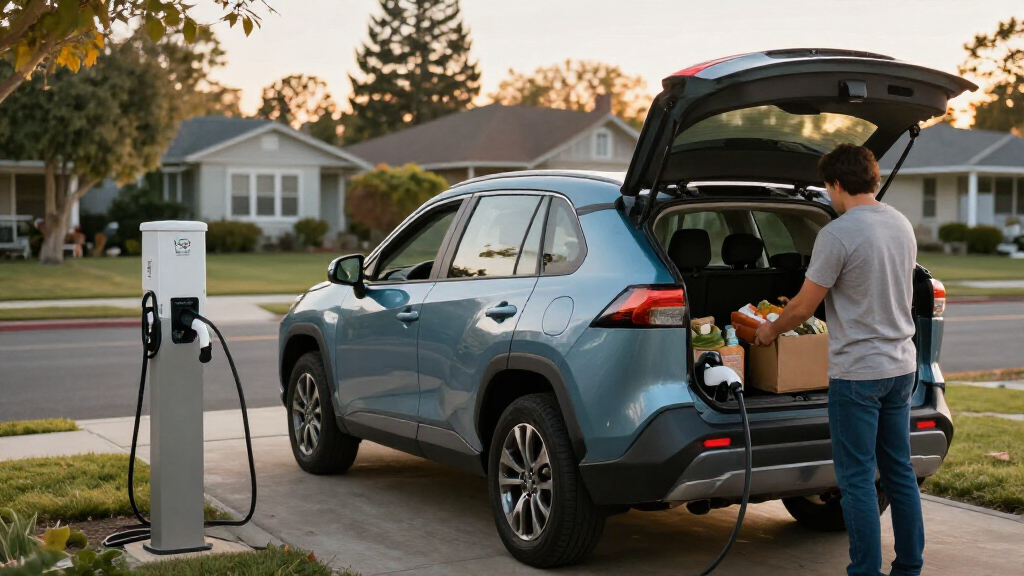
The 2027 Toyota RAV4 Plug-in Hybrid gets a factory-installed NACS charging port and DC fast charging across all trims, according to InsideEVs. The reported maximum rate is 50 kW, while SE and GR Sport trims also gain 11-kW AC charging. Toyota has not provided further details in the supplied report about pricing or availability.
Toyota has added a factory NACS charging port and DC fast-charging capability to every trim of the 2027 RAV4 Plug-in Hybrid, according to InsideEVs. The update extends fast charging to the entry SE and top GR Sport, broadening access to public charging for buyers who previously had to choose certain higher trims to get the feature.
The 2027 RAV4 PHEV can charge at a reported maximum rate of 50 kilowatts. InsideEVs says that rate can take the battery from 10% to 80% in about 30 minutes. The vehicle’s NACS inlet is positioned near the driver’s-side door, replacing the passenger-side location reported for the previous model year. NACS is the connector used at Tesla Superchargers and at some other charging stations.
The change also affects home charging. The SE and GR Sport trims are reported to receive an 11-kW onboard AC charger, up from 7 kW. The XSE and Woodland already had an 11-kW rating, according to InsideEVs. Owners can continue using Level 1 or Level 2 home charging; the DC fast-charging addition is for compatible public chargers.
InsideEVs reports that the RAV4 PHEV’s 22.7-kilowatt-hour battery provides up to 52 miles of EPA-estimated electric range. That figure is the published maximum cited in the report, not a guarantee of range in every driving condition. The model remains a plug-in hybrid, with a gasoline engine available for driving beyond its electric range.
Fast Charging Reaches Every Trim
The key change is access: buyers no longer need to select a particular upper trim to get the reported DC fast-charging hardware. According to InsideEVs, the earlier model offered fast charging only on the XSE and Woodland, while the 2027 update brings it to the full lineup. That could make public charging more useful to buyers considering the lower-priced SE, although the source does not give a complete 2027 price list.
A native NACS port also means the vehicle is equipped to connect directly to compatible NACS cables, rather than relying on a different inlet. The port’s driver-side position may suit some home parking arrangements, but location can matter at public stations too. InsideEVs cautions that older Tesla V3 Supercharger stalls were designed around rear-left charging ports; cable reach could be less convenient there than at newer stations with longer cables.
For plug-in hybrid owners, faster charging can reduce the time spent connected during a stop, but it does not make every trip electric. The RAV4 PHEV still has a finite battery range and a gasoline engine. The practical benefit will depend on charger compatibility, access, route, and how often a driver plugs in.
Products Worth Considering

Autel Home EV Charger up to 50A J1772 Hardwired Level 2 Charger with 25 ft Cable

Autel MaxiCharger Level 2 EV Charger, 40A, 240V, 25-Foot Cable, NEMA 14-50 Plug

Milwaukee 2953-20 18V Cordless 1/4 Hex Impact Driver
As an affiliate, we earn on qualifying purchases.
From CCS to Factory NACS
The previous RAV4 PHEV generation was reported with a CCS charging inlet. InsideEVs says fast charging was limited to the XSE and Woodland trims, leaving other versions without that capability. The 2027 update changes both the connector and the availability of fast charging across the range.
Fast DC charging is uncommon among plug-in hybrids, according to the report. It cites the Mercedes-Benz GLC 350e, which uses CCS, and the Mitsubishi Outlander PHEV, which uses CHAdeMO, as other PHEVs with fast-charging capability. InsideEVs describes the RAV4 as the first and only major U.S. PHEV with a native NACS port; that distinction is the outlet’s characterization, not a separate independently verified market survey in the supplied material.
The reported starting price of $42,100 for the SE applies to the model discussed in the source, but the material does not make clear whether that is the 2027 model’s confirmed price or give a full trim-by-trim price comparison. Buyers should check Toyota’s final specifications and pricing before making a purchase decision.
“The 2027 Toyota RAV4 PHEV gets a maximum fast-charging rate of 50 kilowatts.”
— InsideEVs
Pricing and Launch Details Pending
The supplied report does not specify a 2027 on-sale date, delivery schedule, or a full official price list. It also does not include a Toyota statement or a direct link to a model-year specification sheet confirming the charging changes. The details here are attributed to InsideEVs and should be checked against Toyota’s final published specifications.
Real-world charge times can vary with battery temperature, starting charge, charger output, and charging conditions. The report’s approximate 10%-to-80% time should not be read as a result every owner will experience. Compatibility and convenience may also vary by charging site, particularly at older stations with shorter cables.
Watch for Toyota’s Final Specifications
The next useful confirmation will be Toyota’s official 2027 RAV4 PHEV specifications, including trim-level charging equipment, MSRP, and the timing of sales. Those details would clarify whether the reported $42,100 SE price applies to the new model year and when buyers can order or take delivery.
Drivers considering the update can also check the charging networks and stations they expect to use, including connector availability and cable reach. Until Toyota publishes its full model-year information, the reported port, charging rates, and range should be treated as details from the InsideEVs report rather than a complete finalized buyer guide.
Key Questions
What is new on the 2027 Toyota RAV4 PHEV?
InsideEVs reports that every trim adds a factory NACS port and DC fast charging. The inlet moves to the driver’s side, and the SE and GR Sport are reported to gain 11-kW AC charging.
How fast can the 2027 RAV4 PHEV charge?
The report gives a maximum DC charging rate of 50 kW and an approximate 10%-to-80% time of 30 minutes. Actual results depend on charging conditions and the station.
Does every 2027 RAV4 PHEV trim get fast charging?
Yes, according to InsideEVs. The report says the feature extends to all trims, including the SE and GR Sport.
What is the RAV4 PHEV’s electric range?
InsideEVs cites up to 52 miles of EPA-estimated range from a 22.7-kWh battery. The vehicle also has a gasoline engine for trips beyond its electric range.
When will the 2027 RAV4 PHEV go on sale?
The supplied report does not state an on-sale date. Toyota’s launch timing and final pricing remain to be confirmed in the material provided.
Source: insideevs.com