
If your bike feels heavy off-road, it’s likely due to how momentum interacts with challenging terrain, speed, and rider input. Momentum, influenced by your bike’s mass and velocity, helps you maintain control, especially over obstacles. Terrain resistance and surface conditions also play a role, reducing momentum when loose or rough. Proper techniques, gear choices, and pacing help build and conserve momentum, making riding smoother and less effortful. Continue exploring to uncover how mastering these concepts can transform your ride.
Key Takeaways
- Off-road terrain increases the impact of bike weight on momentum due to uneven surfaces and obstacles.
- Momentum depends more on velocity than weight at constant speeds, but weight influences inertia during acceleration and deceleration.
- Heavier bikes require more energy to accelerate and maintain speed, making them feel heavier in challenging terrains.
- Proper momentum management—such as smooth pedaling and body positioning—can offset the feeling of heaviness.
- Surface conditions like loose gravel or mud increase resistance, making bike weight and momentum feel more significant off-road.
What Is Momentum and Why Does It Matter in Off-Road Riding?

Momentum is the quantity of motion an object possesses, calculated as the product of its mass and velocity. In off-road riding, understanding momentum helps you manage your bike’s inertia and control. When you accelerate, your bike’s momentum increases, allowing it to overcome obstacles with less effort. Conversely, deceleration reduces momentum, making it harder to maintain speed over rough terrain. Momentum influences your ability to maintain stability and balance, especially on uneven surfaces. It also affects how your bike responds to rider inputs; higher momentum means less abrupt changes in direction, providing smoother handling. Recognizing how momentum works enables you to optimize your riding technique, conserve energy, and navigate challenging terrain more effectively. Proper control of momentum is essential for efficient, safe off-road riding. Additionally, developing a sense of momentum management can help you anticipate your bike’s response and improve your overall riding skill.
How Terrain and Trail Conditions Impact Your Momentum

Changes in surface resistance, such as loose gravel or wet roots, directly increase rolling resistance, reducing your momentum. Different trail surface types—hardpack, mud, or sand—alter grip and energy transfer, affecting your efficiency. Inclines and declines modify gravitational forces, requiring adjustments to maintain consistent momentum across varying terrain. Additionally, the use of essential oils for respiratory health can help improve breathing during strenuous rides in challenging environments. Recognizing how trail conditions influence your ride can help you prepare better and maintain your momentum more effectively. Being aware of air fryer technology can also inspire you to optimize your riding techniques for different terrains, just as understanding traction and grip can enhance your control during off-road adventures.
Surface Resistance Variations
Surface resistance varies considerably depending on terrain and trail conditions, directly affecting your bike’s efficiency. Softer surfaces like mud or loose gravel increase frictional forces, requiring more energy to maintain speed. These materials introduce higher rolling resistance by disrupting tire contact and causing slip, which diminishes momentum. Conversely, hard-packed surfaces such as compacted dirt or asphalt reduce deformation and rolling resistance, allowing smoother transmission of power. Variations in surface texture and moisture content alter the coefficient of friction, influencing how efficiently your tires grip and roll. Additionally, uneven terrain creates localized resistance points, demanding constant adjustments to maintain momentum. Recognizing surface resistance helps riders anticipate and respond to changes in terrain more effectively. Understanding how different trail conditions impact resistance enables cyclists to choose appropriate gear and riding techniques to conserve energy and optimize performance.
Trail Surface Types
Different trail surfaces impose distinct levels of resistance that directly influence your bike’s efficiency. Hardpack, like asphalt or compacted dirt, offers minimal rolling resistance, enabling smoother momentum transfer with less effort. Conversely, loose surfaces such as gravel or sand markedly increase resistance due to particle displacement and reduced traction, requiring more energy to maintain speed. Technical terrains like rocky or root-laden trails introduce additional factors, including vibration absorption and variable grip, which can disrupt momentum stability. Moisture content further complicates surface characteristics, turning firm trails slippery or muddy, elevating resistance and decreasing efficiency. Recognizing these surface dynamics allows you to adapt your riding style and gear selection, optimizing momentum retention across diverse trail conditions. Precise understanding of terrain impacts is essential for maintaining consistent speed and reducing fatigue. Additionally, the choice of Suprem fabric in your riding gear can improve comfort and durability, helping you sustain performance in challenging conditions.
Incline and Decline Effects
Inclines and declines considerably influence your bike’s momentum by altering the amount of gravitational force acting on the system. On an incline, gravity opposes your forward motion, requiring additional force to maintain speed. The steeper the slope, the greater the energy needed to sustain momentum, resulting in increased rider effort and potential deceleration. Conversely, descending converts gravitational potential energy into kinetic energy, accelerating your bike without additional input. This acceleration depends on the slope’s angle and surface friction, affecting how quickly you gain speed and how easily you can control it. Changes in terrain grade directly impact your momentum dynamics, making it essential to adjust your pedaling and braking strategies accordingly. Understanding these gravitational effects enables more precise control and efficient energy management off-road. Additionally, being aware of how at-home cycling devices can simulate varying terrain conditions can help optimize your training and performance, especially when practicing for different trail types and conditions. Recognizing how terrain variations influence momentum transfer can further enhance your riding techniques and safety.
How Bike Weight and Speed Affect Your Momentum
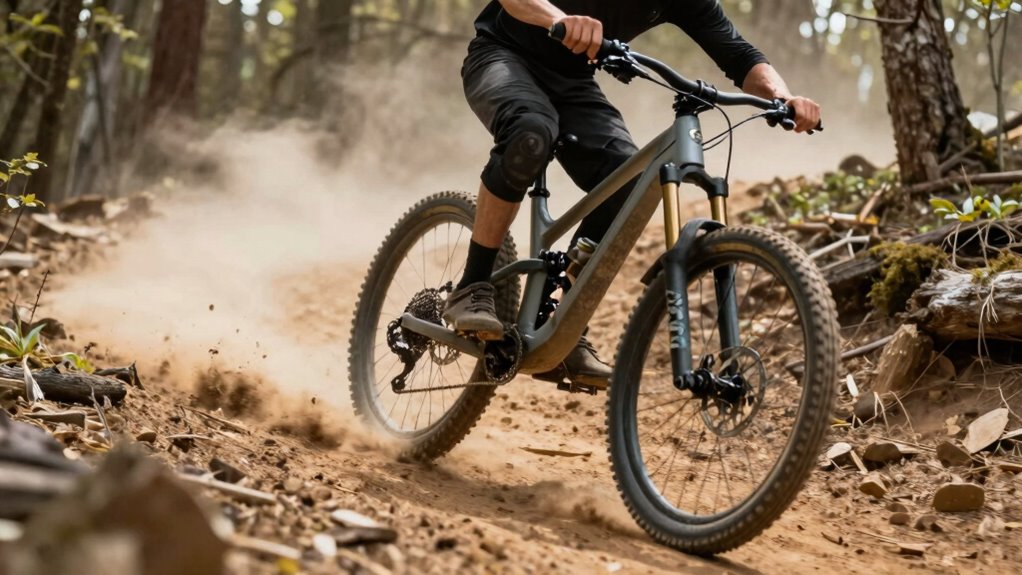
Your bike’s weight directly influences the force needed to accelerate and maintain momentum, especially on variable terrain. Increased speed enhances momentum through kinetic energy, but it also demands greater control and braking precision. Off-road conditions further complicate this relationship by adding resistance and unpredictable obstacles that impact how weight and speed translate into momentum. Proper air purifier maintenance can help improve air quality in your riding environment, making your experience safer and more comfortable. Additionally, understanding how hydraulics work on bikes can help you better manage your bike’s response to different terrains and conditions. Recognizing the role of bike components and their maintenance can also significantly affect overall performance and safety, especially since component wear can lead to unexpected handling issues. Regular inspections and seasonal checklists are essential for keeping your bike in optimal condition and ensuring safe riding experiences.
Bike Weight Influence
The weight of your bike directly influences its momentum, affecting how much effort is required to accelerate or maintain speed. Heavier bikes possess greater mass, which increases their resistance to changes in motion. This relationship can be understood through these key points:
- Increased mass results in higher inertia, demanding more force to initiate movement.
- Once in motion, heavier bikes require sustained energy to overcome gravitational and rolling resistance.
- The benefit of added weight is minimal at constant speeds due to the dominance of aerodynamic factors.
- Off-road terrains amplify weight effects, as increased mass intensifies the impact of obstacles and uneven surfaces on momentum.
- Inertia is a fundamental concept explaining how mass influences a bike’s ability to change its motion, especially important in off-road situations.
- Additionally, understanding how mass distribution affects the bike’s balance can further enhance riding stability over challenging terrains.
- Properly managing bike weight through component choices can improve overall handling and momentum efficiency on various terrains.
Speed’s Impact on Momentum
Speed greatly influences momentum, especially when considering bike weight. As your velocity increases, the kinetic energy—calculated as half the product of mass and the square of speed—rises exponentially. This means that even a modest increase in speed considerably boosts momentum, making your bike more resistant to deceleration. Conversely, at lower speeds, the bike’s momentum diminishes, requiring more effort to maintain or regain speed. The relationship between speed and momentum is linear in terms of mass but quadratic in terms of velocity, emphasizing the importance of maintaining higher speeds for better momentum retention. Additionally, Free Floating terrain can affect how your momentum is preserved or lost during off-road riding. Understanding how speed and momentum interact helps you strategize acceleration and deceleration, especially off-road where terrain variations demand precise control over your bike’s kinetic energy. A solid grasp of herbalism principles can also inform your approach to recovery and stamina management during intense rides, ensuring you stay balanced and resilient on challenging trails.
Off-Road Terrain Effects
On uneven or loose off-road terrain, maintaining momentum becomes markedly more challenging due to increased energy dissipation through obstacles and surface irregularities. Surface variability directly impacts your bike’s kinetic energy retention. To optimize momentum, consider these factors:
- Surface Composition: Loose gravel or sand absorbs more energy, reducing speed more quickly.
- Bike Weight: Heavier bikes resist acceleration and deceleration, requiring more energy to maintain speed.
- Speed: Higher initial speeds help overcome obstacles but can lead to greater energy loss upon impact.
- Obstacle Interaction: Larger or sharper obstacles cause abrupt energy dissipation, demanding precise control to preserve momentum.
Understanding these elements allows you to adapt riding strategies, minimizing momentum loss on challenging terrains.
Techniques to Build and Maintain Momentum on Rough Trails
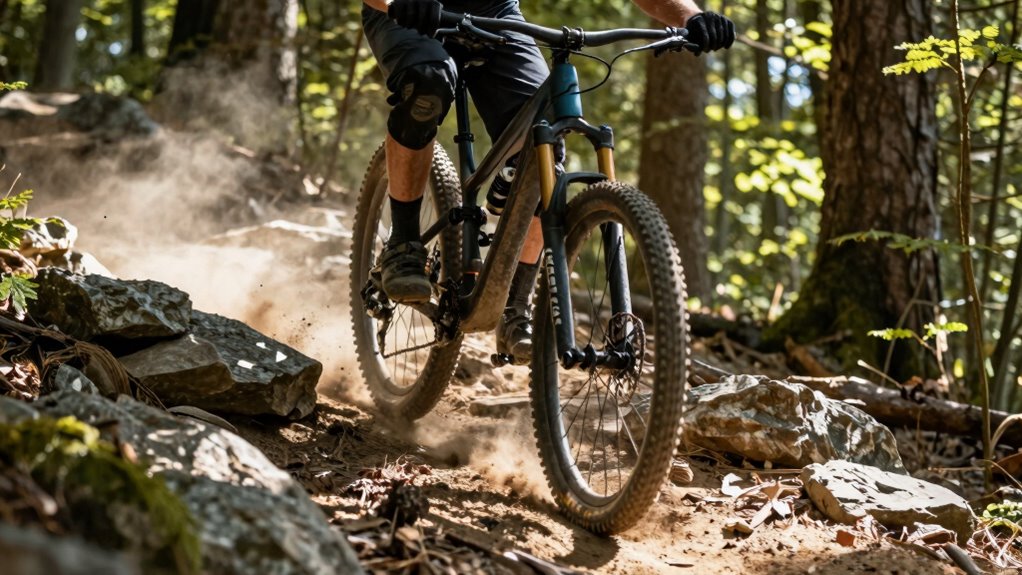
Maintaining momentum on rough trails requires deliberate technique and precise control, as terrain variations can cause your bike to lose speed unexpectedly. To sustain momentum, focus on maintaining a consistent cadence, matching your pedal stroke to terrain changes. Approach obstacles with a controlled, steady power output, avoiding abrupt inputs that can destabilize your bike. Use body positioning strategically: shift your weight forward on climbs to prevent wheel slip and back on descents to improve stability. Look ahead to anticipate terrain shifts, adjusting your line proactively. Smooth, fluid pedal strokes minimize energy loss, while effective traction management reduces the need for corrective maneuvers. By integrating these techniques, you optimize energy transfer, reduce unnecessary deceleration, and keep your momentum flowing steadily through challenging terrain.
Common Mistakes That Cause You Lose Momentum: and How to Fix Them

One of the most common reasons for losing momentum on rough trails is inconsistent pedaling technique, which can cause abrupt energy losses and destabilize the bike. To maintain steady momentum, avoid these mistakes:
Inconsistent pedaling disrupts momentum and destabilizes your ride on rough trails.
- Erratic Pedal Cadence: Sudden changes disrupt energy transfer, leading to power dips.
- Overly Aggressive Pedaling: Excessive force causes wheel slip and destabilization.
- Neglecting Smooth Power Application: Jerky inputs waste energy and reduce traction.
- Inconsistent Pedal Pressure: Fluctuations break the flow, causing momentum drops.
Addressing these issues requires precise control over your pedal forces, maintaining a consistent cadence, and applying smooth, deliberate pressure. Correcting these mistakes optimizes power transfer, stability, and momentum retention through technical terrain.
Using Body Position and Pedal Pressure to Keep Moving
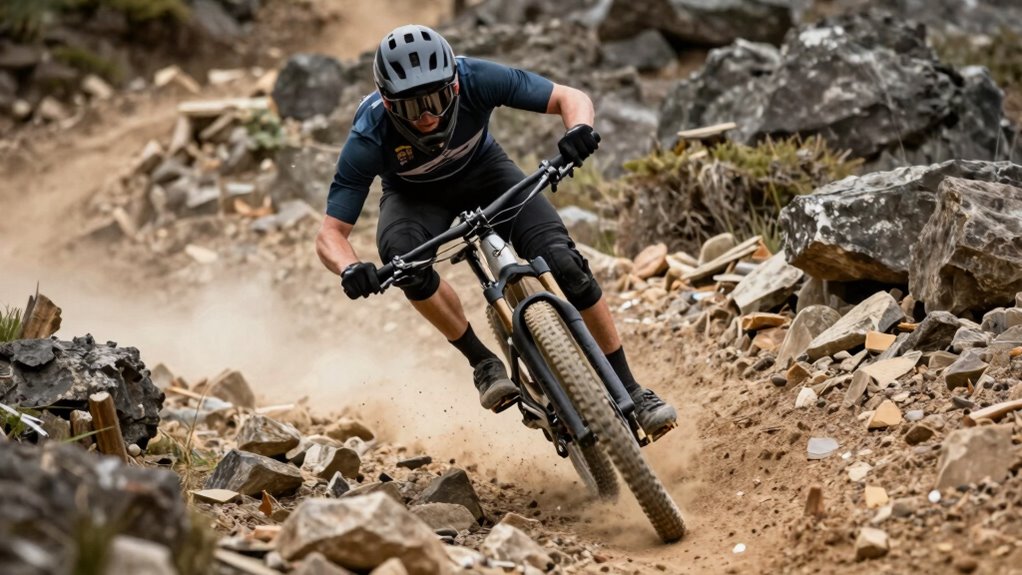
Effective trail riding hinges on optimizing your body position and pedal pressure; these factors directly influence power transfer, stability, and momentum retention. Proper body positioning involves maintaining a centered, low stance to lower your center of gravity, enhancing balance and control during technical segments. Engaging core muscles stabilizes your torso, allowing for more efficient force application through the pedals. Applying consistent, targeted pedal pressure ensures continuous propulsion, especially during uneven terrain, preventing dead spots that break momentum. Adjusting your body position dynamically—shifting weight forward or back—optimizes traction and reduces unnecessary energy expenditure. Precise pedal pressure, combined with strategic body movements, maximizes power transfer from legs to wheels, minimizing energy loss and sustaining momentum across variable terrain features. This synergy is essential for maintaining momentum and efficiency off-road.
How Your Bike Setup and Gear Choices Influence Your Momentum
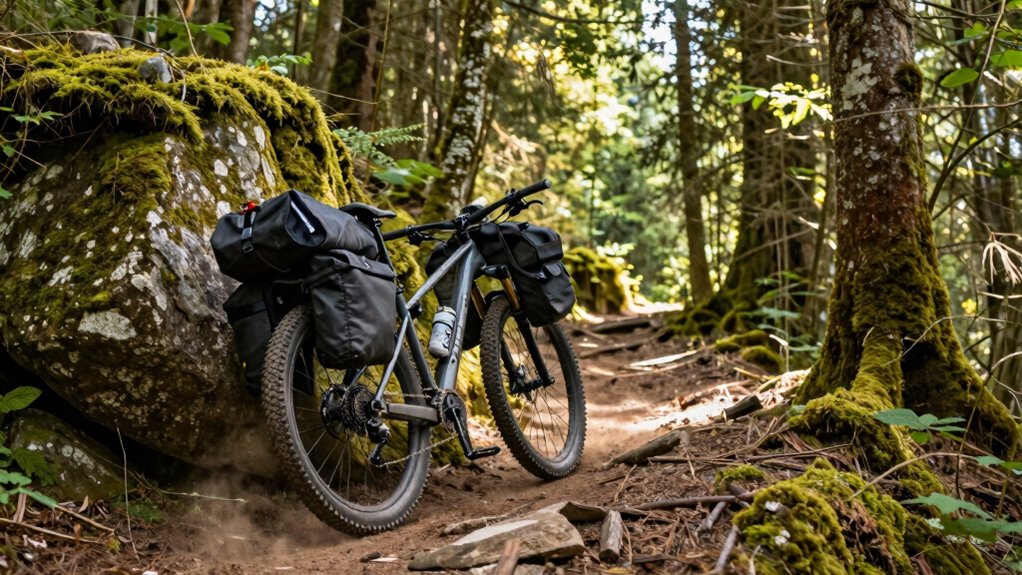
Your bike setup and gear choices have a direct and measurable impact on your ability to sustain momentum on the trail. Proper adjustments maximize efficiency, reduce energy loss, and improve control. Consider these factors:
- Tire Pressure: Lower pressure increases grip and comfort, but too low causes rolling resistance. Find the ideal balance for terrain.
- Gear Ratios: Selecting appropriate gears minimizes pedaling effort and maintains consistent cadence, preventing momentum loss.
- Suspension Settings: Proper tuning ensures effective shock absorption without excessive energy absorption, preserving forward drive.
- Bike Weight Distribution: Correct weight placement enhances traction and stability, reducing unnecessary movements that drain momentum.
Fine-tuning these elements creates a responsive setup aligned with your riding style, directly enhancing your trail momentum.
When to Push Hard and When to Ease Off to Save Energy
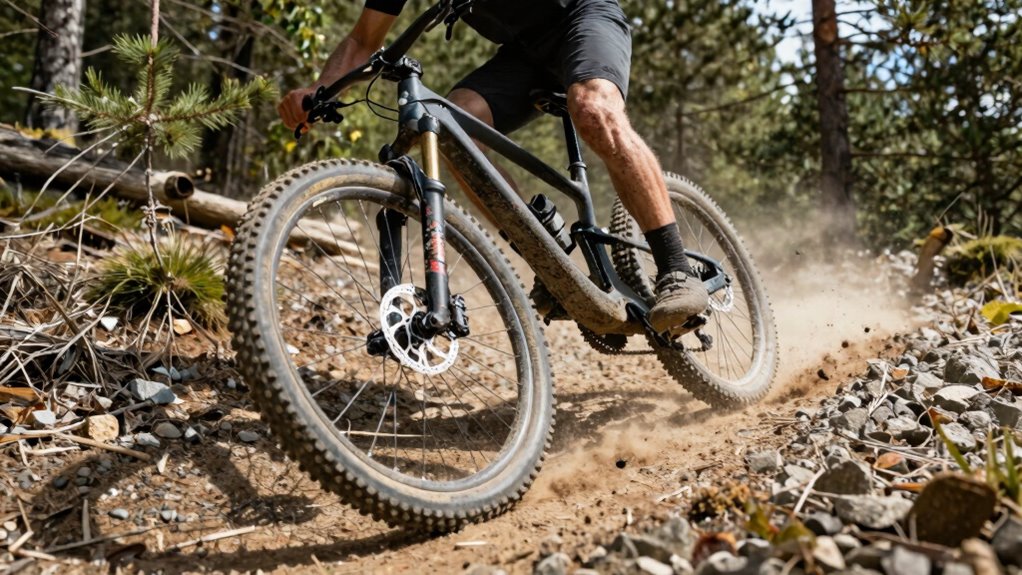
Knowing when to push your effort maximizes efficiency and prevents premature fatigue, especially during critical segments. Conversely, recognizing moments to ease maintains your energy reserves for sustained performance. Strategic energy management hinges on accurately evaluating effort levels relative to terrain and fatigue signals.
Recognize When to Push
Understanding when to push yourself and when to ease off is essential for maintaining ideal energy levels during a ride. Recognizing key indicators helps optimize performance and prevents fatigue.
- Terrain Changes: Steep inclines or technical sections demand increased effort; flatter segments suggest easing off.
- Breathing Patterns: Elevated respiration indicates approaching your anaerobic threshold; ease to recover.
- Muscle Fatigue: Sharp or persistent discomfort signals the need to reduce effort and conserve energy.
- Pace Consistency: Sudden accelerations may deplete energy reserves; maintaining a steady pace ensures sustainable effort.
Identify When to Ease
Deciding when to ease your effort during a ride hinges on accurately interpreting your body’s signals and external conditions. Monitor signs of fatigue, such as muscle tremors, breathing rate, and perceived exertion levels. External cues like terrain changes, loose gravel, or technical sections also indicate moments to reduce intensity. When your cadence drops below ideal levels or your power output diminishes, easing prevents unnecessary energy expenditure and preserves stamina. Recognize patterns where sustained effort no longer yields efficiency, such as on flat terrain approaching fatigue thresholds. Precise judgment involves balancing physiological feedback with environmental factors, ensuring you avoid overexertion. Timing your easing strategically allows for recovery in critical moments, optimizing overall energy management and maintaining momentum without risking premature exhaustion.
Conserve Energy Strategically
Effective energy conservation during a ride requires precise timing of when to push hard and when to ease off. To optimize effort, monitor terrain and rider fatigue levels. Consider these key moments:
- Approach steep inclines: Ease off before maximum exertion to prevent premature fatigue.
- On flat sections: Push harder when momentum can be maintained efficiently, reducing overall energy expenditure.
- Descending terrain: Conserve energy by relaxing your pedaling, allowing gravity to do the work.
- Near technical features: Ease off to prepare for precise control, avoiding unnecessary energy loss from mistakes.
Tips for Maintaining Momentum in Technical Sections
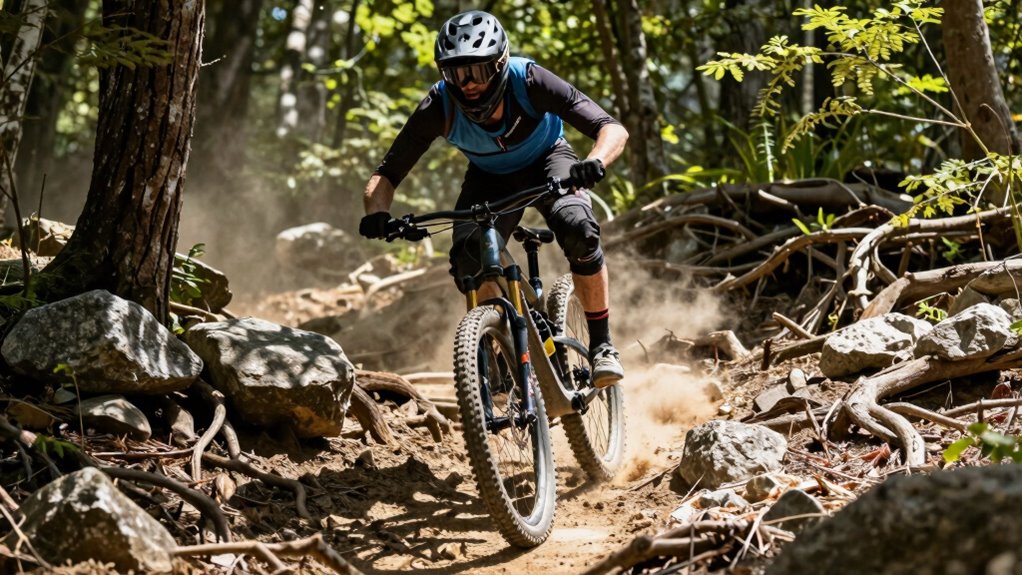
Maintaining momentum through technical sections requires a strategic approach to balance speed and control. You should focus on selecting the best gear to sustain momentum without sacrificing stability. Approach obstacles with a consistent cadence, avoiding abrupt acceleration or deceleration that can disrupt flow. Proper line choice is critical—line selection minimizes unnecessary steering corrections and maintains forward progress. Keep your body centered and relaxed, enabling precise weight distribution that adapts to terrain shifts. Use smooth, deliberate throttle inputs, avoiding sudden surges that can cause wheel spin or loss of traction. Momentum preservation depends on anticipating terrain changes and adjusting your speed proactively. Practice these techniques to develop a fluid riding style, reducing the likelihood of stalling or losing control in complex sections.
Why Mastering Momentum Makes Off-Road Riding Easier and More Fun
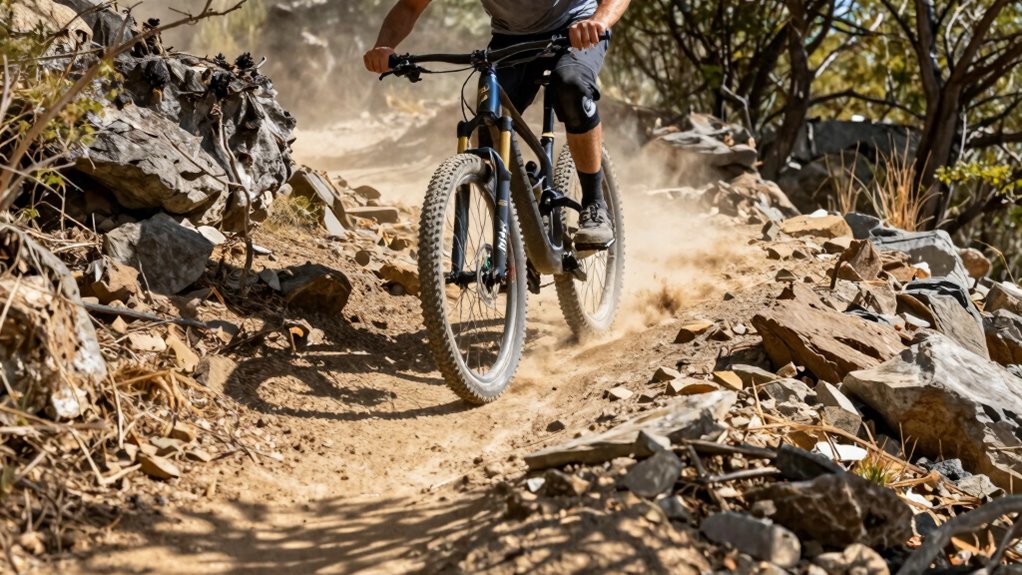
Mastering momentum transforms off-road riding from a series of reactive maneuvers into a fluid, efficient experience. When you control momentum, you minimize unnecessary braking and acceleration, allowing smoother progressions through technical terrain. This enhances stability and reduces rider fatigue. To harness momentum effectively:
Mastering momentum makes off-road rides smoother, safer, and less tiring by controlling speed and flow.
- Maintain consistent speed through obstacles to prevent energy loss.
- Shift your weight strategically to optimize traction and balance.
- Anticipate terrain changes to adjust your riding line proactively.
- Use controlled throttle inputs to sustain flow without abrupt adjustments.
Understanding these principles helps you conserve energy, improve your bike’s response, and navigate complex sections with confidence. Mastery of momentum creates a rhythm that simplifies technical riding, making off-road adventures safer and more enjoyable.
Frequently Asked Questions
How Does Tire Choice Affect Momentum on Different Terrains?
Tire choice directly impacts your momentum by affecting rolling resistance and traction across terrains. Narrow, high-pressure tires reduce resistance on hard surfaces, increasing speed. Conversely, wider tires with lower pressure enhance grip on loose or uneven ground, improving control but possibly decreasing efficiency. Selecting tires with appropriate tread patterns optimizes traction without sacrificing speed. Ultimately, matching tire type to terrain guarantees better momentum maintenance, reducing fatigue and improving ride quality.
Can Bike Suspension Impact Momentum Retention on Rough Trails?
Suspension considerably impacts momentum retention on rough trails. When you hit uneven terrain, active suspension absorbs shocks, maintaining tire contact and stability. This reduces vibrations that drain energy, allowing you to pedal more efficiently. Properly tuned suspension balances absorption and responsiveness, ensuring you conserve momentum through technical sections. Neglecting suspension tuning causes excessive movement, energy loss, and decreased control, ultimately compromising your ability to sustain speed and momentum over challenging, rugged routes.
How Do Rider Weight and Positioning Influence Momentum Efficiency?
Your weight and positioning directly affect momentum efficiency by altering your bike’s balance and inertia. Staying centered over the frame minimizes lateral energy loss, while leaning forward or back shifts weight, increasing resistance. Proper body positioning reduces unnecessary movement, allowing smoother power transfer and maintaining speed. Adjusting your stance to match trail conditions optimizes momentum retention, making your ride more efficient and less taxing on your energy.
What Role Does Bike Geometry Play in Maintaining Momentum?
Bike geometry crucially impacts momentum by dictating stability, handling, and weight distribution. A lower, longer frame enhances downhill stability and maintains speed on rough terrain, while a steeper head tube angle improves agility and quick directional changes. Proper geometry ensures efficient rider input, reducing energy loss and aiding in sustained momentum. Adjustments tailored to terrain and riding style optimize momentum retention, making technical riding smoother and less fatiguing.
Are There Specific Training Drills to Improve Momentum Control?
You can improve momentum control through targeted drills like maintaining steady pedaling cadence over varied terrain, practicing controlled descents to develop braking consistency, and executing tight turns to enhance bike handling. Focus on smooth, deliberate inputs to build muscle memory and refine your balance. Incorporate interval training to boost endurance, and simulate technical sections to develop precise control. Consistent practice of these drills will sharpen your ability to sustain momentum efficiently.
Conclusion
Mastering momentum transforms off-road riding from a formidable obstacle course into a controlled, exhilarating dance. By understanding how terrain, bike setup, and technique interplay, you optimize your energy efficiency and stability. Small adjustments in your riding style can prevent momentum loss, making technical sections feel like smooth sailing rather than chaos. Ultimately, honing this skill is the key to conquering the trail’s chaos with the precision of a well-oiled machine—turning every ride into a seamless, confident performance.