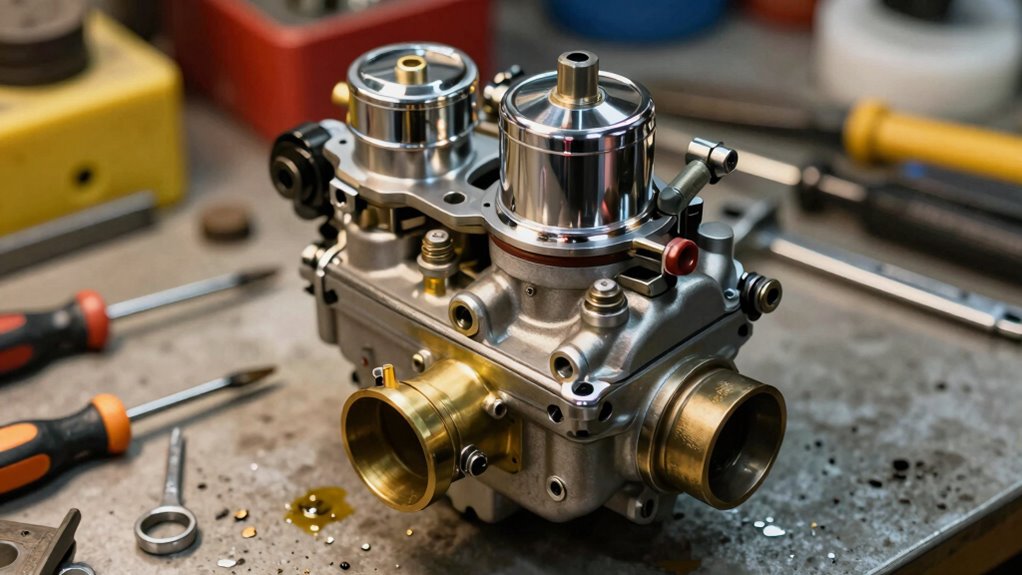

If you’re feeling overwhelmed with Kawasaki carb tuning, remember the ‘one change at a time’ rule. Adjust only one parameter—like the idle mixture screw or jet size—and monitor its specific impact before proceeding. This systematic approach isolates issues, prevents confusion, and guarantees precise tuning. Carefully document each step and allow the engine to stabilize before the next change. Keep following these guidelines to gain control and improve your carburetor’s performance; more details can help refine your process.
Key Takeaways
- Making multiple adjustments at once can cause confusion and misdiagnosis during Kawasaki carb tuning.
- The ‘One Change at a Time’ rule helps isolate each adjustment’s impact for clearer troubleshooting.
- Always start with factory baseline settings before tuning to ensure consistent results.
- Document each change and its effects to track progress and avoid repeating mistakes.
- Use precise tools like vacuum gauges and tachometers for accurate assessment of each adjustment.
Why Kawasaki Carb Tuning Can Feel Overwhelming and How to Simplify It
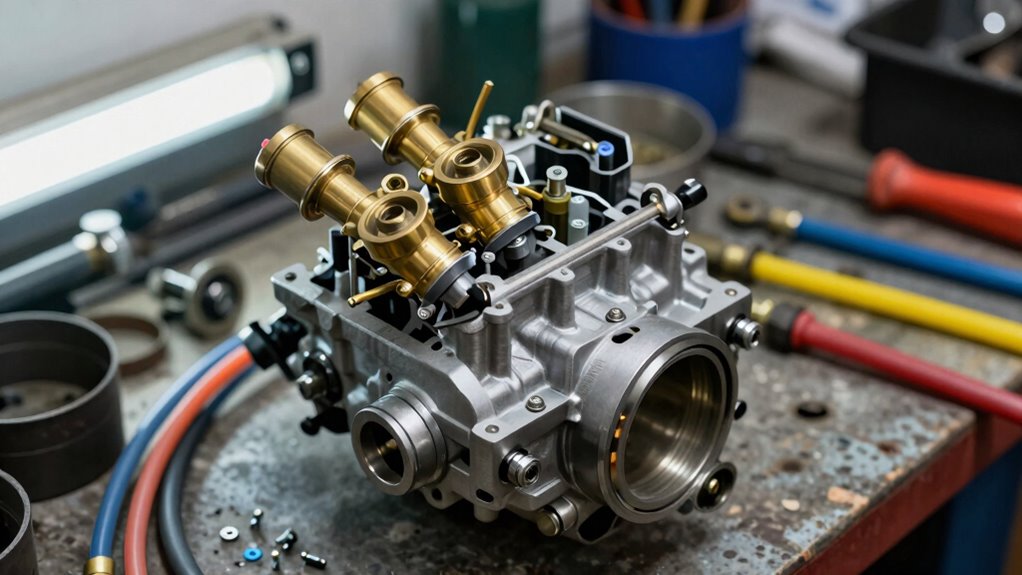
Kawasaki carb tuning can seem overwhelming because it involves multiple complex adjustments that directly affect engine performance, fuel efficiency, and emissions. You must precisely modify idle speed, air-fuel mixture screws, and slide height, each impacting how the engine runs. Incorrect adjustments can lead to rough idling, poor throttle response, or increased emissions. The interdependence of these settings adds to the complexity, making it hard to determine which change causes a specific issue. To simplify, start with baseline settings recommended by the manufacturer. Use accurate measurement tools like vacuum gauges and tachometers to monitor effects. Focus on one adjustment at a time, understanding its impact before proceeding. This methodical approach minimizes guesswork and helps you achieve *ideal* carburetor performance efficiently. Incorporating precision tools can further enhance your tuning accuracy and confidence. Additionally, understanding carburetor basics can help you make more informed adjustments and troubleshoot potential issues more effectively. Remember, patience and systematic testing are key to successful tuning, especially when working with complex engine components.
The ‘One Change at a Time’ Rule: Your Key to Easy Carb Tuning

To effectively tune your carburetor, it’s essential to change only one setting at a time. This approach isolates the impact of each adjustment, ensuring accurate diagnostics. When you modify a single parameter, it’s easier to precisely observe its effect on engine performance, avoiding false correlations. Adhering to this rule minimizes guesswork and prevents multiple variables from confounding your results. Additionally, understanding the importance of regular maintenance routines can help you implement systematic procedures similar to those used in smart appliances and connected systems. Implementing standardized procedures ensures consistent results and simplifies troubleshooting. Moreover, maintaining a detailed adjustment log can help you track changes and identify patterns over time. Focusing on a specific setting before proceeding to the next—record each adjustment and its outcome systematically—allows for better analysis. It is also beneficial to monitor engine response after each change to ensure optimal tuning and prevent over-adjustment. Allow the engine to stabilize after each change and use consistent testing conditions for reliable comparisons.
How to Follow the ‘One Change at a Time’ Approach Step by Step
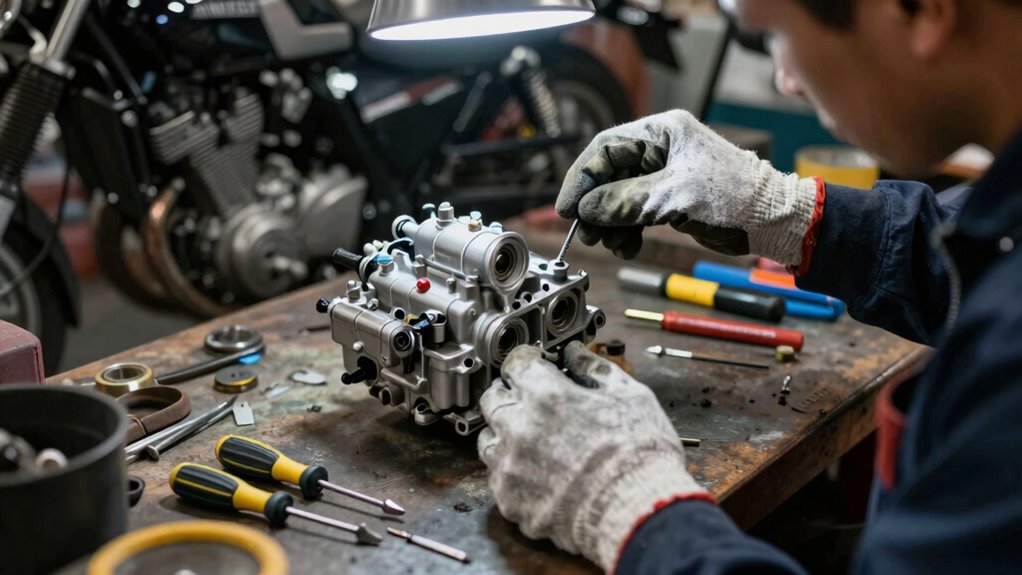
Begin by selecting a specific carburetor setting to adjust, such as the idle mixture screw or jet size. Make only one change at a time, ensuring that you record the exact adjustment made. After each change, run the engine at a consistent RPM and observe the performance, noting any improvements or issues. Allow the engine to stabilize before testing again, typically for about 30 seconds to a minute. Keep detailed notes on each adjustment, including the initial setting, the degree of change, and the resulting effect. Avoid making multiple adjustments simultaneously, as this obscures which change causes a specific outcome. This methodical approach isolates variables, enabling precise troubleshooting and incremental tuning. Repeat this process systematically for each setting until ideal performance is achieved.
Common Kawasaki Carb Tuning Mistakes and How to Avoid Them

One of the most common mistakes in Kawasaki carb tuning is making multiple adjustments simultaneously, which hampers accurate diagnosis of issues. This practice obscures the root cause of performance problems, leading to unnecessary adjustments and extended troubleshooting. To avoid this, focus on one parameter at a time. Key pitfalls include:
- Ignoring baseline settings before tuning
- Adjusting idle and main jets without testing intermediate steps
- Overlooking vacuum leaks or air leaks that skew results
- Failing to document initial settings for comparison
When and How to Troubleshoot Kawasaki Carb Tuning Issues

When troubleshooting Kawasaki carb tuning issues, it’s essential to approach the process systematically and based on specific symptoms. Start by accurately diagnosing the problem—identify whether the engine stalls, idles rough, or experiences power loss. Use diagnostic tools like a vacuum gauge or a tachometer to gather objective data. Confirm proper fuel delivery, check for air leaks, and verify that the idle speed and mixture screws are within factory specifications. Adjust one parameter at a time, such as the pilot screw or throttle sync, and test the result before proceeding. Document each change to avoid unnecessary adjustments. Precise troubleshooting prevents compounding issues and ensures efficient tuning. Always ensure engine temperature is ideal, as cold or hot engines can skew diagnostic outcomes.
Frequently Asked Questions
What Tools Are Essential for Kawasaki Carb Tuning?
You’ll need a flat-head screwdriver for adjusting the idle mixture screw and throttle screws accurately. A set of small needle-nose pliers helps handle tiny components, while a carburetor synchronization tool ensures proper throttle alignment. A carburetor cleaner spray and compressed air are essential for cleaning parts, preventing blockages. Finally, a tachometer helps measure RPMs during tuning, guaranteeing maximum engine performance without unnecessary adjustments.
How Often Should I Tune My Kawasaki Carburetor?
Think of your Kawasaki carburetor like a finely tuned instrument; you should check it every 8 to 12 months, or sooner if you notice power loss, poor idling, or fuel efficiency drops. Regular tuning guarantees peak performance and prevents costly repairs. Use a systematic approach, making one adjustment at a time, and document changes. Consistent maintenance keeps your bike running smoothly, much like a well-conducted orchestra.
Can I Tune My Kawasaki Carb Myself or Need a Professional?
You can tune your Kawasaki carburetor yourself if you have basic mechanical skills and proper tools. Start by adjusting the idle screw and mixture screw incrementally, listening for smooth engine operation. Follow manufacturer specifications for settings, and make only one adjustment at a time to avoid compounding issues. If you’re unsure or the tuning involves complex steps, it’s best to consult a professional to ensure precise calibration and avoid engine damage.
What Signs Indicate My Kawasaki Carb Needs Tuning?
You notice your Kawasaki engine stalls at idle, sputters under load, or experiences sudden power dips—these are clear signs your carb needs tuning. You might also observe uneven acceleration or black smoke from the exhaust. When these symptoms appear, check your carb’s mixture screws and jets carefully. Remember, make small adjustments one at a time, testing after each change to avoid over-tuning and causing further issues.
Are Aftermarket Parts Necessary for Effective Kawasaki Carb Tuning?
You don’t need aftermarket parts for effective Kawasaki carb tuning. Focus on precise adjustments of stock components like idle screws, needle position, and jet sizes. Using quality tools, carefully modify one setting at a time, then test your engine’s response. Aftermarket parts can sometimes simplify tuning but aren’t necessary for peak performance. Consistent, methodical changes ensure reliable results without additional expenses or unnecessary complexity.
Conclusion
By applying the ‘one change at a time’ rule, you’ll navigate Kawasaki carb tuning with the precision of a seasoned mechanic. Think of it as tuning the strings of a fine instrument—each adjustment brings clarity and harmony. Avoid the chaos of trial and error by methodically isolating variables, ensuring ideal performance. Mastering this disciplined approach transforms tuning from a formidable task into a predictable, manageable process, turning your Kawasaki into a symphony of smooth, reliable power.