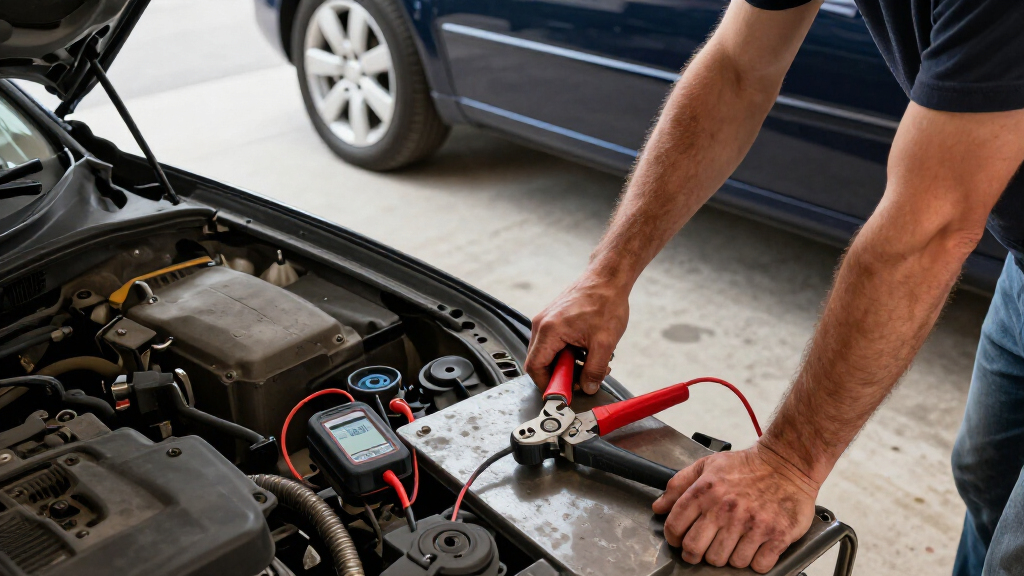

The best car battery tester for most drivers is the TOPDON BT200, which combines battery and alternator checks with support for both 12V and 24V systems. For shop use, the TOPDON BT300P adds a built-in printer, while the ANCEL BA101 offers a more straightforward 12V option for routine checks. The main tradeoffs are system compatibility, whether you need a load test or just a conductance reading, and how much diagnostic detail you want. More functions can save time, but they may add setup steps or cost more than a basic tester warrants. Read on for the full comparison, selection criteria, and guidance on matching a tester to your vehicles.

Get business pricing on garage and car supplies
- Business-only prices and quantity discounts
- Tax-exempt purchasing
- Multiple users, one account, clear invoices
Complete the kit


Key Takeaways
- The TOPDON BT200 earns the overall lead by pairing battery and charging-system checks with 12V/24V compatibility, a useful balance for mixed vehicle needs.
- The BT300P is the better documentation tool: its built-in printer suits workshops that need a physical record, though that feature is less useful for occasional home checks.
- Not every tester covers the same battery job. Digital conductance models such as the KONNWEI KW208 prioritize quick condition checks, while load testers such as the Schumacher BT-100 apply a more direct load.
- Voltage range changes who can use a tester. Several picks are limited to 12V vehicles, while the VDIAGTOOL BT500, FOXWELL BT705, and OBDResource BR502 also support 6V and/or 24V systems.
- More functions do not automatically mean a better fit. An OBD2 scanner-and-tester combination such as the TopDiag T300PRO can consolidate tools, while a simple tester may be easier for a driver who only needs basic battery checks.
| TOPDON BT300P 12V/24V Automotive Battery Tester with Built-In Printer | 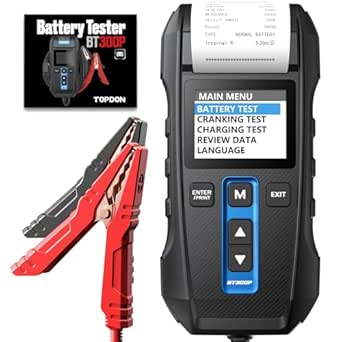 | Best for Printed Diagnostic Reports | Battery compatibility: 12V lead-acid batteries, 100–2000 CCA | Battery types: Flooded, AGM flat plate, AGM spiral, Gel, EFB | System tests: 12V/24V cranking and charging systems | VIEW LATEST PRICE | See Our Full Breakdown |
| VDIAGTOOL BT500 6V/12V/24V Automotive Battery Tester |  | Best for Multi-Voltage Vehicles | Battery voltage: 6V, 12V, 24V | CCA range: 5–3000 CCA | Compatible battery types: Flooded lead-acid, AGM flat plate, AGM spiral, GEL, EFB | VIEW LATEST PRICE | See Our Full Breakdown |
| ANCEL BA101 12V Car Battery Tester |  | Best for Straightforward 12V Checks | Battery voltage: 12V | CCA range: 100–2000 CCA | Compatible battery types: Flooded, AGM, GEL, EFB | VIEW LATEST PRICE | See Our Full Breakdown |
| TopDiag T300PRO OBD2 Scanner and 12V Battery Tester |  | Best for Battery Testing Plus OBD2 Diagnostics | Battery compatibility: 12V flooded, AGM, EFB, and GEL batteries | Battery readings: SOH, SOC, CCA, internal resistance | System checks: Cranking performance and alternator charging voltage | VIEW LATEST PRICE | See Our Full Breakdown |
| MOTOPOWER MP0515A 12V Automotive Battery Tester, 100–2000 CCA |  | Best Value for Basic 12V System Checks | Compatible voltage: 12V | CCA range: 100–2000 CCA | Power source: Battery powered | VIEW LATEST PRICE | See Our Full Breakdown |
| TOPDON AB101 12V Car Battery Tester |  | Best Compact Tester | Compatible batteries: 12V flooded, AGM flat plate, AGM spiral, and gel | CCA range: 100–2000 CCA | Tests: Battery health, cranking, and charging system | VIEW LATEST PRICE | See Our Full Breakdown |
| TOPDON BT200 12V/24V Car Battery and Alternator Tester, 100–2000 CCA | 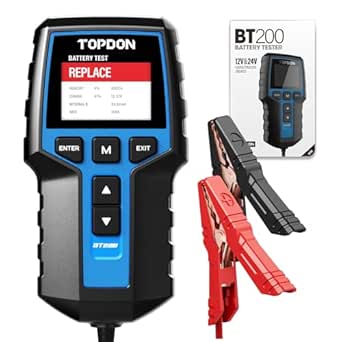 | Best for Mixed-Voltage Vehicles | Battery voltage: 12V and 24V | CCA range: 100–2000 CCA | Battery types: Flooded, AGM, GEL, and deep-cycle | VIEW LATEST PRICE | See Our Full Breakdown |
| UHANBUT 12V Car Battery and Alternator Tester |  | Best for Basic Status Checks | Voltage: 12V | Measurement type: Voltmeter | Display: LED indicators | VIEW LATEST PRICE | See Our Full Breakdown |
| KONNWEI KW208 12V Car Battery Tester |  | Best for Detailed 12V Diagnosis | Battery voltage: 12V | Compatible battery types: Flooded, AGM flat plate, AGM spiral, and gel | CCA range: 100–2000 CCA | VIEW LATEST PRICE | See Our Full Breakdown |
| FOXWELL BT705 12V/24V Car Battery, Alternator, and Load Tester |  | Best Guided Tester for Longer Reach | Compatible systems: 12V and 24V | CCA range: 100–2000 CCA | Compatible battery types: Flooded, AGM, GEL, and EFB lead-acid | VIEW LATEST PRICE | See Our Full Breakdown |
| TOPDON BT100 12V Car Battery Tester |  | Best Compact Battery-and-System Tester | Model: BT100 | Minimum operating voltage: 12V | Battery compatibility: 100–2000 CCA; flooded, AGM, EFB, and GEL | VIEW LATEST PRICE | See Our Full Breakdown |
| Schumacher Electric BT-100 6V/12V Battery Load Tester | 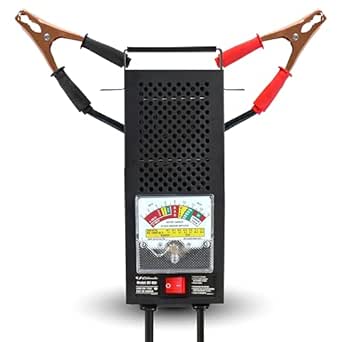 | Best for Traditional Load Testing | Voltage compatibility: 6V and 12V | Maximum cranking amps: 1,000 CA | Load test: 50A for 6V; 100A for 12V | VIEW LATEST PRICE | See Our Full Breakdown |
| Yaegoo Battery Load Tester, 12V 100A / 6V 50A |  | Best Value-Style Analog Load Tester | Model: B0CH39JPW4 | Supported battery voltage: 6V and 12V | Load test: 50A for 6V; 100A for 12V | VIEW LATEST PRICE | See Our Full Breakdown |
| MOTOPOWER MP0514A 12V Digital Car Battery Tester and Charging System Analyzer |  | Best for Simple Voltage Checks | Model: MP0514A | Compatible battery voltage: 12V | Testing voltage range: 4–20V DC | VIEW LATEST PRICE | See Our Full Breakdown |
| OBDResource BR502 Digital Car Battery Tester, 6V/12V/24V, 100–2000 CCA |  | Best for Multi-Voltage Battery Diagnostics | Model: BR502 | Battery voltage compatibility: 6V, 12V, and 24V | CCA range: 100–2000 CCA | VIEW LATEST PRICE | See Our Full Breakdown |
| car battery tester | Display | Weight | CCA range |
|---|---|---|---|
| TOPDON BT300P 12V/24V Automoti | 2.4-inch color screen | — | — |
| VDIAGTOOL BT500 6V/12V/24V Aut | — | — | 5–3000 CCA |
| ANCEL BA101 12V Car Battery Te | Black-and-white screen with adjustable contrast and white backlight | 5 ounces | 100–2000 CCA |
| TopDiag T300PRO OBD2 Scanner a | — | 1.1 pounds | — |
| MOTOPOWER MP0515A 12V Automoti | — | 340 g | 100–2000 CCA |
| TOPDON AB101 12V Car Battery T | Backlit screen | 7.04 ounces | 100–2000 CCA |
| TOPDON BT200 12V/24V Car Batte | 2.4-inch color LCD | 15.52 ounces | 100–2000 CCA |
| UHANBUT 12V Car Battery and Al | LED indicators | 81 g | — |
| KONNWEI KW208 12V Car Battery | — | 230 g | 100–2000 CCA |
| FOXWELL BT705 12V/24V Car Batt | 2.8-inch screen | — | 100–2000 CCA |
| TOPDON BT100 12V Car Battery T | — | 9 ounces | — |
| Schumacher Electric BT-100 6V/ | Analog meter | — | — |
| Yaegoo Battery Load Tester | — | — | — |
| MOTOPOWER MP0514A 12V Digital | 4-digit digital LCD | 150g | — |
| OBDResource BR502 Digital Car | 1.8-inch HD screen | — | 100–2000 CCA |
More Details on Our Top Picks
TOPDON BT300P 12V/24V Automotive Battery Tester with Built-In Printer
The TOPDON BT300P is the clearest fit for buyers who want a record of a battery check, not just a result on-screen. It tests 12V lead-acid batteries and checks cranking and charging systems on 12V and 24V vehicles, then prints results from its built-in thermal printer. That makes it more useful for documenting inspections than the simpler MOTOPOWER MP0515A, which has no listed printer. Its color display and support for five lead-acid battery types add flexibility, while safety protections help guard against clamp mistakes. The tradeoff is extra bulk compared with the compact VDIAGTOOL BT500, and printing depends on keeping thermal paper on hand. I’d choose it for a home garage or service workflow where paper reports matter; skip it if you only need occasional on-screen checks.
Pros:- Checks 12V lead-acid batteries plus cranking and charging systems on 12V and 24V vehicles
- Built-in thermal printer creates reports without ink cartridges
- Supports flooded, AGM flat plate, AGM spiral, Gel, and EFB batteries
- Reverse-polarity protection and spark-free clamps help reduce connection risks
Cons:- Printing requires replacement thermal paper
- Larger dimensions make it less convenient to store than the VDIAGTOOL BT500
- Battery testing is limited to 12V lead-acid batteries
Best for: DIY mechanics, small repair shops, and used-car inspectors who want printed battery and charging-system results for their records.
Not ideal for: Drivers who want a small, occasional-use tester or do not need paper reports; it is bulkier than compact handheld options and printing requires thermal paper.
- Battery compatibility:12V lead-acid batteries, 100–2000 CCA
- Battery types:Flooded, AGM flat plate, AGM spiral, Gel, EFB
- System tests:12V/24V cranking and charging systems
- Display:2.4-inch color screen
- Printer:Built-in thermal printer
- Cable length:31.5 inches
- Supported standards:CCA, JIS, EN, DIN, SAE, IEC
- Weight and dimensions:16 ounces; 12 × 8.5 × 4.5 inches
Our verdict“Choose the BT300P if printed records and 12V/24V system checks matter more than a compact, paper-free setup.”
VDIAGTOOL BT500 6V/12V/24V Automotive Battery Tester
The VDIAGTOOL BT500 earns its place through voltage range: it tests 6V, 12V, and 24V lead-acid batteries, covering equipment the 12V-only ANCEL BA101 cannot handle. It also checks battery condition, cranking, and charging, so one tool can help separate a weak battery from a vehicle-system issue. Its 5–3000 CCA range is broad, and it draws power from the test battery rather than needing a separate charger. The compact body and support for 12 languages suit a mixed-vehicle garage. Its boundary is chemistry and application: it is not compatible with lithium, deep-cycle, or golf-cart batteries. Unlike the TOPDON BT300P, it has no built-in report printer, so results stay on the device. I’d favor it when voltage flexibility matters more than printed documentation.
Pros:- Tests 6V, 12V, and 24V lead-acid systems
- Wide 5–3000 CCA range
- Checks battery condition, cranking, and charging systems
- Reverse-polarity and short-circuit protection
Cons:- Does not support lithium, deep-cycle, or golf-cart batteries
- No built-in printer for keeping paper diagnostic records
- Requires at least 6V to operate
Best for: Owners or technicians working across 6V, 12V, and 24V lead-acid vehicles, including cars, motorcycles, trucks, boats, and ATVs.
Not ideal for: Golf-cart and deep-cycle battery owners or anyone testing lithium batteries; those battery types are listed as unsupported.
- Battery voltage:6V, 12V, 24V
- CCA range:5–3000 CCA
- Compatible battery types:Flooded lead-acid, AGM flat plate, AGM spiral, GEL, EFB
- Tests:Battery, cranking, charging
- Power source:Powered by test battery; no charging required
- Minimum operating voltage:6V
- Protection:Reverse polarity and short circuit
- Dimensions and languages:6.45 × 3.35 × 0.96 inches; 12 languages
Our verdict“Pick the BT500 if you need one compact tester for multiple lead-acid system voltages and can work without printed reports.”
ANCEL BA101 12V Car Battery Tester
The ANCEL BA101 is a focused choice for people who want detailed readings from a conventional 12V lead-acid battery without stepping up to a scanner-style tool. It reports health, charge, voltage, current, and CCA, then checks cranking and charging performance. The backlit monochrome screen and one-handed operation keep the routine approachable, while its list of supported standards helps when battery labels use different rating systems. Compared with the VDIAGTOOL BT500, it gives up 6V and 24V coverage; compared with the TopDiag T300PRO, it avoids extra OBD2 functions that some buyers will never use. The main limits are firm: it does not support lithium or non-12V batteries, and its 30Ah minimum makes it a poor match for smaller motorcycle batteries.
Pros:- Reports battery health, charge, voltage, current, and CCA
- Checks cranking and charging performance
- Backlit display with adjustable contrast
- Protection against reverse polarity, short circuits, overcurrent, and overvoltage
Cons:- Limited to 12V batteries
- Does not support lithium batteries
- Minimum 30Ah capacity rules out some small motorcycle batteries
Best for: Drivers and DIY owners with 12V lead-acid batteries who want battery, starter, and alternator readings in a simple handheld tester.
Not ideal for: Owners of lithium, 6V, or 24V batteries, and motorcyclists testing batteries below 30Ah.
- Battery voltage:12V
- CCA range:100–2000 CCA
- Compatible battery types:Flooded, AGM, GEL, EFB
- Supported standards:JIS, EN, DIN, SAE, BCI, GB, CA, MCA, IEC
- Minimum battery capacity:30Ah
- Display:Black-and-white screen with adjustable contrast and white backlight
- Power source:Vehicle battery
- Weight:5 ounces
Our verdict“Choose the BA101 for detailed checks on standard 12V lead-acid batteries, but look to the BT500 for broader voltage coverage.”
TopDiag T300PRO OBD2 Scanner and 12V Battery Tester
The TopDiag T300PRO is the broadest tool here for owners who want battery checks alongside engine diagnostics. It measures state of health, state of charge, CCA, internal resistance, cranking performance, and alternator voltage, while its OBD2 functions read and clear trouble codes and show live data. That makes it a different proposition from the battery-focused ANCEL BA101: the T300PRO can help investigate a warning light as well as a starting problem, but it also brings functions that are unnecessary if battery testing is the only goal. Its 2.8-inch color screen and plug-and-play setup avoid a phone app, and the included ECU breakout tester adds diagnostic reach. The tradeoff is 12V-only battery testing and vehicle compatibility that varies by region and model year. I’d pick it for a garage wanting one multi-purpose tool, not a battery-only kit.
Pros:- Combines battery, starter, and alternator checks with OBD2 diagnostics
- Reads and clears trouble codes and displays live data
- Includes an ECU breakout tester
- Plug-and-play operation with a 2.8-inch color screen
Cons:- Battery testing is limited to 12V systems
- Vehicle compatibility varies by region and model year
- OBD2 features add complexity for buyers seeking battery checks only
Best for: DIY mechanics who want to test 12V batteries and perform OBD2 troubleshooting on compatible gasoline vehicles with one handheld device.
Not ideal for: Buyers who only need a basic battery tester, or owners of 6V/24V systems and vehicles whose OBD2 compatibility is uncertain.
- Battery compatibility:12V flooded, AGM, EFB, and GEL batteries
- Battery readings:SOH, SOC, CCA, internal resistance
- System checks:Cranking performance and alternator charging voltage
- Screen:2.8-inch TFT color screen
- Diagnostic features:Read/clear DTCs, live data, freeze frame, I/M readiness, O2 sensor test, EVAP test, VIN lookup, MIL status
- Vehicle compatibility:OBD2 gasoline vehicles and 12V motorcycles
- Included components:Battery clamp cable, scanner, user guide
- Weight:1.1 pounds
Our verdict“Choose the T300PRO if you want OBD2 troubleshooting and 12V battery testing in one tool, rather than a dedicated tester like the BA101.”
MOTOPOWER MP0515A 12V Automotive Battery Tester, 100–2000 CCA
The MOTOPOWER MP0515A keeps the job centered on standard 12V car batteries: it measures batteries across a 100–2000 CCA range and checks cranking and charging performance. That makes it a practical alternative to the feature-heavy TopDiag T300PRO for owners who do not need engine-code diagnostics, and it includes a storage bag for keeping the tester with vehicle supplies. Its tradeoffs are more limiting than the VDIAGTOOL BT500: it is designed for 12V batteries rather than 6V or 24V systems, and the listed maximum operating voltage is 12.29V. The product data identifies its measurement type as a multimeter, so buyers seeking a clearly described diagnostic display or printed reports may prefer another option. I’d consider it for routine checks on a single 12V vehicle, not a mixed-voltage workshop.
Pros:- Checks battery, cranking, and charging systems
- Supports 100–2000 CCA 12V batteries
- Includes a storage bag and instruction manual
- Battery-powered operation
Cons:- Designed for 12V car batteries only
- Listed maximum operating voltage is 12.29V
- Does not offer the built-in printer of the TOPDON BT300P or OBD2 functions of the T300PRO
Best for: Car owners who want a basic tester for 12V batteries and cranking/charging checks, with a storage bag for garage or roadside-kit storage.
Not ideal for: Owners of 6V or 24V vehicles, buyers needing broad diagnostic readouts or printed reports, and workshops testing varied battery systems.
- Compatible voltage:12V
- CCA range:100–2000 CCA
- Power source:Battery powered
- Operating voltage:Minimum 12V; maximum 12.29V
- Measurement type:Multimeter
- Weight:340 g
- Dimensions:5.91 × 0.91 × 3.35 inches
- Included components:Battery tester, storage bag, instruction manual
Our verdict“Choose the MP0515A for routine 12V battery and charging checks when you do not need multi-voltage support or extra diagnostics.”
TOPDON AB101 12V Car Battery Tester
The TOPDON AB101 is a straightforward choice for drivers who want battery, cranking, and charging-system checks without carrying a larger tester. It supports common 12V flooded, AGM, and gel batteries, with a 100–2000 CCA range that covers many cars, SUVs, and light trucks. Results appear on a backlit display in about three seconds, while the rubber-protected clips add a useful layer of handling protection. Compared with the TOPDON BT200, the AB101 is smaller and lighter, but gives up 24V compatibility and the BT200’s color screen and memory function. Its main limitation is the same one that makes it simple: it is strictly a 12V tester. I’d choose it for routine checks on a personal vehicle, not for a shop or a fleet with mixed-voltage systems.
Pros:- Checks battery health, cranking, and charging systems
- Supports flooded, AGM flat-plate, AGM spiral, and gel batteries
- Backlit display presents results in about three seconds
- Lightweight body and rubber-protected clips
Cons:- Works only with 12V batteries
- Does not offer the BT200’s color display, memory function, or 24V support
Best for: Car, SUV, and light-truck owners who want a lightweight tester for routine 12V battery, starting, and charging checks.
Not ideal for: Mechanics or fleet owners who need 24V testing, broader vehicle coverage, or saved results.
- Compatible batteries:12V flooded, AGM flat plate, AGM spiral, and gel
- CCA range:100–2000 CCA
- Tests:Battery health, cranking, and charging system
- Minimum operating voltage:12 volts
- Display:Backlit screen
- Weight:7.04 ounces
- Dimensions:4.9 × 2.6 × 0.7 inches
- Warranty:1 year
Our verdict“Choose the AB101 for compact, quick checks on a typical 12V vehicle; choose the BT200 if you need 24V coverage or stored results.”
TOPDON BT200 12V/24V Car Battery and Alternator Tester, 100–2000 CCA
The TOPDON BT200 earns its place for buyers who need one tester to cover both 12V and 24V systems. Along with battery checks, it assesses cranking and charging, and supports flooded, AGM, gel, and deep-cycle batteries. Its 2.4-inch color LCD is a more informative interface than the AB101’s backlit screen, while the memory function can help keep track of test results. The broad temperature range also suits work in cold or hot settings. Against the FOXWELL BT705, the BT200 has a lighter, more compact listed form and a wider stated set of supported battery specifications; the FOXWELL counters with a longer cable and guided result summaries. The BT200 still requires the user to interpret its readings, and its claimed accuracy should not be treated as independently verified. I’d favor it for varied vehicles, rather than a single-car owner who only needs basic 12V checks.
Pros:- Tests 12V and 24V batteries, cranking, and charging systems
- Supports flooded, AGM, GEL, and deep-cycle batteries
- Color LCD, memory function, and support for multiple battery rating standards
- Specified operating range of -20°C to 60°C
Cons:- Larger and heavier than the compact TOPDON AB101
- Its accuracy claim is not independently verified in the supplied product information
Best for: Owners, technicians, or small fleets that work with both 12V and 24V vehicles and want broad battery-type support.
Not ideal for: Drivers who only maintain one 12V car and prefer a smaller, simpler tester like the TOPDON AB101.
- Battery voltage:12V and 24V
- CCA range:100–2000 CCA
- Battery types:Flooded, AGM, GEL, and deep-cycle
- Test functions:Battery, cranking, and charging system
- Display:2.4-inch color LCD
- Operating temperature:-20°C to 60°C (-4°F to 140°F)
- Supported specifications:CCA, DIN, JIS, EN, IEC, GB, SAE, MCA, BCI, CA
- Weight:15.52 ounces
Our verdict“Pick the BT200 when 24V capability and a color interface matter more than the AB101’s smaller, simpler design.”
UHANBUT 12V Car Battery and Alternator Tester
The UHANBUT 12V tester is aimed at buyers who want a quick indication of battery voltage and charging status, not a detailed diagnostic report. Its LED display keeps the readout simple, and reverse-connection and over-voltage protection add safeguards during hookup. Support for cars, trucks, motorcycles, and boats makes it more flexible across 12V vehicles than a tool framed only around passenger cars. That simplicity is also its main tradeoff: unlike the KONNWEI KW208, it does not list outputs such as internal resistance, CCA, or battery capacity, and its description does not specify cranking-system analysis. I’d treat it as a basic status checker rather than a substitute for a more diagnostic tester. Buyers who need to distinguish a weak battery from a starter or alternator issue should step up to the KW208 or another model with broader system tests.
Pros:- Shows battery voltage and charging status on an LED display
- Includes reverse-connection and over-voltage protection
- Compatible with cars, trucks, motorcycles, and boats
- Compact, lightweight form at 81 g
Cons:- Limited to 12V systems
- Does not list detailed outputs such as CCA, internal resistance, or capacity
- Requires correct connection to the battery terminals
Best for: Motorcycle, boat, and car owners who want a simple LED voltage and charging-status check on 12V systems.
Not ideal for: DIY mechanics diagnosing battery capacity, CCA, starter performance, or detailed cranking problems.
- Voltage:12V
- Measurement type:Voltmeter
- Display:LED indicators
- Compatible devices:Cars, trucks, motorcycles, and boats
- Protection:Reverse connection and over-voltage protection
- Weight:81 g
- Dimensions:4.53 × 2.75 × 0.79 inches
- Color:Black
Our verdict“Choose the UHANBUT for simple 12V status checks across several vehicle types, but choose the KONNWEI KW208 for deeper diagnosis.”
KONNWEI KW208 12V Car Battery Tester
The KONNWEI KW208 suits owners who want more than a pass-or-fail battery reading. It reports voltage, internal resistance, CCA, amp-hour capacity, battery health, and charge status, then adds checks for cranking, charging, starter, and alternator performance. That range of outputs can help narrow down whether a starting complaint points to the battery or another part of the system. Compared with the UHANBUT 12V tester, the KW208 is much more diagnostic; compared with the TOPDON BT200, it gives up 24V compatibility but covers several common 12V battery types and can test in or out of the vehicle. It remains a 12V-only tool, so mixed-voltage fleets should look at the BT200 or FOXWELL BT705 instead. Its appeal is breadth of 12V readings, not multi-voltage flexibility.
Pros:- Reports voltage, internal resistance, CCA, AH capacity, health, and charge status
- Checks battery, cranking, charging, starter, and alternator performance
- Supports flooded, AGM flat-plate, AGM spiral, and gel batteries
- Can test batteries in or out of the vehicle
Cons:- Limited to 12V batteries
- Does not cover the 24V vehicle systems supported by the TOPDON BT200 and FOXWELL BT705
Best for: DIY car owners who want detailed 12V battery readings and checks of starter, alternator, cranking, and charging performance.
Not ideal for: Technicians or fleet owners who need to test 24V systems.
- Battery voltage:12V
- Compatible battery types:Flooded, AGM flat plate, AGM spiral, and gel
- CCA range:100–2000 CCA
- Test functions:Battery, cranking, charging, starter, and alternator
- Measurement outputs:Voltage, internal resistance, CCA, AH capacity, battery health, and charge status
- Testing position:In-vehicle or out-of-vehicle
- Weight:230 g
- Language support:Up to 8 languages
Our verdict“Choose the KW208 for a broad set of 12V diagnostic readings, but pick a 12V/24V model if your work includes heavier vehicles.”
FOXWELL BT705 12V/24V Car Battery, Alternator, and Load Tester
The FOXWELL BT705 is the most workshop-oriented option here for buyers who value guided results and room to work around a vehicle. Its 12V and 24V coverage, 100–2000 CCA range, and support for flooded, AGM, GEL, and EFB lead-acid batteries handle a broad set of common systems. The 2.8-inch display summarizes findings as GOOD, RECHARGE, or REPLACE, which is more approachable than interpreting the KW208’s longer list of measurements. A 5.9-foot cable can make one-person testing easier when the battery is tucked away, and the included hard case helps keep the tester and clamps together. Compared with the TOPDON BT200, the FOXWELL offers a longer stated cable and simpler result labels, but it is heavier and limited to lead-acid battery types. Its corded power source also makes it less self-contained than the battery-powered options.
Pros:- Tests 12V and 24V battery health, cranking, and charging output
- Supports flooded, AGM, GEL, and EFB lead-acid batteries
- Guided display summarizes results as GOOD, RECHARGE, or REPLACE
- 5.9-foot cable, protective housing, durable clamps, and hard case
Cons:- Supports lead-acid battery types only
- Heavier and bulkier than the TOPDON BT200
- Corded electric power source is less self-contained than battery-powered testers
Best for: Home mechanics and small workshops testing 12V or 24V lead-acid vehicles who want guided summaries and a long cable.
Not ideal for: Drivers who need a pocketable tester, support for non-lead-acid batteries, or the cordless convenience of battery-powered models.
- Compatible systems:12V and 24V
- CCA range:100–2000 CCA
- Compatible battery types:Flooded, AGM, GEL, and EFB lead-acid
- Display:2.8-inch screen
- Test cable length:5.9 ft
- Power source:Corded electric
- Item weight:325 g
- Included storage:Hard carrying case
Our verdict“Pick the BT705 for guided 12V/24V lead-acid checks with extra cable reach, but choose a battery-powered model for a lighter, more portable setup.”
TOPDON BT100 12V Car Battery Tester
The TOPDON BT100 packs battery health, cranking, and charging-system checks into a unit weighing just 9 ounces. That makes it a better fit for a glove box or a small home toolkit than the heavier, steel-cased Schumacher BT-100, which adds 6V testing and a physical load test. The BT100 instead reports health, charge, and voltage for 12V lead-acid batteries, including flooded, AGM, EFB, and GEL types across a stated 100–2000 CCA range. Its spark-proof clamps and LED indicators suit drivers who want guided checks without a bulky tester. The tradeoff is a firm 12V limit, and it needs to be connected to a battery to power on. Choose it for compact diagnostics, not for 6V batteries or standalone operation.
Pros:- Checks battery health, cranking, and charging-system performance
- Supports flooded, AGM, EFB, and GEL 12V batteries
- Compact 9-ounce design with LED indicators
- Spark-proof clamps
Cons:- Does not support 6V batteries
- Requires connection to a battery to power on
Best for: Drivers who want a small tester for routine checks on 12V cars, motorcycles, boats, or other listed vehicles, including several lead-acid battery types.
Not ideal for: Owners of 6V systems or anyone who needs the tester to power on away from a connected battery; the Schumacher BT-100 supports 6V batteries.
- Model:BT100
- Minimum operating voltage:12V
- Battery compatibility:100–2000 CCA; flooded, AGM, EFB, and GEL
- Tests:Battery health, cranking, and charging system
- Measurement type:Voltmeter
- Power source:Battery powered; requires connection to a battery to power on
- Weight:9 ounces
- Dimensions:5.3 × 3 × 1 inches
- Maximum operating temperature:140°F
Our verdict“Choose the TOPDON BT100 for portable 12V battery and system checks, but pick the Schumacher BT-100 if you need 6V compatibility.”
Schumacher Electric BT-100 6V/12V Battery Load Tester
For buyers who want a direct load test rather than only a voltage-based check, the Schumacher BT-100 is the clearest match in this group. It applies a stated 50A load to 6V batteries and 100A to 12V batteries, while also checking charging performance and starter draw. Its 6V/12V compatibility gives it an advantage over the 12V-only TOPDON BT100, and the analog meter offers a visible reading without relying on a digital screen. A steel case and insulated handle suit workshop storage and regular handling. The tradeoff is that analog readings may be less convenient to interpret than the screen and status indicators on the MOTOPOWER MP0514A. It also lacks a stated digital battery-health report, so this is better for hands-on load checks than quick, guided diagnostics.
Pros:- Tests both 6V and 12V batteries
- Performs battery, charging-system, and starter-draw checks
- Provides 50A load testing for 6V and 100A for 12V
- Steel case and rubber-insulated carrying handle
Cons:- Analog meter may take more interpretation than a digital display
- Maximum stated capacity is 1,000 cranking amps
- Does not list detailed SOH, SOC, or internal-resistance readings
Best for: Home mechanics and small workshops that need a conventional load tester for 6V and 12V batteries, including cars, boats, motorcycles, and light trucks.
Not ideal for: Drivers who want quick digital readouts or detailed battery-health measurements; the MOTOPOWER MP0514A provides an LCD and colored indicators for voltage checks.
- Voltage compatibility:6V and 12V
- Maximum cranking amps:1,000 CA
- Load test:50A for 6V; 100A for 12V
- Display:Analog meter
- Tests:Battery condition, charging system, and starter motor draw
- Compatible vehicles:Motorcycles, ATVs, lawn tractors, cars, boats, light trucks, and RVs
- Case:Steel with baked enamel shell
- Handle:Rubber-insulated carrying handle
Our verdict“Pick the Schumacher BT-100 for traditional 6V/12V load testing, and choose a digital analyzer if you prefer guided battery readings.”
Yaegoo Battery Load Tester, 12V 100A / 6V 50A
The Yaegoo Battery Load Tester covers the core workshop jobs—battery condition, starter draw, and charging-system checks—with load settings of 50A for 6V and 100A for 12V batteries. That makes it a practical alternative to the Schumacher BT-100 for users seeking the same stated voltage coverage and load levels in a portable, handle-equipped format. Its listed ±0.2V voltage accuracy gives buyers a concrete specification, while the ventilated case is intended to help manage heat during use. The product information does not list a digital display or detailed battery-health outputs like the OBDResource BR502, which reports SOH, SOC, CCA, and internal resistance. Its appeal is straightforward load testing rather than richer diagnostics. It is limited to 6V and 12V systems, so it is not the pick for 24V batteries.
Pros:- Checks battery condition, starter draw, and charging systems
- Supports 6V and 12V batteries up to 1,000 CCA
- Provides 50A and 100A load settings for the respective voltages
- Insulated carry handle and ventilated case
Cons:- Limited to 6V and 12V batteries
- Product details do not specify a digital display or detailed health metrics
- Listed load-test capacity is capped at 100A for 12V batteries
Best for: DIY mechanics who want a portable 6V/12V load tester for checking battery condition, starter draw, and charging systems.
Not ideal for: Owners of 24V systems or buyers who want a screen with detailed SOH, SOC, and internal-resistance results; the OBDResource BR502 supports 24V and lists those measurements.
- Model:B0CH39JPW4
- Supported battery voltage:6V and 12V
- Load test:50A for 6V; 100A for 12V
- Maximum battery capacity:Up to 1,000 CCA
- Voltage accuracy:±0.2V
- Measurement type:Ammeter
- Power source:Battery powered
- Part number:243-S
Our verdict“Choose Yaegoo for portable 6V/12V load checks, but step up to the OBDResource BR502 for 24V support and more battery measurements.”
MOTOPOWER MP0514A 12V Digital Car Battery Tester and Charging System Analyzer
The MOTOPOWER MP0514A is a voltage checker, not a load tester, and that distinction makes it a useful, easy-to-place option in this lineup. Its four-digit LCD shows readings across a 4–20V DC range, while eight colored LEDs give a quick status cue for battery and alternator checks. Reverse-connection and over-voltage protection add reassurance for occasional users connecting clips under the hood. Compared with the TOPDON BT100, it is more focused: the BT100 also tests cranking and reports battery health, while the MP0514A keeps to voltage analysis. That simplicity also limits what it can tell you; the product details do not list capacity, CCA, or load testing. Its 50cm extension cable and 150g weight suit basic 12V checks, but not buyers diagnosing a weak battery under load.
Pros:- Four-digit LCD and eight colored LEDs show voltage status
- Checks battery and alternator voltage
- Includes reverse-connection and over-voltage protection
- Lightweight design with 50cm extension cable and alligator clips
Cons:- Designed for voltage testing rather than load testing
- Product details do not list CCA, capacity, or internal-resistance measurements
- Compatible only with vehicles using 12V batteries
Best for: Everyday 12V vehicle owners who want a compact LCD voltage checker for basic battery and alternator status checks.
Not ideal for: DIY mechanics who need load testing, cranking analysis, or CCA and battery-capacity measurements; the TOPDON BT100 lists battery-health and cranking tests.
- Model:MP0514A
- Compatible battery voltage:12V
- Testing voltage range:4–20V DC
- Voltage accuracy:0.01V
- Display:4-digit digital LCD
- Indicators:8 colored LEDs
- Cable length:50cm
- Weight:150g
- Warranty:1 year manufacturer
Our verdict“Choose the MP0514A for straightforward 12V voltage checks, but use a tester such as the TOPDON BT100 when you need cranking or battery-health analysis.”
OBDResource BR502 Digital Car Battery Tester, 6V/12V/24V, 100–2000 CCA
The OBDResource BR502 has the broadest voltage coverage in this group, testing 6V, 12V, and 24V batteries across a stated 100–2000 CCA range. Its 1.8-inch screen reports SOH, SOC, CCA, internal resistance, and voltage, giving a more informative diagnosis than the voltage-focused MOTOPOWER MP0514A or the load-test format of the Schumacher BT-100. Results are listed at about two seconds, and in-vehicle or out-of-vehicle testing gives it flexibility for workshop checks. It supports flooded, AGM flat plate, AGM spiral, and gel batteries, with reverse-polarity protection. The caveat is that its stated accuracy is based on CCA testing, and incorrectly clamped clips can make the screen flicker. Buyers who want a physical load test should compare it with the Schumacher rather than treating these diagnostic readings as a substitute.
Pros:- Supports 6V, 12V, and 24V batteries
- Measures SOH, SOC, CCA, internal resistance, and voltage
- Tests flooded, AGM flat plate, AGM spiral, and gel batteries
- Fast listed test time with reverse-polarity protection
Cons:- Incorrectly clamped clips can cause screen flicker
- Listed accuracy is based on CCA testing
- Does not list a physical load-test function
Best for: DIY mechanics and small workshops working across 6V, 12V, and 24V vehicles who want quick digital battery-health and CCA readings.
Not ideal for: Buyers who need a conventional load test or expect reliable operation with loosely attached clips; the Schumacher BT-100 lists load-test amperage, while this model may flicker when clamps are incorrect.
- Model:BR502
- Battery voltage compatibility:6V, 12V, and 24V
- CCA range:100–2000 CCA
- Compatible battery types:Flooded, AGM flat plate, AGM spiral, and gel
- Measurements:SOH, SOC, CCA, internal resistance, and voltage
- Display:1.8-inch HD screen
- Test time:About 2 seconds
- Minimum operating voltage:6V
- Dimensions:4.72 × 0.79 × 2.56 inches
Our verdict“Choose the BR502 for fast, multi-voltage digital diagnostics, but pick the Schumacher BT-100 if an applied load test is your priority.”
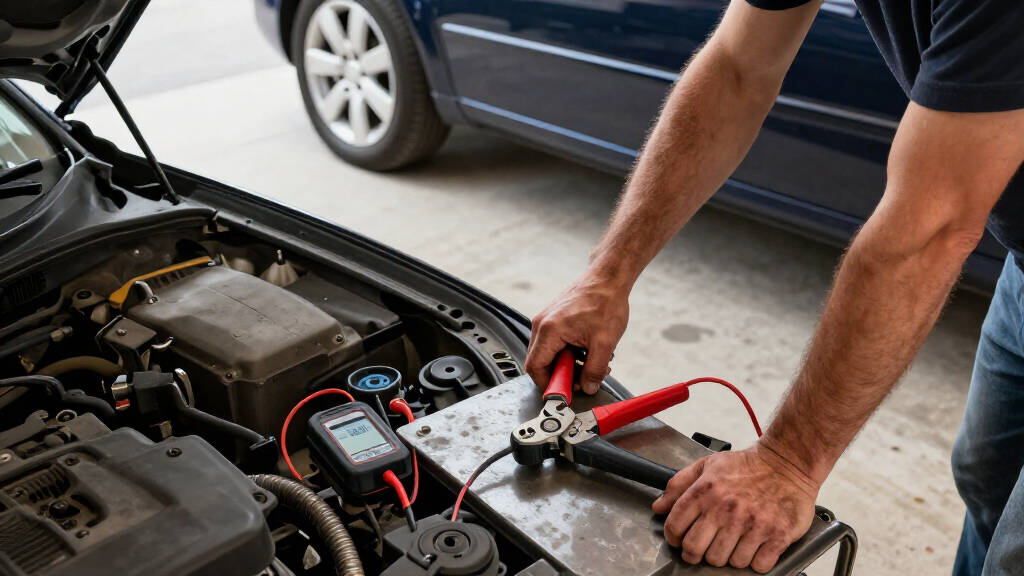
How We Picked
I ranked these car battery testers by how well their capabilities match common buyer needs: identifying battery condition, checking alternator or charging-system behavior, covering the right voltage range, and presenting results clearly. I also weighed practical details such as stated CCA range, test method, ease of connection, and whether added features—like a printer or OBD2 functions—solve a real need rather than add complexity.
The ranking favors useful coverage and clear fit over feature count alone. That puts versatile testers with battery and charging checks near the top, while specialist tools remain strong choices for their intended jobs. A 12V-only model can still be the better pick for a typical car owner if it is simpler and covers the checks they actually need; 6V/24V support matters most for buyers with older, commercial, or mixed-voltage vehicles. Because these tools use different test approaches, I distinguish quick electronic checks from dedicated load testing rather than treating their results as interchangeable.
Factors to Consider When Choosing Car Battery Testers
Choosing among car battery testers starts with the vehicles and decisions the tool needs to support. These points help separate a simple maintenance check from a workshop tool or a dedicated load tester.
Match Voltage Support to Every Vehicle You Own
Many passenger cars use 12V systems, but a household or garage may also include an older 6V vehicle or 24V commercial equipment. Check each vehicle’s system voltage before buying; a tester that handles 24V is not automatically suitable for every 6V battery. Avoid choosing a wider range just because it sounds more capable if you will only test one 12V car—the extra support may add functions you never use. For a mixed fleet, confirm that the tester supports the relevant voltage and battery type for each vehicle. This check prevents a common mismatch: buying a tool based on its CCA range while overlooking voltage compatibility.
Choose the Test Method for the Question You Need Answered
A conductance tester estimates battery condition electronically and is often convenient for quick checks without a prolonged high-current test. A load tester applies a load, which can help assess how a battery responds under demand, but the method requires careful use and attention to the tool’s instructions. These approaches do not answer every question in the same way, so do not treat their readings as directly interchangeable. If you are screening a battery before winter, a quick electronic check may be enough; if you need a more direct performance check, a load-testing model may suit the job. A weak result from either method can call for a second check or professional diagnosis rather than an immediate battery replacement.
Decide Whether You Need Alternator and Charging Checks
A battery can test poorly because it is aging, but a charging-system fault can also leave a healthy battery undercharged. If you want to distinguish those possibilities, choose a tester that includes alternator or charging-system checks. For a driver who only wants periodic battery screening, those functions may add little value. For someone troubleshooting repeated no-starts, checking the charging side can help narrow the cause before replacing parts. Remember that a tester’s charging result is a diagnostic clue, not a substitute for inspecting connections, belts, or other vehicle systems.
Treat CCA Range and Battery-Type Support as Separate Checks
The stated CCA range indicates which cold-cranking amp values a tester can work with, but it does not by itself confirm compatibility with every battery. Check whether the tool supports the battery chemistry and type installed in your vehicle, and enter the correct rating when prompted. A wrong battery setting or rating can produce a misleading result even when the tester’s range appears suitable. If you service vehicles with different batteries, prioritize clear setup instructions and broad type support over a high maximum CCA figure alone. When the label is hard to read, identify the battery specification before starting the test.
Pay for Workflow Features Only When They Save You Time
Features such as a built-in printer, stored results, or combined OBD2 functions can make sense in a shop or for someone maintaining several vehicles. A printed record may help document repeated checks, while a scanner-and-tester combination can reduce the number of tools to carry. For occasional home use, those additions may mean more menus, setup, and equipment than the task requires. Think about how often you will test, whether you need to share or keep results, and whether you already own a scan tool. Ease of repeatable use is often more valuable than extra capabilities that stay unused.
Use Test Results as Evidence, Not a Replacement Verdict
Battery readings can be affected by charge level, temperature, dirty or loose terminals, and incorrect input settings. Follow the tester’s guidance on battery condition before testing, and clean or secure connections if readings seem inconsistent. A low state-of-charge result does not always mean the battery has reached the end of its service life; charging it and retesting may clarify the picture. Compare repeated results alongside starting symptoms and charging-system behavior rather than relying on one number. This approach reduces unnecessary replacement and helps avoid overlooking a poor connection or charging fault.
Frequently Asked Questions
Should I buy a conductance tester or a battery load tester?
Choose a conductance tester when you want quick electronic checks with minimal setup, such as routine screening at home. A load tester applies a direct load and may suit buyers who specifically want to observe battery response under demand. Neither method makes every diagnosis on its own, and results can vary with battery charge and connection quality. If you are unsure, consider which test you will repeat most often and follow the tool’s instructions closely. A battery that produces a concerning result may need charging and retesting before you decide to replace it.
Is a 12V-only tester enough if I own a car and a motorcycle?
It may be, but check the motorcycle battery’s voltage and the tester’s stated support before buying. Many motorcycles use 12V batteries, yet the tester must also accept the battery type and rating you plan to enter. A wider-voltage model is useful if you also maintain 6V or 24V equipment, but it is not necessary just because you own more than one 12V vehicle. Compare the tool’s supported battery types and CCA range with the labels on both batteries. That match matters more than the number of vehicles alone.
Can a battery tester tell me whether the alternator is causing a dead battery?
A tester with charging-system checks can help identify whether alternator output looks abnormal during the test, which narrows the likely causes. It cannot prove that the alternator is the only fault or rule out wiring, belt, terminal, or parasitic-draw problems. A battery that repeatedly goes flat may also be undercharged, damaged, or losing charge while the vehicle is parked. Use the result alongside starting symptoms and a visual check of connections. If the readings remain unclear, a mechanic can test the charging and electrical systems in more depth.
When is a built-in printer worth choosing over a basic digital tester?
A printer is most useful when you test vehicles regularly and need a paper record for service notes, customer handoffs, or follow-up comparisons. For a single household vehicle, noting the reading digitally or on paper may be just as practical. The printer also adds a feature you need to maintain and may make the tool less suited to buyers who value simplicity above documentation. Think about whether anyone besides you needs to see the test results. If not, a less elaborate tester may better match the job.
Should I replace a battery as soon as a tester reports a weak result?
Not always. A discharged battery, poor terminal contact, or incorrect tester settings can affect the reading, so check the connections and follow the tool’s instructions before acting. If the battery is low on charge, charging it and repeating the test can help separate a temporary low-charge condition from reduced battery health. Compare the result with how the vehicle starts and whether the charging system is working properly. If weak readings persist or the car is unreliable, seek a professional diagnosis before relying on the battery for essential use.
Conclusion
For most buyers, I recommend the TOPDON BT200 for its mix of battery and charging-system checks and 12V/24V support. The best value depends on how simply you need to test: the ANCEL BA101 is a sensible direction for routine 12V checks, while buyers who want straightforward electronic readings can compare it with the KONNWEI KW208. For a more feature-rich, professional workflow, the TOPDON BT300P is my premium pick because its built-in printer supports documented testing. Beginners should favor a clearly set-up digital tester such as the TOPDON BT100 rather than paying for functions they may not use. For dedicated load testing, look at the Schumacher BT-100; for wider voltage needs, compare the VDIAGTOOL BT500, FOXWELL BT705, and OBDResource BR502 against your vehicles’ exact requirements. Choose by test method, voltage, and workflow—not by feature count alone.