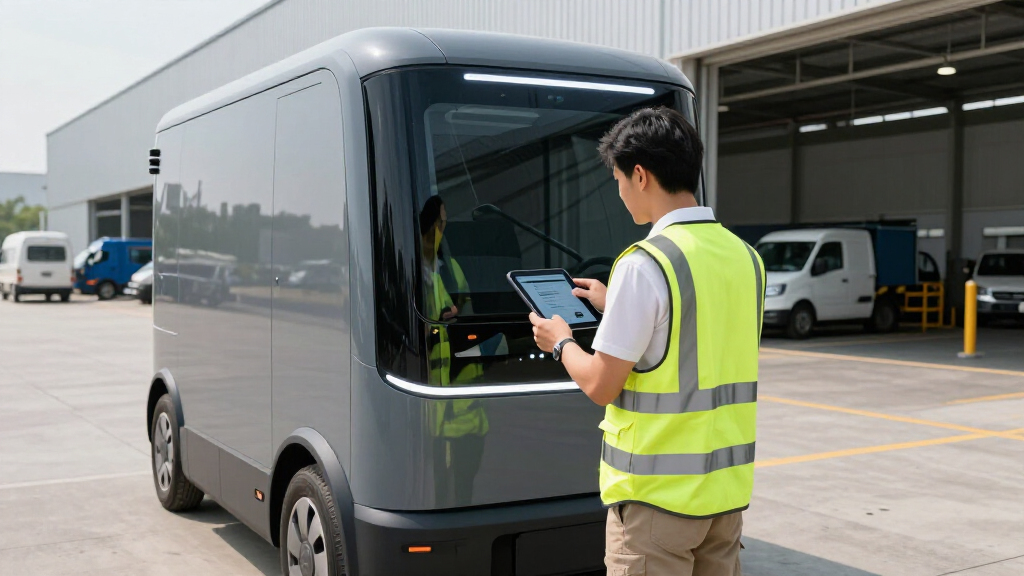

When searching for the best autonomous delivery trucks, the options are diverse, ranging from small food robots to large freight vehicles. The best overall pick, Alpha Oxbot F150, offers a robust payload and advanced navigation, making it suitable for many use cases. The Food Delivery Robot Cart stands out for its agility in tight spaces, ideal for restaurants. However, tradeoffs include differences in payload capacity, navigation complexity, and deployment environments. Continue reading for an in-depth comparison that clarifies which model fits your specific needs.

Get business pricing on garage and car supplies
- Business-only prices and quantity discounts
- Tax-exempt purchasing
- Multiple users, one account, clear invoices
Complete the kit


Key Takeaways
- Payload capacity varies dramatically, influencing suitability for food versus freight deliveries.
- Navigation technology, such as 3D obstacle avoidance, is a key factor for operational safety and efficiency.
- Cost and complexity of deployment differ; smaller robots are easier to implement but may have limited range.
- Versatility across environments is often traded off against specialization; some trucks excel in warehouses while others are better for urban settings.
- Build quality and maintenance needs significantly impact long-term value and operational uptime.
| Food Delivery Robot Cart with 3D Obstacle Avoidance |  | Best Overall Autonomous Delivery Robot for Complex Environments | Storage Capacity: 60 L | Maximum Runtime: 48 hours | Navigation: Visual SLAM + Laser SLAM | VIEW LATEST PRICE | See Our Full Breakdown |
| Food Delivery Robot for Restaurants and Hotels |  | Best Indoor Delivery Robot for Hospitality and Medical Environments | Navigation: Smart indoor navigation with sensors and mapped routes | Capacity: Multiple large trays | Use Cases: Restaurants, hotels, hospitals | VIEW LATEST PRICE | See Our Full Breakdown |
| Alpha Oxbot F150 Autonomous Delivery Robot with 330lb Payload |  | Best Heavy-Duty Indoor Material Transport Robot | Payload Capacity: 150 kg (330 lb) | Navigation: LiDAR, SLAM, RGBD cameras | Display: 13.3-inch Full HD touchscreen | VIEW LATEST PRICE | See Our Full Breakdown |
| Tommy the Autonomous Truck |  | Best Heavy-Duty Autonomous Logistics Vehicle | Features: Autonomous driving technology | VIEW LATEST PRICE | See Our Full Breakdown | ||
| Smart Restaurant Service Robot for Autonomous Food and Drink Delivery |  | Best Versatile Indoor Food & Beverage Delivery Robot | Navigation: Autonomous indoor navigation with sensors | Tray Capacity: Large trays for multiple items | Delivery signals: Visual indicators and voice prompts | VIEW LATEST PRICE | See Our Full Breakdown |
| Commercial Delivery Robot with 3D Vision and Independent Suspension |  | Best for Narrow Passageway Operations | Tray Capacity: 3 trays | Navigation Technology: Visual + laser SLAM | Passage Width: 75 cm (28 inches) | VIEW LATEST PRICE | See Our Full Breakdown |
| AGV Trackless Forklift Handling Vehicle, 1.5T Lifting Capacity, for Warehousing, Logistics, and Factory Workshop Transport |  | Best for Precision and Heavy Lifting in Warehouses | Load Capacity: 1.5 T | Navigation Modes: Laser SLAM, QR code, inertial | Positioning Accuracy: ±10mm | VIEW LATEST PRICE | See Our Full Breakdown |
| autonomous delivery truck | Navigation |
|---|---|
| Food Delivery Robot Cart with | Visual SLAM + Laser SLAM |
| Food Delivery Robot for Restau | Smart indoor navigation with sensors and mapped routes |
| Alpha Oxbot F150 Autonomous De | LiDAR, SLAM, RGBD cameras |
| Tommy the Autonomous Truck | — |
| Smart Restaurant Service Robot | Autonomous indoor navigation with sensors |
| Commercial Delivery Robot with | — |
| AGV Trackless Forklift Handlin | — |
More Details on Our Top Picks
Food Delivery Robot Cart with 3D Obstacle Avoidance
This robot stands out for its dual SLAM navigation system, combining visual and laser data to maintain precise positioning even in busy or cluttered settings, outperforming basic single-sensor models. Its 3D obstacle avoidance ensures safety around pedestrians and furniture, making it ideal for dynamic environments like hotels or restaurants. The auto-recharge feature and 48-hour runtime minimize downtime, supporting continuous service. While it’s a versatile choice, its generic branding raises questions about long-term support and warranty, and the pricing isn’t transparent without direct contact. Compared to more specialized or branded options, this model offers broad functionality at a potentially uncertain after-sales experience.
Pros:- Dual SLAM navigation for precise indoor positioning
- Advanced 3D obstacle detection enhances safety
- Extended 48-hour runtime reduces operational interruptions
- Large 60-liter capacity supports multiple deliveries
Cons:- Branding and manufacturer support are unclear, which may impact service continuity
- Pricing details require direct inquiry, adding uncertainty for budgeting
Best for: Large restaurants or hotels needing reliable, continuous delivery in complex indoor spaces
Not ideal for: Small venues or businesses requiring a highly customizable or budget-friendly solution
- Storage Capacity:60 L
- Maximum Runtime:48 hours
- Navigation:Visual SLAM + Laser SLAM
- Features:3D obstacle avoidance, auto-charge, app remote control, one-key dispatch
- Included Components:Robot
- Manufacturer:GENERIC
Our verdict“This robot is best suited for large, busy venues that prioritize safety and continuous operation despite potential support uncertainties.”
Food Delivery Robot for Restaurants and Hotels
This robot excels in indoor environments like restaurants and hospitals thanks to its smart navigation and large capacity trays, making it a practical choice for efficient meal and beverage service. Its obstacle avoidance and mapped routes help it navigate crowded or layout-rich spaces more smoothly than simpler models. Interactive voice prompts enhance guest and staff interaction, adding a layer of service quality. The main tradeoff is that pricing isn’t fixed, and setup may require ongoing adjustments, which could be a challenge for smaller operations or those seeking a plug-and-play solution. Compared to more autonomous carts, its focus on hospitality environments makes it more specialized but potentially less adaptable to outdoor or highly dynamic settings.
Pros:- Smart navigation with obstacle avoidance for indoor spaces
- Large trays support multiple items per delivery
- Interactive voice prompts improve customer experience
- Designed specifically for hospitality and healthcare environments
Cons:- Pricing varies based on customization, complicating budget planning
- Setup and maintenance might demand technical expertise
Best for: Indoor dining venues, hotels, or hospitals aiming to improve service flow without outdoor navigation concerns
Not ideal for: Outdoor venues or businesses requiring rugged, weatherproof solutions
- Navigation:Smart indoor navigation with sensors and mapped routes
- Capacity:Multiple large trays
- Use Cases:Restaurants, hotels, hospitals
Our verdict“This robot makes the most sense for indoor hospitality and healthcare settings prioritizing efficiency and guest interaction over outdoor durability.”
Alpha Oxbot F150 Autonomous Delivery Robot with 330lb Payload
The Alpha Oxbot F150 best serves large-scale indoor transport tasks, thanks to its impressive 150 kg (330 lb) payload capacity, surpassing smaller robots like the restaurant-focused models. Its LiDAR and SLAM-based navigation provide reliable, precise movement within complex environments, and its elevator integration ensures seamless multi-floor operation. The 13.3-inch touchscreen simplifies control, making it accessible for trained staff. However, its primary design for indoor use and limited payload options make it less suitable for outdoor or heavy industrial tasks. The setup can be complex, often requiring technical expertise, which might deter smaller businesses or those seeking quick deployment.
Pros:- LiDAR and SLAM navigation for dependable indoor movement
- Elevator integration supports multi-floor operation
- Large touchscreen interface eases daily operation
- Supports payloads up to 150 kg
Cons:- Limited to indoor environments, not suitable for outdoor use
- Setup complexity may require technical support
Best for: Warehouses, hospitals, or large facilities needing reliable indoor material handling with high payload capacity
Not ideal for: Outdoor environments or small operations with lighter transport needs
- Payload Capacity:150 kg (330 lb)
- Navigation:LiDAR, SLAM, RGBD cameras
- Display:13.3-inch Full HD touchscreen
- Obstacle Detection:Yes
- Elevator Integration:Yes
- Operation Environment:Indoor commercial facilities
Our verdict“This model is tailored for large, indoor material transport tasks where high payload and reliability matter most, despite its indoor-only limitation.”
Tommy the Autonomous Truck
Tommy the Autonomous Truck offers autonomous driving capabilities aimed at freight and logistics, with a focus on route safety and efficiency. While details are sparse compared to other robots on this list, its autonomous driving tech makes it suitable for highway or large-scale freight routes. However, the lack of detailed specs, customer feedback, or specific features makes it difficult to evaluate its true strengths or limitations. Its potential high cost and limited publicly available information suggest it’s best suited for established logistics firms with specific freight needs and technical resources, rather than small or experimental operations.
Pros:- Autonomous driving technology for freight routes
- Designed for large-scale logistics and transportation
Cons:- Limited information on features and capabilities
- Potentially high cost and complex integration
Best for: Large logistics companies or fleet operators needing autonomous highway or long-distance freight transport
Not ideal for: Small businesses or those seeking detailed specifications and quick deployment
- Features:Autonomous driving technology
Our verdict“This truck is ideal for large-scale freight operations with the resources to support high-cost, specialized autonomous vehicles, though its specifics remain unclear.”
Smart Restaurant Service Robot for Autonomous Food and Drink Delivery
This robot emphasizes versatility within indoor settings, combining autonomous navigation with large trays and visual/voice signals to enhance service. Compared with the more industrial-looking DR-519-02, this model focuses on guest interaction, making it more suitable for customer-facing environments like restaurants and hotels. Its visual and voice prompts improve user experience, but pricing and configuration complexity may pose challenges for smaller or less tech-savvy operators. It’s a flexible choice for venues with varied indoor layouts that want to streamline food and drink delivery while maintaining guest engagement.
Pros:- Autonomous navigation reduces manual labor
- Large trays support multiple dishes/drinks simultaneously
- Visual indicators and voice prompts enhance guest experience
- Suitable for diverse indoor commercial environments
Cons:- Prices are variable, affecting budgeting certainty
- Setup and customization may be complex for some users
Best for: Restaurants, hotels, or hospitals seeking a flexible, interactive indoor delivery robot
Not ideal for: Outdoors or venues with very tight budgets or minimal technical support capacity
- Navigation:Autonomous indoor navigation with sensors
- Tray Capacity:Large trays for multiple items
- Delivery signals:Visual indicators and voice prompts
- Suitable environments:Restaurants, hotels, hospitals
Our verdict“This robot suits indoor venues prioritizing guest interaction and flexible delivery, despite possible setup complexity and cost variability.”
Commercial Delivery Robot with 3D Vision and Independent Suspension
This autonomous delivery robot stands out for its large 3-tray capacity combined with advanced navigation technology, including visual and laser SLAM, making it highly effective for complex environments like restaurants and hotels. Compared to the AGV Trackless Forklift, this model offers more flexibility in tight spaces thanks to its slim profile and obstacle avoidance. However, its price is customizable, which could lead to higher costs for tailored setups, and it requires proper integration to reach full operational potential. Its auto-charging feature ensures minimal downtime, and smart connectivity allows for easy customization via app. It’s best suited for venues needing frequent, multi-order deliveries in narrow passages.
Pros:- Large 3-tray capacity for handling multiple orders simultaneously
- Precise navigation with visual and laser SLAM for accurate obstacle avoidance
- Slim design allows navigation through narrow passageways
- Smart connectivity and customizable voice options
Cons:- Price varies depending on customization, potentially increasing overall cost
- Requires setup and system integration for full functionality
Best for: Restaurants, hotels, and event venues requiring precise, continuous delivery in tight spaces
Not ideal for: Large-scale warehouses or factories where higher load capacity and more rugged handling are needed
- Tray Capacity:3 trays
- Navigation Technology:Visual + laser SLAM
- Passage Width:75 cm (28 inches)
- Connectivity:WiFi and 4G
- Auto-Charging:Yes
- Customizable Voice Packs:Available
Our verdict“This robot makes the most sense for venues needing flexible, multi-order delivery in confined spaces, despite higher customization costs.”
AGV Trackless Forklift Handling Vehicle, 1.5T Lifting Capacity, for Warehousing, Logistics, and Factory Workshop Transport
This autonomous forklift excels in environments requiring high-load handling with exceptional precision, thanks to multi-mode navigation that includes laser SLAM, QR code, and inertial systems. It offers ±10mm positioning accuracy, which surpasses the visual SLAM-based system of the Delivery Robot, making it ideal for exact pallet placement and dock docking. Its comprehensive safety features, including lidar and ultrasonic sensors, protect operators during continuous operation. Unlike simpler robots, this model supports fleet management and integrates seamlessly with WMS, ERP, and MES systems, making it suitable for 24/7 production lines. It is better suited for large warehouses and factories with complex logistical needs, though it likely requires professional setup.
Pros:- Multi-mode navigation allows quick deployment without modifications
- Millimeter-level accuracy ensures precise pallet handling
- 360° safety sensors provide comprehensive obstacle detection
- Integrates with existing WMS, ERP, and MES systems for fleet coordination
Cons:- Pricing and warranty details are not publicly available
- Setup and system integration require professional expertise
Best for: Industrial warehouses and manufacturing facilities with high-volume, continuous material handling needs
Not ideal for: Small retail stores or environments needing lightweight, simple delivery solutions with minimal integration
- Load Capacity:1.5 T
- Navigation Modes:Laser SLAM, QR code, inertial
- Positioning Accuracy:±10mm
- Safety Features:Lidar, ultrasonic sensors, anti-collision strips
- Vision System:3D vision sensors with deep learning
- Operation:24/7, three-shift
Our verdict“This vehicle is ideal for large-scale, high-precision logistics operations that demand seamless fleet management and continuous operation.”
How We Picked
I evaluated these autonomous delivery trucks based on core criteria that matter most to potential buyers: performance reliability, navigation and obstacle avoidance capabilities, payload capacity, ease of deployment, and overall value. I prioritized products with proven technology, versatility across environments, and realistic cost considerations. Comparing these aspects allowed me to rank the options from most versatile and reliable to those more specialized or budget-focused, ensuring each pick addresses different user needs and operational contexts.| autonomous delivery truck | Navigation |
|---|---|
| Food Delivery Robot Cart with | Visual SLAM + Laser SLAM |
| Food Delivery Robot for Restau | Smart indoor navigation with sensors and mapped routes |
| Alpha Oxbot F150 Autonomous De | LiDAR, SLAM, RGBD cameras |
| Tommy the Autonomous Truck | — |
| Smart Restaurant Service Robot | Autonomous indoor navigation with sensors |
| Commercial Delivery Robot with | — |
| AGV Trackless Forklift Handlin | — |
Factors to Consider When Choosing Best Autonomous Delivery Trucks
Choosing the right autonomous delivery truck involves balancing several factors. Beyond basic features, understanding the operational environment, payload needs, and future scalability can help prevent costly mistakes. This guide covers the key considerations to help you make an informed decision that aligns with your delivery demands and budget.Payload Capacity and Size
Payload capacity directly impacts how much the vehicle can carry, influencing whether it’s suitable for food, groceries, or heavier freight. Larger trucks like the Alpha Oxbot F150 handle up to 330 pounds, ideal for logistics, while smaller robots excel in delivering meals or small packages in tight spaces. Consider your typical load size and whether the vehicle can scale with future growth to avoid frequent upgrades or operational bottlenecks.
Navigation and Obstacle Avoidance
Advanced navigation features such as 3D obstacle avoidance and sensor redundancy improve safety and reduce delivery errors. Vehicles equipped with sophisticated vision systems are better suited for complex environments like urban streets or crowded warehouses. However, these systems often come at a higher cost, so weigh the importance of safety against your budget and operational simplicity.
Deployment Environment
Some trucks are optimized for indoor use, like restaurants or warehouses, while others are designed for outdoor or mixed environments. Deploying a vehicle in a controlled environment reduces the risk of accidents and simplifies maintenance. Conversely, outdoor models need rugged build quality and weather resistance, which can increase upfront costs but extend operational flexibility across different settings.
Cost and Maintenance
Initial investment varies widely, from budget-friendly units to premium models with advanced sensors. Consider not only the purchase price but also ongoing maintenance and software updates. Cheaper models might save money initially but could incur higher long-term costs due to frequent repairs or limited durability. Prioritize models with a proven track record of reliability and good support services.
Scalability and Integration
Evaluate whether the vehicle can integrate with your existing logistics system or fleet management software. Scalability is key if you plan to expand your autonomous delivery operations. Some trucks come with modular features or open APIs that simplify integration, whereas others may require costly customization, potentially limiting growth or increasing downtime.
Frequently Asked Questions
Can these autonomous trucks operate in both indoor and outdoor environments?
Many autonomous delivery trucks are designed for specific environments, with some optimized for indoor use such as restaurants or warehouses, and others built for outdoor operation. Vehicles with advanced sensors and weatherproofing can often handle mixed environments, but it’s important to match the truck’s capabilities with your operational needs. Using an indoor-only model outdoors may lead to safety issues, while outdoor models in indoor settings could be unnecessarily costly and complex.
What is the typical lifespan of an autonomous delivery truck?
The lifespan depends on build quality, usage intensity, and maintenance, but most commercial models are designed to last between 3 to 7 years with proper care. Higher-end units with robust construction and advanced sensors tend to last longer and sustain more operational cycles. Regular updates and servicing are essential to maximize longevity and ensure safety compliance over time.
How difficult is it to deploy these autonomous trucks without technical expertise?
Deployment complexity varies widely; some models are plug-and-play, designed for easy setup with minimal technical skills, making them suitable for small businesses or restaurants. Others require integration with existing fleet management software or additional programming, which might necessitate technical support or a dedicated team. Carefully consider your team’s technical capacity before investing to avoid unexpected delays or costs.
Are these autonomous trucks compliant with current safety and transportation regulations?
Most reputable models adhere to local safety standards and regulations, but compliance can vary by region and intended use. It’s crucial to verify whether the manufacturer provides necessary certifications and whether your local laws permit autonomous operation for commercial vehicles. Staying compliant may involve additional documentation, permits, or safety measures that could influence total deployment costs.
What kind of support and maintenance do these vehicles typically require?
Support needs range from routine software updates to hardware repairs, with higher-end models offering comprehensive service packages. Many manufacturers provide remote diagnostics and regular maintenance plans, which can reduce downtime. Budgeting for ongoing support is vital, as neglecting maintenance or updates can compromise safety and efficiency over time.
Conclusion
The best overall choice for most users is the Alpha Oxbot F150, thanks to its impressive payload capacity and advanced navigation suited for diverse environments. For those prioritizing affordability and ease of use, smaller units like the Food Delivery Robot Cart make sense, especially for indoor applications. If you need a high-end solution with maximum versatility, consider premium models with robust sensors and expandability. Beginners or small business owners should look for straightforward, easy-to-deploy options, while large logistics operations might justify higher investments for scalable, integrated systems.