This checklist is for anyone outfitting an overlanding setup and deciding which camping essentials to consider first. The picks cover shelter, power, food storage, cooking, shade, and water, with options named for vehicle-based trips.

Get business pricing on garage and car supplies
- Business-only prices and quantity discounts
- Tax-exempt purchasing
- Multiple users, one account, clear invoices
Each section focuses on one gear slot and its listed pick. The guidance explains why the slot matters, what to check before buying, and where fit and compatibility deserve attention.
Use the checklist to compare each item with your vehicle, travel group, and planned setup. Confirm the product’s current specifications and included components before purchase, especially for dimensions, connections, and capacity.
Rooftop Tent
A rooftop tent can make shelter a central part of a vehicle-based camp, so start by checking whether the tent suits your vehicle and the way you travel. The Naturnest pick is described as a hard-shell pop-up tent for two to four people, but the product name alone does not establish its exact dimensions, weight, mounting requirements, or included hardware. Confirm those details with the seller and compare them with your vehicle’s roof load limits and rack setup.
A common mistake is choosing by sleeping capacity alone. Consider how many people will actually share the tent, the space needed for bedding, and whether the packed size leaves room for other rooftop gear. Check the opening and closing process, the ladder arrangement, and whether access works at your usual campsite. Before purchasing, verify rack compatibility, mounting hardware, and whether installation requires a particular crossbar layout. Vehicle fit and roof limits should guide the decision, while the hard-shell design and pop-up description are useful starting points to investigate rather than a substitute for checking specifications.
What to look for:
- Confirm vehicle roof load limits and rack compatibility.
- Check tent dimensions and packed height against the vehicle.
- Verify mounting hardware and crossbar requirements.
- Match sleeping capacity to your group and bedding.
- Review setup, ladder, and access details.
Naturnest Rooftop Tent Hard Shell, Easy Set Up Pop Up Tents for 2-4 Person

This rooftop tent features an easy setup with gas struts, a spacious interior with raised height, and a durable hard shell exterior. It is waterproof, windproof, and equipped with multiple comfort and storage features, making it suitable for all-season camping.
Pros:
- Easy to set up with gas struts and automatic pop-up design
- Spacious interior with high roof and panoramic views
- Durable, weather-resistant construction with premium hardware
- Includes comfort features like foam mattress and LED lighting
Cons:
- Requires a compatible roof rack for installation
- Additional equipment needed for climate control (heater/air conditioner)
- Heavy and may require assistance to mount
Best for: Vehicle campers seeking a hard-shell pop-up tent for two to four people.
Not ideal for: Setups whose roof limits or rack configuration do not match the confirmed requirements.
Bottom line: Verify roof capacity, rack fit, and dimensions before making this the centerpiece of camp.
Portable Power Station
A portable power station can support equipment that needs electricity at camp, making capacity and output key parts of the overlanding plan. The listed Jackery HomePower 3600 Plus is named as a 3,584 Wh unit with 3,600 W AC output. Those figures give you a starting point, but they do not say how long a particular appliance will run or which ports and charging methods are included. Check the current product specifications and compare them with the devices you intend to use.
A frequent buying mistake is treating watt-hours and watts as interchangeable. Capacity relates to stored energy, while output limits affect which devices can be powered at once. List the equipment you plan to bring, note its power needs, and allow for the fact that real-world runtime depends on use and conditions. Check the station’s dimensions and weight for storage and handling, along with its port types, vehicle charging options, and any accessories needed for your setup. Power needs and connections should be matched before departure; avoid assuming a device will work simply because the station has a large capacity figure.
What to look for:
- Compare appliance draw with the station’s output limits.
- Estimate energy needs for the length of your trip.
- Confirm port types for every device you plan to connect.
- Check vehicle charging options and required accessories.
- Review dimensions and weight for storage and handling.
Jackery HomePower 3600 Plus Power Station, 3584Wh, 3600W AC Output

The Jackery HomePower 3600 Plus is a portable power station with 3600W output (7200W in parallel) and 3584Wh capacity, expandable up to 43kWh with multiple units. It features high-temp resistant ceramic membrane LFP battery cells rated for 6,000 cycles and a 10-year lifespan, and can recharge from 0-100% in as little as 2 hours.
Pros:
- High 3600W output expandable to 7200W in parallel can run major appliances like pumps, heaters, and dryers
- Fast 0-100% recharge in just 2 hours with hybrid charging
- Long battery lifespan of 6,000 cycles with safety-tested ceramic membrane cells
- Ultra-portable design with wheels and telescopic handle, 34% smaller and 29.3% lighter than comparable models
Cons:
- 240V output requires parallel connection with a second unit
- Large upfront investment likely required for whole-home expansion to 43kWh
Best for: Campers whose planned devices match the confirmed output and connection options.
Not ideal for: Travelers who need a lighter or smaller unit for their available storage space.
Bottom line: Match both capacity and output to your actual devices before packing it.
12V Refrigerator
A 12V refrigerator can keep chilled and frozen items organized while traveling, and a dual-zone layout may suit trips with different storage needs. The ICECO VL60 is identified as a 60-liter dual-zone portable refrigerator and freezer. Confirm the exact compartment arrangement, temperature controls, dimensions, and power connections in the current product details; the name does not specify how much usable room each zone provides or what accessories come in the box.
One common mistake is choosing capacity without checking where the unit will sit and how it will be powered. Measure the intended cargo area, including clearance for opening the lid and accessing contents. Check the vehicle’s available 12V connection and confirm cable reach and requirements. Think through how you will organize food between zones and whether the internal layout works for the containers you carry. Space, access, and power all matter on a moving trip: a refrigerator that fits the cargo area but blocks other gear or is awkward to open may not suit your setup. Verify the product’s operating requirements before relying on it for food storage.
What to look for:
- Measure cargo space and lid-opening clearance.
- Confirm 12V connection type and cable reach.
- Check usable space and the dual-zone layout.
- Match compartment dimensions to your food containers.
- Review operating requirements for your vehicle setup.
ICECO VL60 Dual Zone 12V Portable Refrigerator and Freezer, 60 Liters

The ICECO VL60 is a versatile dual-zone portable fridge freezer with 60 liters capacity, suitable for camping and outdoor adventures. It features independent temperature control, durable construction, and dual power options for reliable performance on the go.
Pros:
- Dual-zone independent control for flexible storage
- Durable construction with insulation and secure latch
- Dual power options for versatile use
Cons:
- May be heavy for some users
- Requires proper ventilation during operation
- Price not specified
Best for: Travelers who want separate refrigerator and freezer zones in a portable unit.
Not ideal for: Vehicles without suitable space, access clearance, or a compatible power connection.
Bottom line: Check cargo fit and 12V compatibility before planning meals around it.
Portable Camping Stove
A portable stove gives your camp kitchen a dedicated place to cook, and a combination design may offer more than one cooking surface. The Coleman Cascade 3-in-1 is described as a portable cooktop with grill and griddle. Confirm exactly what the three-in-one arrangement includes, how the parts are configured, and what fuel and cookware the stove requires. The product name does not settle those details, so use the current instructions and specifications to plan your kitchen kit.
A common mistake is focusing on cooking features while overlooking setup space and compatibility. Check the stove’s dimensions when packed and assembled, and make sure your cooking area can accommodate it safely and steadily. Verify fuel type, connection requirements, and whether fuel or any cooking components are included. Consider how many people you need to cook for and whether the listed surfaces fit your usual meals. Fuel and cooking layout are practical checks before leaving home; also review the care and storage instructions so the stove fits your camp routine. Keep cooking clear of tent fabric and follow the manufacturer’s directions for placement and operation.
What to look for:
- Confirm fuel type and connection requirements.
- Check what components the 3-in-1 setup includes.
- Measure packed size and assembled cooking footprint.
- Match cooking surfaces to your typical meals and group.
- Review setup, operation, and care instructions.
Coleman Cascade 3-in-1 Camp Stove, Portable Cooktop with Grill & Griddle
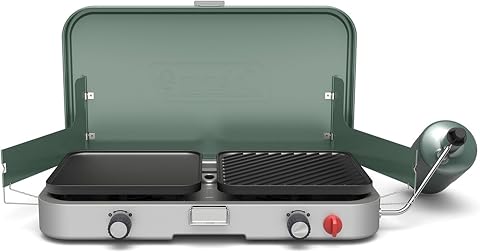
The Coleman Cascade 3-in-1 Camp Stove offers versatile cooking options with removable cast-iron grill and griddle accessories. It features two adjustable burners with precise temperature control, is easy to transport and clean, and provides 24,000 BTUs of power, making it ideal for camping trips.
Pros:
- Versatile 3-in-1 design with grill and griddle accessories
- Easy to transport with handle and carry case
- Powerful with 24,000 BTUs for quick cooking
- Simple to clean with removable parts
Cons:
- Requires separate propane cylinder (not included)
- Size may be bulky for small backpacking trips
Best for: Campers who want a portable stove described with cooktop, grill, and griddle functions.
Not ideal for: Kitchens without room for its confirmed footprint or compatible fuel arrangement.
Bottom line: Verify fuel, included components, and cooking space before building your camp kitchen around it.
Overland Awning
An awning can add a covered area beside a vehicle for time outside the tent or vehicle, so mounting and deployment deserve close attention. The OPENROAD pick is described as a 270-degree freestanding camping awning for SUVs and off-road vehicles. Confirm what “freestanding” means for this model, whether supports or mounting hardware are included, and which rack or vehicle configurations it accepts. The product name alone does not provide its dimensions or coverage area.
A frequent mistake is assuming that an awning labeled for SUVs will fit every SUV. Compare mounting requirements with your rack, roof setup, and any rooftop tent already installed. Check the deployed footprint against the space available at your usual campsites, and consider how doors, storage access, and walking paths will work with it open. Verify the setup steps and the conditions under which additional supports are needed. Mounting fit and clearance matter as much as the stated 270-degree coverage: measure both the vehicle attachment area and the space the awning occupies when deployed. Confirm the supplied parts and read the operating guidance before depending on the awning for shelter.
What to look for:
- Confirm rack and vehicle mounting compatibility.
- Check what mounting hardware and supports are included.
- Measure deployed coverage and campsite clearance.
- Ensure the awning works alongside other rooftop gear.
- Review setup steps and support requirements.
OPENROAD 270° Freestanding Camping Awning for SUVs and Off-Road Vehicles

The OPENROAD 270° Freestanding Camping Awning provides quick setup and reliable protection from wind and rain, featuring durable tear-resistant materials and customizable LED lighting. Its lightweight design makes it portable and suitable for various outdoor adventures.
Pros:
- Easy and quick to install
- Provides extensive 270° coverage for protection
- Durable and tear-resistant construction
- Includes customizable LED lighting
Cons:
- May be heavy for some portable needs
- Limited to specific vehicle types (SUVs, off-road vehicles)
Best for: SUV and off-road vehicle campers whose rack matches the confirmed mounting requirements.
Not ideal for: Vehicles or campsites without sufficient mounting fit and deployment clearance.
Bottom line: Measure the vehicle and campsite footprint before counting on the awning’s coverage.
Collapsible Water Container
Water storage is a core part of camp planning, and containers with a spigot can make dispensing more convenient. This pick is named as a BPA-free collapsible water container with a spigot, supplied as a 10-pack of 5.3-gallon containers. Confirm the exact capacity per container, the materials and intended use, and whether caps or other fittings are included. The product name does not establish dimensions when full or folded, or how the containers are meant to be cleaned.
A common mistake is focusing on total listed capacity without planning how much water the trip requires or where it will be stored. Consider how many containers you need to fill, transport, and access, and check that the filled dimensions and weight work for your vehicle and campsite. Verify the spigot design, closure, and instructions for cleaning and storage between trips. A collapsible container may save space when empty, but filled size and handling still need to fit your setup. Confirm the product is suitable for your intended water use and follow its care directions. Keep containers secured during travel to prevent shifting.
What to look for:
- Confirm capacity for each container and total set contents.
- Check filled and folded dimensions for storage planning.
- Verify spigot, cap, and closure details.
- Review intended water use and cleaning instructions.
- Plan how filled containers will be transported and secured.
BPA-Free Collapsible Water Container with Spigot, 10-Pack, 5.3 Gallon

This set of ten BPA-free, collapsible water containers is made from environmentally friendly, food-grade materials. Designed for portability and durability, they feature leakproof spigots and are suitable for outdoor activities, emergency preparedness, and household use.
Pros:
- Made from food-grade, BPA-free, and environmentally friendly materials
- Foldable and lightweight for easy transport and storage
- Leakproof spigot with adjustable flow and replaceable head
- Fast water flow with venting prevents collapsing
Cons:
- May be less rigid when fully filled, requiring careful handling
- Spigot components might require replacement over time
- Limited color options
Best for: Groups wanting multiple collapsible containers with spigots for camp water storage.
Not ideal for: Setups without room to carry the containers when filled or access them at camp.
Bottom line: Plan around filled dimensions and confirm intended water use before buying the set.
Build your buying order around the trip’s constraints: first confirm vehicle fit for the rooftop tent and awning, then identify the power and 12V needs for your gear. Add the stove and water containers according to your cooking and water plans. Compatibility comes first; verify measurements, connections, and included parts before filling gaps in the kit.
You do not need to assemble every part of an overlanding setup at once. Start with the essentials that match your vehicle and the way you camp, then add equipment as your needs become clearer. A little measuring and specification checking can make each choice easier to live with on the road.
Fall Picks
fall essentials
As an affiliate, we earn on qualifying purchases.