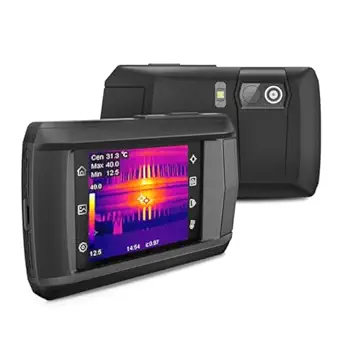
For a thermal imaging camera for search and rescue, I would start with the Seek Thermal Reveal 300 for its handheld design, 320×240 infrared resolution, 25Hz imaging, and built-in flashlight. The Seek Thermal FirePRO 200 is a purpose-focused alternative, while the Thermal Master Thor002 512×384 stands out for buyers who prioritize image detail. The main tradeoffs are handheld readiness versus phone-based portability, resolution versus ease of use, and advertised inspection features versus documented field suitability. None of these product listings alone establishes that a camera is certified or proven for professional rescue operations, so match any candidate to your team’s protocols. Read on for the full comparison and guidance on choosing for your search conditions.

Get business pricing on garage and car supplies
- Business-only prices and quantity discounts
- Tax-exempt purchasing
- Multiple users, one account, clear invoices
Complete the kit


Key Takeaways
- Seek Thermal Reveal 300 is the clearest match in this lineup for a self-contained search tool: it is listed with a 320×240 sensor, 25Hz frame rate, and flashlight.
- Thermal Master Thor002 512×384 offers the highest stated resolution among the listed handheld cameras, but resolution alone does not establish detection distance or rescue readiness.
- The Seek Thermal FirePRO 200 has a rescue-relevant name and handheld format, but the supplied listing gives fewer technical details than the Reveal 300, so buyers should verify specifications before selecting it for field duty.
- Phone-connected options such as the TOPDON TC002C Duo trade standalone operation for smartphone dependence; its listed 512×384 super resolution may appeal to teams already comfortable with a compatible device.
- Several products are presented mainly for HVAC, electrical, plumbing, or home inspection. Their temperature ranges and diagnostic features can be useful, but they do not by themselves show suitability for locating people in a live search.




| thermal imaging camera for search and rescue | Temperature range | Battery life | Field of view |
|---|---|---|---|
| HP96 Thermal Imaging Camera wi | -4°F to 662°F | Up to 4 hours | — |
| FOXWELL RT280 Thermal Imaging | -4°F to 1022°F | — | 50° × 38° |
| GOYOJO Thermal Imaging Camera | -4°F to 752°F (-20°C to 400°C) | — | 50° |
| Thermal Master Thor002 Thermal | -4°F to 1022°F | — | — |
| HF96 Thermal Camera with AI Sc | -4°F to 1022°F | Up to 11 hours | — |
| GT14S Thermal Imaging Camera w | -4°F to 1202°F | 14 hours | 50° |
| GT14S Thermal Imaging Camera w | 4°F to 1022°F | 14 hours | 50° |
| Thermal Camera | -4°F to 1022°F | — | 50° |
| Seek Thermal Reveal 300 Therma | -4°F to 1022°F | — | 18° × 24° |
| TOPDON TC004 Mini Thermal Imag | -4°F to 842°F (-20°C to 450°C) | Up to 15 hours | 40° × 30° |
| TOPDON TC002C Duo Thermal Came | -4°F to 1022°F | — | — |
| Seek Thermal FirePRO 200 Handh | — | Up to 6 hours thermal-only; 3.5 hours with flashlight | — |
| TOPDON TC004 3.5-Inch Thermal | -4°F to 1022°F | — | — |
| Thermal Master Thor002 Handhel | — | Up to 10.5 hours | — |
More Details on Our Top Picks
HP96 Thermal Imaging Camera with 3.5″ Touch Screen and Visual Camera
The HP96 suits rescue teams that want a large touchscreen and a visible-light reference alongside thermal imaging. Its 3.5-inch display and dual cameras can help an operator inspect a scene and record context without relying on a phone. Compared with the FOXWELL RT280, it has a larger touchscreen and scene-detection features, but its 96 × 96 native IR resolution is far lower than the FOXWELL’s 240 × 180 thermal resolution. The stated 240 × 240 super-resolution output should not be confused with native sensor detail when scanning at distance. A 6.6-foot drop test and up to four hours of battery life suit shorter deployments, but not extended shifts. I’d rank it for ease of handling and scene context, not maximum target detail or endurance.
Pros:- 3.5-inch touchscreen is larger than the FOXWELL RT280’s 2.8-inch display.
- Dual thermal and visible cameras provide scene context in recorded images.
- Scene detection and multiple imaging modes can speed up routine scanning.
- 6.6-foot drop-test rating supports field handling.
Cons:- Native 96 × 96 IR resolution offers less sensor detail than the FOXWELL RT280’s 240 × 180 thermal resolution.
- Up to four hours of battery life may be limiting for prolonged searches.
- Some features require firmware updates, and the advanced controls may challenge new operators.
Best for: Search teams that prioritize a large touch display, visible-light context, and quick documentation during shorter deployments.
Not ideal for: Teams needing detailed thermal identification at longer range or a full-shift battery; its native IR resolution is modest and rated runtime is up to four hours.
- IR resolution:96 × 96
- Super-resolution output:240 × 240
- Display:3.5-inch touchscreen
- Visual camera resolution:640 × 480
- Frame rate:25 Hz
- Temperature range:-4°F to 662°F
- Thermal sensitivity:Below 50 mK
- Battery life:Up to 4 hours
- Drop test:6.6 ft
Our verdict“Choose the HP96 when touchscreen usability and visual scene context matter more than native thermal detail or long runtime.”
FOXWELL RT280 Thermal Imaging Camera, 320×240 Resolution, 2.8″ LCD, Laser Targeting, PC Analysis, 8GB Storage
For teams that need to distinguish heat patterns rather than simply spot a warm area, the FOXWELL RT280 has the strongest stated native thermal detail in this group: 240 × 180 thermal resolution. That gives it an advantage over the HP96’s 96 × 96 sensor when searching visually complex scenes, though it cannot replace trained search procedures or guarantee detection through obstructions. Its 50° × 38° field of view supports broad scanning, while laser targeting and temperature alarms add practical tools for checking specific spots. Compared with the Thermal Master Thor002, the FOXWELL lists a lower maximum temperature and less onboard storage, but is described as weighing unspecified and offers IP54 protection. I’d favor it for detail and environmental protection; the missing battery-life figure makes shift planning less straightforward.
Pros:- 240 × 180 thermal resolution is higher than the HP96’s 96 × 96 native IR resolution.
- 50° × 38° field of view supports broad scene scanning.
- IP54 water- and dust-resistance rating and 6.6-foot drop resistance suit field use.
- Laser targeting, temperature alarms, and 8GB storage support inspection and documentation.
Cons:- Battery life is not specified, making deployment planning difficult.
- PC analysis is not compatible with Mac computers.
- The 2.8-inch LCD is smaller than the HP96 and Thor002 displays.
Best for: Search personnel who want higher native thermal detail, a broad field of view, and a rugged handheld for scanning outdoor or industrial scenes.
Not ideal for: Teams that need verified all-shift runtime, Mac-based PC analysis, or the Thor002’s higher stated maximum temperature.
- Thermal resolution:240 × 180
- Display:2.8-inch LCD
- Frame rate:25 Hz
- Temperature range:-4°F to 1022°F
- Field of view:50° × 38°
- Storage:8GB eMMC
- Drop resistance:6.6 ft
- Water and dust resistance:IP54
Our verdict“Pick the FOXWELL RT280 when native thermal detail and IP54 protection outweigh display size and uncertainty about battery runtime.”
GOYOJO Thermal Imaging Camera for Android and iPhone 15/16/17 – 192×192 IR Resolution for Leak Detection, HVAC, Electrical, Plumbing, Automotive, Home Inspection
The GOYOJO is the pocketable pick for a search operator who already carries a compatible phone and wants a small thermal accessory rather than another handheld device. Its 192 × 192 sensor exceeds the HP96’s 96 × 96 native resolution on paper, while its 50° field of view is suited to scanning nearby areas. The tradeoff is operational dependence: the camera connects through USB-C and runs through a smartphone app, so compatibility, battery management, and app access become part of the search setup. Unlike the standalone FOXWELL RT280, it has no listed onboard display, drop rating, storage capacity, or frame rate. Its small size is helpful for carrying, but the supplied data does not establish ruggedness for rough rescue conditions. I’d choose it for portability and skip it for a primary team camera.
Pros:- Compact 1.77 × 0.43 × 1.34-inch body is easy to carry as a secondary tool.
- 192 × 192 resolution is higher than the HP96’s native 96 × 96 sensor.
- USB-C connection supports direct smartphone integration.
- 50° field of view supports scanning a broad nearby area.
Cons:- Requires a compatible smartphone and app, creating extra setup and device dependencies.
- No dedicated display, battery life, storage capacity, or drop rating is listed.
- Temperature range tops out at 752°F, below the FOXWELL RT280 and Thor002 maximums.
Best for: Phone-equipped responders who need a compact secondary imager for close-range checks and already use a compatible USB-C Android device or supported iPhone.
Not ideal for: Rescue teams seeking a standalone, rugged camera with a dedicated screen, documented drop protection, or independent storage.
- IR resolution:192 × 192
- Pixel pitch:12 μm
- Temperature range:-4°F to 752°F (-20°C to 400°C)
- Temperature accuracy:±2%
- Field of view:50°
- Dimensions:1.77 × 0.43 × 1.34 inches
- Compatibility:Android and iPhone 15/16/17 series
- Connectivity:USB-C
Our verdict“Choose the GOYOJO as a compact phone-powered secondary camera, not as a rugged standalone primary tool for search operations.”
Thermal Master Thor002 Thermal Camera with 3.5-Inch IPS Screen
The Thor002 is the endurance-oriented choice here, with a stated up to 10.5-hour runtime and a 5,000 mAh battery that can reduce interruptions during a long search. It also combines a 3.5-inch IPS display, IP54 protection, and a 2-meter drop-test claim, giving it a stronger documented field package than the smartphone-dependent GOYOJO. Its key caveat is resolution: the camera’s native sensor is 256 × 192, while the advertised 512 × 384 image comes from super-resolution processing. That distinction matters when a team is judging fine thermal detail. The fixed-focus lens also limits flexibility compared with cameras that offer focus adjustment. I’d rank it above the HP96 for runtime and ruggedness, but not as an automatic choice for the highest native image detail.
Pros:- Up to 10.5 hours of runtime exceeds the HP96’s stated four hours.
- 3.5-inch IPS display offers a large viewing area for field use.
- IP54 rating and 2-meter drop-test claim support rougher operating conditions.
- Wi-Fi, PC analysis tools, and 32GB storage support reviewing and sharing recorded findings.
Cons:- Native IR resolution is 256 × 192; 512 × 384 is a super-resolution output.
- Fixed-focus lens offers less control over focus than an adjustable-focus design.
- Listed weight of 4.2 pounds may be burdensome for extended handheld scanning.
Best for: Search teams needing a standalone camera for long shifts, with a large screen, extended stated runtime, and documented weather and drop protection.
Not ideal for: Buyers who prioritize adjustable focus or want 512 × 384 native sensor resolution rather than an upscaled output.
- Display:3.5-inch IPS
- Native infrared resolution:256 × 192
- Super-resolution output:512 × 384
- Thermal sensitivity:40 mK
- Temperature range:-4°F to 1022°F
- Temperature accuracy:±3.6°F
- Runtime:Up to 10.5 hours
- Ingress protection:IP54
- Weight:4.2 pounds
Our verdict“Choose the Thor002 for long deployments and a rugged standalone setup, while treating its 512 × 384 figure as processed output rather than native sensor detail.”
HF96 Thermal Camera with AI Scene Detection, Laser Pointer, 240×240 Resolution, -4°F to 1022°F, Infrared Camera for Inspection
The HF96 is aimed at operators who want a handheld camera to flag unusual heat patterns quickly, with AI scene detection, live super resolution, and a laser pointer in one device. Its stated 240 × 240 resolution and 25 Hz frame rate give it a stronger feature set for responsive scanning than the HP96’s 96 × 96 native sensor, although the supplied data does not clarify the HF96’s native-versus-processed resolution. The 11-hour battery rating is also a clear advantage over the HP96’s four hours and puts it close to the Thor002’s up-to-10.5-hour runtime. The HF96 is more inspection-oriented than a purpose-built rescue instrument, and its 4GB storage is limited beside the FOXWELL RT280’s 8GB. I’d pick it for automated scanning and long runtime, while checking firmware readiness before deployment.
Pros:- 11-hour battery rating exceeds the HP96’s stated four-hour runtime.
- AI scene detection and live super resolution can help direct attention to thermal anomalies.
- Laser pointer supports targeting a specific area for follow-up inspection.
- 6.6-foot drop-test rating and below-50 mK sensitivity suit field inspection work.
Cons:- No moisture or humidity readings are available.
- Full functionality requires firmware updates, so setup should be handled before deployment.
- 4GB storage is lower than the FOXWELL RT280’s 8GB.
Best for: Operators who want a compact handheld with scene-recognition aids, a laser pointer, and long stated runtime for repeated hotspot scans.
Not ideal for: Teams that need documented native sensor resolution, moisture readings, or high onboard storage for extensive search documentation.
- Resolution:240 × 240
- Frame rate:25 Hz
- Temperature range:-4°F to 1022°F
- Thermal sensitivity:Below 50 mK
- Battery life:Up to 11 hours
- Storage:4GB
- Drop test:6.6 ft
Our verdict“Choose the HF96 for long-runtime scanning with automated scene aids, provided its firmware is updated and its resolution details meet your team’s requirements.”
GT14S Thermal Imaging Camera with Edge Enhancement and Thermometer Mode
For search teams that need a lightweight imager for extended sweeps, this GT14S pairs a 240g body with a stated 14-hour battery life. Its 50° field of view can help scan a broad area without constantly reframing, while NETD below 50mK supports spotting subtle heat differences. The temperature range extends to 1202°F, though that upper range is more relevant to equipment checks than locating people. Compared with the Seek Thermal Reveal 300, this model is lighter on documented field-readiness: the Reveal lists weather resistance, recording, and detection distance, while the GT14S listing does not specify ruggedness or capture features. I’d choose it for long, controlled searches where endurance and low weight matter more than verified weather protection. The limited connectivity details also leave questions about sharing findings with a command post.
Pros:- 240g weight is suited to prolonged handheld scanning.
- Stated 14-hour battery life can cover a long operational shift.
- NETD below 50mK supports detection of subtle temperature differences.
- 50° field of view covers a broad scene during sweeps.
Cons:- No waterproofing or ruggedness rating is provided.
- Connectivity and image-sharing capabilities are not specified.
- No detection-distance or image-recording details are supplied.
Best for: Search teams prioritizing low carry weight and long operating time for extended sweeps in controlled conditions.
Not ideal for: Teams working in rain, mud, or rough terrain who need stated weather protection, impact resistance, or documented image recording.
- Temperature range:-4°F to 1202°F
- Image frequency:25Hz
- Weight:240g
- Battery life:14 hours
- Sensor sensitivity:NETD < 50mK
- Field of view:50°
Our verdict“Choose this GT14S for long searches where a light camera and extended runtime outweigh the need for documented weather resistance or recording.”
GT14S Thermal Imaging Camera with Thermometer Mode, 240g, 4°F~1022°F Range, 14H Runtime, Live Tracking, Infrared for HVAC/Electrical Inspection
This GT14S is the more alert-focused of the two GT14S listings, adding live tracking and customizable alerts to a lightweight 240g form. Those features may help a rescuer notice and follow a changing heat signature while scanning, rather than relying only on a static image. Its 14-hour runtime and 50° field of view also suit lengthy, broad-area checks. Compared with the first GT14S Edge Enhancement listing, its stated temperature ceiling is lower at 1022°F, but the alert and emissivity-adjustment details are more explicit here. For search and rescue, however, neither listing supplies a ruggedness rating, detection distance, or recording details. I’d favor this version when alert behavior is the priority, but teams entering wet or impact-prone environments should look more closely at the Seek Thermal Reveal 300, which explicitly describes weather-resistant construction.
Pros:- Live tracking and customizable alerts can draw attention to temperature anomalies.
- At 240g, it is light enough for extended handheld use.
- Stated 14-hour battery life supports prolonged searches.
- Emissivity adjustment offers flexibility when measuring different materials.
Cons:- No waterproofing or ruggedness rating is specified.
- Detection distance and image or video recording features are not documented.
- The temperature range is narrower than the other GT14S listing.
Best for: Rescuers who want a light handheld imager with live tracking and customizable alerts for methodical sweeps.
Not ideal for: Teams needing proven weather or impact protection, or buyers who need a documented detection distance and recording workflow.
- Weight:240g
- Temperature range:4°F to 1022°F
- Battery life:14 hours
- Sensor sensitivity:NETD < 50mK
- Emissivity adjustment:Yes
- Field of view:50°
- Features:Thermal and thermometer modes; live tracking; customizable alerts
Our verdict“Pick this GT14S when tracking and alerts matter more than ruggedness, recording, or a higher maximum temperature range.”
Thermal Camera, 240×240 Resolution, -4°F to 1022°F Temp Range, 25Hz Infrared Handheld Thermal Imaging Camera
The listed 240 × 240 resolution gives this handheld camera a defined image specification, a useful starting point when distinguishing a warm target from nearby background heat. Its 25Hz frame rate supports a live view that updates as the operator moves, and the product description cites water and dust resistance for field use. Six color palettes provide different ways to make heat contrasts easier to read. Compared with the TOPDON TC004 Mini, this camera has a higher stated temperature ceiling and the listing describes 240 × 240 resolution directly; the TOPDON instead documents storage, alert-triggered capture, battery endurance, and drop resistance. That leaves this model’s main search-and-rescue limitation: no battery-life or connectivity information is provided, and its handheld form may not suit teams seeking advanced professional workflows. I’d shortlist it for straightforward scanning where a clear live image matters most.
Pros:- Stated 240 × 240 resolution provides a defined image specification.
- 25Hz frame rate supports a responsive live view while scanning.
- Water and dust resistance are cited for use in harsher conditions.
- Six color palettes allow different approaches to viewing heat contrast.
Cons:- Battery life is not specified, making shift planning difficult.
- Connectivity and image-storage capabilities are not documented.
- The listing cautions that it may not suit professional industrial applications.
Best for: Searchers who want a specified 240 × 240 image, live thermal updates, and water/dust resistance for portable field scanning.
Not ideal for: Teams that need known battery endurance, onboard image storage, or connectivity for relaying thermal evidence.
- Resolution:240 × 240
- Temperature range:-4°F to 1022°F
- Frame rate:25Hz
- Field of view:50°
- Color palettes:6 (listed examples include White Heat, Rainbow, Red Heat, Black Heat, and Iron)
- Environmental protection:Water and dust resistance stated
Our verdict“Choose this camera for portable, responsive scanning with stated resolution and environmental resistance, but skip it if runtime or image transfer must be confirmed.”
Seek Thermal Reveal 300 Thermal Camera, 320×240 High Resolution IR Imager, 25Hz Frame Rate, -4°F to 1022°F Temp Range, with Flashlight for Inspection, Hunting, Boating, Search & Rescue
The Reveal 300 is the most explicitly field-oriented option in this group: its listing names search and rescue, cites a rugged, weather-resistant design, and includes a flashlight plus image and video capture. The 320 × 240 sensor offers more stated pixels than the 240 × 240 cameras here, giving operators more image detail to inspect, while the listed detection distance of over 100 meters provides a useful planning reference. Its 18° × 24° field of view is narrower than the GT14S models’ 50° view, so broad sweeps may require more deliberate scanning. Compared with the TOPDON TC004 Mini, the Reveal has a higher listed resolution and a more clearly stated outdoor role, while the TOPDON provides known battery life and drop resistance. The Reveal’s battery life and connectivity remain unspecified, so I’d confirm those needs before deployment.
Pros:- 320 × 240 sensor has more stated pixels than the 240 × 240 options in this batch.
- Rugged, weather-resistant design is specified for demanding outdoor use.
- Image and video capture can preserve findings for review or handoff.
- Built-in flashlight adds a visible-light aid in dark search areas.
Cons:- Battery life and power details are not specified.
- 18° × 24° field of view is narrower than the GT14S models’ 50° view.
- Connectivity options are not detailed.
Best for: Outdoor rescue teams needing a weather-resistant handheld imager with recording, a flashlight, and a stated detection-distance figure.
Not ideal for: Teams needing a documented all-shift runtime, broad 50° scene coverage, or confirmed wireless connectivity.
- Resolution:320 × 240
- Frame rate:25Hz
- Temperature range:-4°F to 1022°F
- Field of view:18° × 24°
- Detection distance:Over 100 meters
- Built-in features:Flashlight; image and video capture
- Design:Rugged, weather-resistant
- Power:Not specified
Our verdict“The Reveal 300 is the strongest fit here for outdoor teams that value documented weather resistance and recording, provided its unspecified runtime fits the mission.”
TOPDON TC004 Mini Thermal Imaging Camera, 240 × 240 TISR Resolution
The TC004 Mini brings a useful combination of drop resistance, IP54 protection, and onboard photo storage in a compact handheld format. Its 128 × 128 infrared sensor is enhanced to 240 × 240 with TISR, so the output resolution should not be read as native sensor resolution. For rescue teams, high- and low-temperature alerts with automatic photo capture can help preserve an anomaly without stopping to take a manual image; 512MB stores up to 8,000 photos, and runtime is listed at up to 15 hours. Compared with the Seek Thermal Reveal 300, the TC004 Mini has lower native sensor resolution and no stated detection distance, but it provides clearer battery and drop-resistance specifications. Its temperature ceiling is also lower than the Reveal’s. I’d choose it for compact, documented field use, while teams needing a more explicitly rugged outdoor imaging package may prefer the Reveal.
Pros:- IP54 rating and stated 2-meter drop resistance suit more demanding handling than an unrated compact camera.
- Up to 15 hours of battery life supports extended use.
- Temperature alerts can trigger automatic photo capture.
- 512MB storage holds up to 8,000 photos for later review.
Cons:- The 240 × 240 image is enhanced from a 128 × 128 infrared sensor.
- Temperature range tops out at 842°F, below the other products in this batch.
- Charging head and printed manual are not included.
Best for: Searchers seeking a compact, drop-resistant camera with known runtime and automatic photo capture for documenting thermal findings.
Not ideal for: Teams that require a native 240 × 240 sensor, a stated long-range detection distance, or a temperature ceiling above 842°F.
- Thermal resolution:128 × 128, enhanced to 240 × 240 with TISR
- Field of view:40° × 30°
- Refresh rate:25Hz
- Temperature range:-4°F to 842°F (-20°C to 450°C)
- Temperature accuracy:±3.6°F / 2%
- Storage:512MB eMMC; up to 8,000 photos
- Battery life:Up to 15 hours
- Protection:IP54; drop-resistant up to 2 meters
- Weight:1.03 pounds
Our verdict“Choose the TC004 Mini for compact field documentation and known durability and runtime, but look elsewhere if native resolution or a higher temperature ceiling is required.”
TOPDON TC002C Duo Thermal Camera
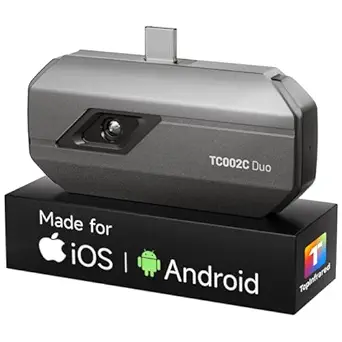
The TC002C Duo is the lightest, least self-contained option here: at 1.1 ounces, it turns a compatible USB-C phone or tablet into a thermal viewer without adding a handheld camera body. Its 256 × 192 infrared resolution, 25Hz refresh rate, and 40mK sensitivity are useful for scanning changing scenes, while its stated 512 × 384 super-resolution output may offer a more detailed view. Compared with the Seek Thermal FirePRO 200, it is far easier to pack and has higher native sensor resolution, but it lacks the FirePRO’s built-in flashlight, onboard image storage, and rugged handheld design. For search and rescue, the phone-dependent setup also adds compatibility and handling concerns when working in poor weather or with gloves. I’d choose it for a team already carrying supported USB-C devices, not as a standalone field camera.
Pros:- Compact 1.1-ounce design adds little weight to a field kit.
- 256 × 192 infrared sensor with 25Hz refresh rate supports scanning moving scenes.
- Compatible with USB-C smartphones and tablets across iOS, Android, and Windows, subject to device limitations.
- Wide stated temperature range of -4°F to 1022°F.
Cons:- Requires a compatible phone or tablet and the TopInfrared app rather than operating as a standalone camera.
- Not compatible with Mac devices or Android 16 devices, and connectivity is limited to USB-C.
- Lacks the built-in flashlight, onboard photo storage, and rugged handheld form of the Seek Thermal FirePRO 200.
Best for: Search teams or trained volunteers who already carry a compatible USB-C phone or tablet and prioritize a very light thermal add-on.
Not ideal for: Responders who need a self-contained, rugged camera, or who use Mac devices or Android 16 devices; it also depends on the TopInfrared app for full functionality.
- Infrared resolution:256 × 192
- Super-resolution output:512 × 384
- Temperature range:-4°F to 1022°F
- Refresh rate:25Hz
- Heat sensitivity:40mK
- Compatibility:USB-C smartphones and tablets; iOS, Android, and Windows
- Size:2.8 × 1.7 × 0.55 inches
- Weight:1.1 oz
Our verdict“Choose the TC002C Duo if minimizing carried weight matters more than having a standalone, weather-ready search camera.”
Seek Thermal FirePRO 200 Handheld Thermal Camera
For search work where equipment may take knocks or face wet conditions, the FirePRO 200 makes a stronger field case than the phone-connected TOPDON TC002C Duo. Its IP67 rating, stated 2-meter drop resistance, integrated 300-lumen flashlight, and handheld design keep core tools together instead of relying on a separate device. Mixed-gain imaging is intended to show hot and cool areas at once, which can help retain scene context when scanning. The tradeoff is its 200 × 150-pixel sensor: the TC002C Duo and Thermal Master Thor002 list higher thermal resolutions, which may help distinguish smaller or closer heat signatures. Battery life is listed at up to six hours in thermal-only mode, but falls to 3.5 hours with the flashlight running. I’d favor it for durability and integrated lighting over fine image detail.
Pros:- IP67 rating and stated 2-meter concrete drop resistance suit demanding field conditions.
- Mixed-gain imaging displays hot and cool regions simultaneously.
- Integrated 300-lumen LED provides a light source without a separate flashlight.
- Stores more than 1,000 thermal photos for later review or training.
Cons:- 200 × 150-pixel thermal resolution is lower than the TOPDON TC002C Duo and Thermal Master Thor002.
- Battery life falls to 3.5 hours when the flashlight is on.
- Uses a nonstandard battery, which may complicate replacement and resupply.
Best for: Search-and-rescue crews who need a standalone handheld camera with water and drop protection, onboard lighting, and image capture.
Not ideal for: Teams whose priority is identifying small or distant heat signatures in fine detail, or who need a long shift with the flashlight continuously on.
- Thermal resolution:200 × 150 pixels
- Refresh rate:Over 25Hz
- Flashlight:Integrated 300-lumen LED
- Battery life:Up to 6 hours thermal-only; 3.5 hours with flashlight
- Image storage:More than 1,000 thermal photos
- Protection:IP67; 2-meter drop rating
- Dimensions:7.4 × 4.7 × 3.7 inches
- Battery:One included nonstandard battery
Our verdict“Pick the FirePRO 200 when ruggedness and integrated lighting matter more to your team than higher thermal resolution.”
TOPDON TC004 3.5-Inch Thermal Imaging Camera
The TOPDON TC004 is the more practical choice than the phone-attached TC002C Duo for teams that want a dedicated screen and onboard file handling. Its 3.5-inch display makes the live thermal view independent of a phone, while 64GB of storage and wireless transfer support saving images and sharing them after a sweep. The infrared sensor is 256 × 192, with TISR listed as providing up to 512 × 384 resolution; that gives it a similar stated resolution path to the TC002C Duo, but in a standalone body. A built-in laser pointer can help indicate a spot during inspection, though it is not a substitute for thermal detection range or search-specific locating tools. Compared with the Seek Thermal FirePRO 200, it offers more storage and a larger stated resolution, but the supplied data does not specify a flashlight or battery life. Its feature set leans toward documented field inspections as much as rescue use.
Pros:- 3.5-inch display allows viewing without a connected phone.
- 64GB storage supports retaining thermal images for later review.
- Wireless connectivity supports file transfer for field reporting.
- 2-meter drop resistance and IP54 protection are suited to field handling.
Cons:- 256 × 192 infrared resolution is below the Thermal Master Thor002’s listed 512 × 384 sensor resolution.
- The supplied product data does not state battery life or include a flashlight specification.
- Laser targeting and inspection features may be less useful than ruggedness and simple search-focused controls in rescue scenarios.
Best for: Field teams that need a standalone thermal camera with a readable built-in screen, substantial image storage, and wireless file transfer.
Not ideal for: Casual users seeking a simple, low-complexity search tool, or responders who require confirmed long battery runtime and integrated lighting.
- Display:3.5 inches
- Infrared resolution:256 × 192; up to 512 × 384 with TISR
- Temperature range:-4°F to 1022°F
- Storage:64GB
- Protection:IP54
- Drop resistance:2 meters
- Connectivity:Wireless
- Laser pointer:Built in
Our verdict“Choose the TC004 if a standalone screen and image documentation matter more than a confirmed long runtime or higher native resolution.”
Thermal Master Thor002 Handheld Thermal Camera
The Thermal Master Thor002 leads this group on listed native thermal resolution, with a 512 × 384 sensor and 40mK sensitivity. Those figures make it the detail-focused option here, while its 3.5-inch IPS screen gives a crew a dedicated display instead of the phone-dependent setup of the TOPDON TC002C Duo. A 2MP visible-light camera, photo and video recording, and wireless transfer add context to saved observations; up to 10.5 hours of stated battery life also compares favorably with the FirePRO 200’s listed thermal-only runtime. The tradeoffs are substantial for a search kit: at 3.12 pounds, it is much heavier than the TC002C Duo, and its ±3.6°F temperature accuracy is not exceptional for precise measurement. Its product data is geared toward inspections, so I’d check that its controls and handling suit the team’s search procedures before selecting it.
Pros:- 512 × 384 thermal resolution and 40mK sensitivity provide the highest listed native detail in this group.
- 3.5-inch IPS display works without a separate phone.
- Up to 10.5 hours of battery life supports extended field use.
- Records photos and video and supports Wi-Fi and USB transfer.
Cons:- At 3.12 pounds, it is considerably heavier than the TOPDON TC002C Duo and may add fatigue during long searches.
- Temperature accuracy is specified as ±3.6°F.
- Its inspection-oriented measurement features may not match every rescue team’s preferred search workflow.
Best for: Search teams prioritizing a detailed thermal image, a built-in screen, and long stated runtime for extended field scans.
Not ideal for: Responders who need a light, easily carried camera or who require especially precise temperature readings; its 3.12-pound weight and ±3.6°F accuracy are drawbacks.
- Thermal resolution:512 × 384
- Display:3.5-inch, 640 × 480 IPS
- Visible-light camera:2MP
- Refresh rate:25Hz
- Thermal sensitivity:40mK
- Temperature range and accuracy:-4°F to 1022°F; ±3.6°F
- Battery life:Up to 10.5 hours
- Protection:IP54; drop resistance up to 2 meters
- Weight:3.12 pounds
Our verdict“Choose the Thor002 for a higher-detail standalone thermal view and long stated runtime if your team can accept its weight.”

How We Picked
I ranked these cameras by how directly their listed features support field use for search and rescue: handheld operation, stated infrared resolution and frame rate, screen or phone dependence, practical controls, and useful accessories. A self-contained camera with clear image specifications received priority over inspection-focused devices or models whose listings provide limited technical detail. Resolution matters because it can preserve more image detail when scanning, but I treated it as one factor rather than a substitute for detection range, thermal sensitivity, field testing, or reliable operation.
The lineup includes products marketed for different tasks, so the ranking reflects the available product information, not a claim that any model is certified for rescue work. The Reveal 300 ranks highly because its listing combines a handheld format, 320×240 resolution, 25Hz imaging, and a flashlight. The higher-resolution Thor002 models and phone-based TOPDON TC002C Duo are strong alternatives for different priorities, while inspection-oriented cameras rank lower unless their listings make a clear case for field use. Buyers should confirm current specifications, compatibility, environmental limits, and team requirements before deployment.
Factors to Consider When Choosing Thermal Imaging Camera For Search And Rescue
Choosing a camera for search and rescue involves more than comparing resolution numbers. I would first match the device to how a team searches, what it must withstand, and whether operators can use it alongside their other equipment. These broader checks can prevent a capable inspection camera from being mistaken for a field-ready rescue tool.
Match the camera format to the search workflow
A handheld unit keeps its screen, controls, and thermal sensor together, which can simplify operation when a rescuer is moving or wearing gloves. A phone-connected camera can be lighter to carry, but it adds dependence on a compatible phone, connection, battery, and app. Before choosing, consider whether the operator needs one-handed scanning, shared viewing, image recording, or integration with an existing device. Try to account for how the camera will be carried alongside radios, lights, and protective gear. A compact attachment may suit a trained team with a defined phone workflow, while a standalone unit may reduce setup steps for general field use. Check whether the advertised phone compatibility covers the exact device and operating system your team uses.
Read resolution alongside the full imaging picture
Higher pixel counts can show more spatial detail, but they do not guarantee that a person will be detectable at a useful distance. Thermal sensitivity, lens field of view, focus, image processing, and the contrast between a person and the surroundings all affect what an operator can distinguish. Frame rate also matters during movement: a camera listed at 25Hz may provide a smoother view than a slower device, though other factors still shape the image. Do not assume a feature called super resolution equals the sensor’s native resolution; check how the manufacturer describes both figures. Ask for detection or recognition distances under conditions similar to your expected terrain and weather. If those figures are unavailable, treat resolution as a comparison point, not a performance promise.
Check field durability and operating limits
Search conditions can expose equipment to rain, dust, impacts, cold, heat, and long periods of use. Product listings that emphasize temperature measurement ranges may be describing the temperatures the camera can read, not the ambient conditions it can survive. Look for an ingress-protection rating, drop information, operating-temperature limits, battery details, and warranty terms in the manufacturer documentation. A wide measurement range is useful for inspection tasks but says little about durability or reliability during an outdoor search. Also check whether the screen remains readable in bright daylight and whether buttons are usable with gloves. If these details are absent, get confirmation before assigning the camera to operational use.
Separate rescue use from inspection features
Laser pointers, spot temperature readings, AI scene detection, and PC analysis can help with building diagnostics, but they do not automatically improve the ability to find a person. For rescue work, prioritize a clear live thermal view, controls that are easy to operate under stress, and a way to communicate observations to the rest of the team. A laser can help mark an inspection target, yet it may add little to a search in darkness or dense terrain. Similarly, an inspection-oriented temperature range does not prove useful human detection in every setting. Decide which features solve a real task in your search plan and avoid paying attention to feature counts alone. Team drills and standard operating procedures matter as much as the camera’s menu options.
Plan for batteries, sharing, and backup equipment
Searches can last longer than a camera’s stated runtime, and cold conditions may reduce battery performance. Compare runtime claims with the way the device is used, including screen brightness, recording, wireless connections, and temperature. Check whether batteries are replaceable, whether charging can happen in the field, and how long a full recharge takes. A phone-based camera also draws on the phone’s power and may compete with navigation or communications apps. Decide how thermal observations will be shared: a built-in display, saved images, or a connected device each creates different workflow needs. Keep a conventional flashlight and other search tools available, since thermal imaging does not replace visual checks or established rescue methods.
Verify suitability before relying on a device operationally
Product titles and marketing categories are not proof of certification, field validation, or endorsement for emergency response. Ask the manufacturer for documentation on environmental testing, warranty coverage, software support, and any stated detection performance. Your organization may also have requirements for training, record keeping, equipment approvals, and interoperability. Test shortlisted cameras in representative terrain and weather before deployment, rather than relying on indoor demonstrations. Include operators with different experience levels in that evaluation; a camera that produces useful images but is hard to interpret can slow a search. If a device will be used in a professional response, follow agency policy and keep it as one input alongside visual search and other established methods.
Frequently Asked Questions
Which camera in this roundup is the clearest fit for a handheld search role?
The Seek Thermal Reveal 300 has the most directly relevant combination in the supplied listings: a handheld format, 320×240 infrared resolution, a 25Hz frame rate, and a built-in flashlight. That makes it a clearer starting point for a self-contained search workflow than inspection-focused models or a phone attachment. It still should not be treated as field-certified based on the listing alone. Verify durability, detection performance, battery behavior, and your team’s required operating conditions before relying on it.
Should I choose the highest-resolution model for finding people?
Not automatically. The Thermal Master Thor002 512×384 and TOPDON TC002C Duo 512×384 list higher resolution than many options here, which may provide more image detail. Detection also depends on the lens, sensitivity, processing, viewing conditions, and operator skill, none of which can be judged from pixel count alone. Compare manufacturer detection or recognition data for the distances and environments your team expects. If that evidence is missing, prioritize a camera your operators can use reliably and assess it in realistic drills.
Is a phone-connected thermal camera a sensible choice for a rescue team?
It can be, if the team already uses compatible phones and has a dependable process for power, mounting, and sharing images. The TOPDON TC002C Duo is listed as a USB-C phone and tablet attachment, so it depends on a suitable host device rather than working as a complete standalone camera. That setup may suit a compact kit, but it can complicate use if the phone is needed for navigation or communications. Confirm device compatibility and app support, then test connection stability and battery impact during a realistic exercise. Teams wanting fewer dependencies may prefer a camera with its own screen.
Can an inspection thermal camera replace a dedicated search camera?
Not based on inspection features alone. Many models in this roundup are described for HVAC, electrical, plumbing, automotive, or home inspection, and tools such as laser targeting or AI scene detection may be aimed at those jobs. Their listed temperature ranges do not establish how well they locate people or withstand field conditions. A device may still be useful if it provides a clear live view and meets your team’s operational requirements, but those points need verification. Treat it as a possible tool to evaluate, not a rescue-ready camera by default.
What should I verify before using one of these cameras in an actual search?
Check the manufacturer’s documentation for detection performance, thermal sensitivity, field of view, operating limits, ingress protection, drop resistance, and battery runtime. Confirm whether the device can be used with gloves and whether its display is readable in the conditions your team faces. For phone attachments, verify compatibility and test whether the connection remains dependable while other apps are in use. Have operators practice identifying people and communicating thermal observations in representative settings, since interpretation takes training. Follow your agency’s approval and equipment procedures, and keep thermal imaging as one part of the search plan rather than the sole means of locating someone.
Conclusion
For a broad handheld search role, I would start with the Seek Thermal Reveal 300, the lineup’s clearest mix of listed resolution, frame rate, and self-contained features. My best value pick is the TOPDON TC004 Mini for buyers who want a compact dedicated camera, though its supplied listing gives fewer details than the Reveal 300, so verify specifications before deciding. For a premium-resolution priority, consider the Thermal Master Thor002 512×384; it is the strongest stated resolution choice here, not a guarantee of superior detection. Beginners may find a standalone model with its own screen simpler to operate than the TOPDON TC002C Duo, which relies on a compatible phone or tablet. For teams already committed to a phone-based setup, the TC002C Duo is the specific-fit option; for a rescue-focused handheld alternative, investigate the Seek Thermal FirePRO 200 and confirm its full specifications with the manufacturer. Before operational use, I would validate any pick against team requirements and test it in realistic search conditions.