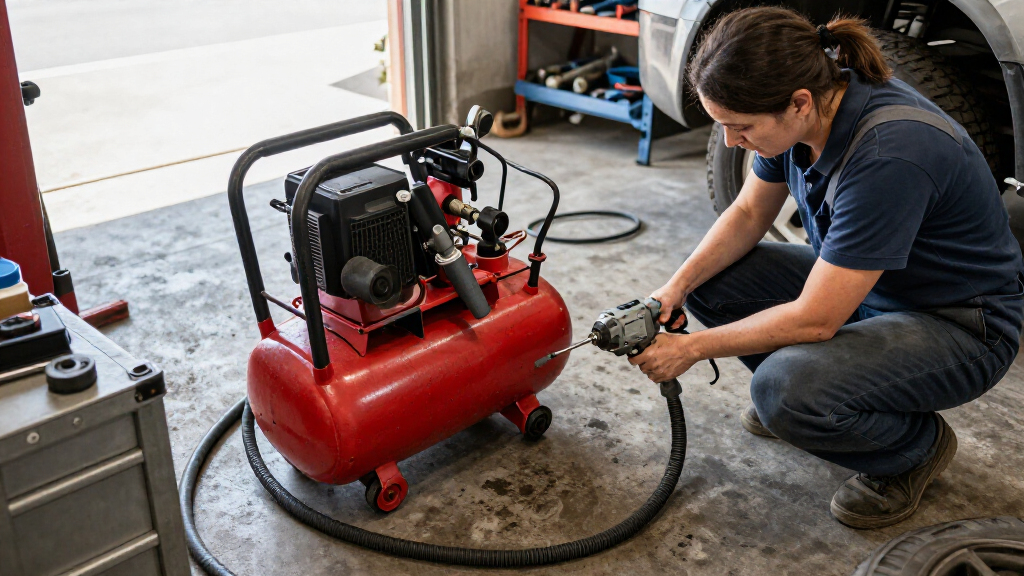
For a fixed workshop running air hungry tools, I’d start with the Campbell Hausfeld 60-gallon, two-stage compressor; its 230V power and 175 PSI rating suit sustained shop work. The DEWALT 60-gallon stationary models are strong alternatives for buyers who want a large receiver, while the Klutch 29-gallon offers a more manageable 120V option with a stated 5.1 CFM at 90 PSI. The main tradeoff is between sustained airflow and shop space, electrical capacity, and mobility: a larger tank alone cannot make up for low delivered airflow. I’ve compared all 12 options by their stated specs, setup needs, and likely garage use. Read on for the full breakdown and a guide to matching a compressor to your tools.

Get business pricing on garage and car supplies
- Business-only prices and quantity discounts
- Tax-exempt purchasing
- Multiple users, one account, clear invoices
Complete the kit


Key Takeaways
- Stationary, two-stage capacity leads for sustained demand: Campbell Hausfeld’s 60-gallon, 230V, 175 PSI configuration is the clearest fit here for a shop with compatible wiring and air-hungry tools.
- Two 60-gallon DEWALT listings need careful spec checking: both offer stationary storage, but the available descriptions do not establish enough difference to rank one above the other on performance.
- The Klutch 29-gallon has a useful stated airflow figure: its 5.1 CFM at 90 PSI gives buyers a concrete comparison point that several other listings lack.
- Oil-free mid-size tanks favor simpler upkeep: the VEVOR 20-gallon and Craftsman 20-gallon trade the long-run positioning of larger shop units for compact storage and less routine oil service.
- Portable labels do not mean easy to move: 25-, 27-, 29-, and 33-gallon models can still take substantial floor space and may be awkward to reposition in a crowded garage.
| DEWALT 60-Gallon Vertical Electric Stationary Air Compressor |  | Best Overall for a Dedicated Garage | Tank capacity: 60 gallons | Air delivery: 11.5 CFM at 90 PSI | Maximum pressure: 175 PSI | VIEW LATEST PRICE | See Our Full Breakdown |
| DEWALT 25-Gallon Vertical Portable Electric Air Compressor |  | Best for a 120 V Garage | Tank capacity: 25 gallons | Air delivery at 90 PSI: 6.2 CFM | Air delivery at 40 PSI: 7.7 CFM | VIEW LATEST PRICE | See Our Full Breakdown |
| DEWALT 27-Gallon Vertical Portable Air Compressor |  | Best for Lower-Maintenance Garage Use | Tank capacity: 27 gallons | Air delivery: 5.1 SCFM at 90 PSI | Maximum pressure: 200 bar (as listed) | VIEW LATEST PRICE | See Our Full Breakdown |
| Klutch 29-Gallon Air Compressor, 2.5 HP, 120V, 175 PSI, 5.1 CFM at 90 PSI |  | Best for Jobsite-Style Mobility | Tank capacity: 29 gallons | Air delivery: 5.1 CFM at 90 PSI | Maximum pressure: 175 PSI | VIEW LATEST PRICE | See Our Full Breakdown |
| Craftsman 33 Gallon Vertical Portable Air Compressor |  | Best for Larger Portable Tank Capacity | Tank capacity: 33 gallons | Air delivery: 5.1 CFM at 90 PSI | Maximum pressure: 175 PSI | VIEW LATEST PRICE | See Our Full Breakdown |
| VEVOR 13-Gallon Air Compressor, 2HP, 4.6 SCFM@90PSI |  | Best Quiet Portable Pick | Tank capacity: 13 gallons | Motor power: 2 HP | Airflow: 4.6 CFM at 90 PSI | VIEW LATEST PRICE | See Our Full Breakdown |
| VEVOR 20-Gallon Oil-Free Air Compressor, 2 HP |  | Best Larger Tank for Light-Duty Work | Tank capacity: 20 gallons | Motor power: 2 HP | Airflow: 4.5 CFM at 90 PSI | VIEW LATEST PRICE | See Our Full Breakdown |
| RyanTek 15-Gallon Oil-Free Air Compressor, 2 HP |  | Best Compact Vertical Pick | Tank capacity: 15 gallons | Motor power: 2 HP | Airflow: 4.5 CFM at 90 PSI | VIEW LATEST PRICE | See Our Full Breakdown |
| Makita MAC2400 2.5 HP Big Bore Air Compressor |  | Best Durable Portable Pick | Motor power: 2.5 HP | Airflow: 4.2 CFM at 90 PSI | Maximum pressure: 130 PSI | VIEW LATEST PRICE | See Our Full Breakdown |
| DEWALT 60-Gallon 175 PSI Stationary Electric Air Compressor |  | Best for a High-Output Garage Shop | Tank capacity: 60 gallons | Airflow: 14.6 SCFM at 90 PSI | Maximum pressure: 175 PSI | VIEW LATEST PRICE | See Our Full Breakdown |
| Craftsman 20-Gallon Oil-Free Air Compressor, 1.8 HP, 175 PSI |  | Best for Low-Maintenance Home Workshops | Tank capacity: 20 gallons | Maximum pressure: 175 PSI | Motor power: 1.8 HP | VIEW LATEST PRICE | See Our Full Breakdown |
| Campbell Hausfeld 60-Gallon 2-Stage Air Compressor, 175 PSI, 230V |  | Best for Demanding Fixed Workshops | Tank capacity: 60 gallons | Maximum pressure: 175 PSI | Airflow at 90 PSI: 7.6 CFM | VIEW LATEST PRICE | See Our Full Breakdown |
| heavy duty garage air compressor | Tank capacity | Maximum pressure | Noise level | Motor power |
|---|---|---|---|---|
| DEWALT 60-Gallon Vertical Elec | 60 gallons | 175 PSI | 87 dB | 3.7 HP |
| DEWALT 25-Gallon Vertical Port | 25 gallons | 200 PSI | 79 dB | 2 HP |
| DEWALT 27-Gallon Vertical Port | 27 gallons | 200 bar (as listed) | 78 dB | 1.7 HP |
| Klutch 29-Gallon Air Compresso | 29 gallons | 175 PSI | 81 dB | 2.5 HP |
| Craftsman 33 Gallon Vertical P | 33 gallons | 175 PSI | 80 dB | — |
| VEVOR 13-Gallon Air Compressor | 13 gallons | 125 PSI | 66 dB | 2 HP |
| VEVOR 20-Gallon Oil-Free Air C | 20 gallons | 125 PSI | 70 dB | 2 HP |
| RyanTek 15-Gallon Oil-Free Air | 15 gallons | 125 PSI | 66 dB at 4 m | 2 HP |
| Makita MAC2400 2.5 HP Big Bore | 4.2 gallons | 130 PSI | 79 dB at 3 ft | 2.5 HP |
| DEWALT 60-Gallon 175 PSI Stati | 60 gallons | 175 PSI | 70 dB | 5 HP |
| Craftsman 20-Gallon Oil-Free A | 20 gallons | 175 PSI | 80 dB | 1.8 HP |
| Campbell Hausfeld 60-Gallon 2- | 60 gallons | 175 PSI | 65 dB | 3.7 HP |
More Details on Our Top Picks
DEWALT 60-Gallon Vertical Electric Stationary Air Compressor
The 60-gallon tank and 11.5 CFM at 90 PSI make this the strongest fit here for a garage running air-hungry tools for longer stretches. Its 3.7 HP motor and 175 PSI maximum give it more working headroom than the portable DEWALT 25-Gallon, which supplies 6.2 CFM at 90 PSI but is easier to move around. The spread-volt motor can run on 208 V or 230 V, useful when matching an existing shop supply. I’d choose this for a fixed workshop set up for serious pneumatic work, not a garage that needs to reclaim floor space after each job. At 200 pounds and 87 dB, it is heavy, loud, and stationary; plan for a suitable electrical circuit and a place where its operating noise is manageable.
Pros:- 11.5 CFM at 90 PSI supports higher-demand pneumatic tools.
- 60-gallon tank provides a larger reserve for sustained work.
- Spread-volt motor supports 208 V and 230 V supplies.
- Oil-lubricated pump and ASME-certified tank suit regular workshop use.
Cons:- At 200 pounds, it is not practical to relocate once installed.
- 87 dB operating noise may be intrusive in an attached or confined garage.
- Requires 208 V or 230 V power rather than a standard 120 V outlet.
Best for: Home mechanics or small-shop owners with 208 V or 230 V power who regularly run demanding pneumatic tools.
Not ideal for: Garage users who need a compressor they can move between work areas or who have only standard 120 V power.
- Tank capacity:60 gallons
- Air delivery:11.5 CFM at 90 PSI
- Maximum pressure:175 PSI
- Motor power:3.7 HP
- Voltage:208 V / 230 V
- Pump lubrication:Oil-lubricated
- Noise level:87 dB
- Weight:200 lb
Our verdict“Choose this fixed DEWALT for a properly powered garage where sustained airflow matters more than portability or low noise.”
DEWALT 25-Gallon Vertical Portable Electric Air Compressor
This DEWALT brings 6.2 CFM at 90 PSI and a 200 PSI maximum to a portable, 120 V format, making it a practical middle ground for garages without the wiring for a stationary compressor. Its belt drive and oil-lubed pump call for upkeep, but the airflow exceeds the 5.1 CFM at 90 PSI listed for the DEWALT 27-Gallon and Klutch 29-Gallon. That extra delivery can help when a tool draws air steadily. The tradeoff is that its 25-gallon tank holds less reserve than the larger Craftsman 33-Gallon, and its 79 dB operation is still audible. Pneumatic wheels help with workshop moves, though they do not make this a lightweight unit. I’d pick it when useful airflow and ordinary outlet compatibility matter more than oil-free convenience or a larger tank.
Pros:- Delivers 6.2 CFM at 90 PSI, more than the listed 5.1 CFM models in this batch.
- Runs on 120 V power for broader garage compatibility.
- Pneumatic wheels support moving it around a workshop.
- 200 PSI maximum pressure offers a higher stated ceiling than the 175 PSI models.
Cons:- Oil-lubed pump requires routine lubrication maintenance.
- 79 dB noise remains noticeable during indoor use.
- Its 25-gallon tank provides less reserve than the 33-gallon Craftsman.
Best for: Garage mechanics with 120 V power who want stronger listed airflow than the oil-free portable models provide.
Not ideal for: Buyers who want minimal pump maintenance, quieter operation, or a fixed compressor for prolonged high-demand use.
- Tank capacity:25 gallons
- Air delivery at 90 PSI:6.2 CFM
- Air delivery at 40 PSI:7.7 CFM
- Maximum pressure:200 PSI
- Motor power:2 HP
- Voltage:120 V
- Drive type:Belt drive
- Pump lubrication:Oil-lubed
- Noise level:79 dB
Our verdict“Choose this DEWALT if your garage has 120 V power and airflow is a higher priority than oil-free upkeep or tank size.”
DEWALT 27-Gallon Vertical Portable Air Compressor
The oil-free pump and 78 dB noise level make this DEWALT a more convenient choice for indoor garage work than the oil-lubed DEWALT 25-Gallon, which supplies more air but needs lubrication upkeep. It delivers 5.1 SCFM at 90 PSI from a 27-gallon tank, a useful combination for intermittent tool use, inflation, and general projects. Low-voltage easy start is a helpful feature when starting on 120 V power, though it does not turn this into a high-output stationary unit: the 60-gallon DEWALT supplies more than twice the listed airflow for sustained demand. At 136 pounds, it is still a heavy machine to lift or load, even with built-in wheels. I’d favor it when easier maintenance and comparatively quieter operation matter more than maximum airflow.
Pros:- Oil-free pump avoids routine oil lubrication.
- 78 dB rating is the quietest among the five products in this batch.
- Low-voltage easy start is suited to 120 V garage power.
- Built-in wheels and vertical form help with storage and repositioning.
Cons:- 5.1 SCFM at 90 PSI is below the DEWALT 25-Gallon’s 6.2 CFM rating.
- 136-pound weight makes lifting and loading difficult.
- Its airflow is far below the stationary 60-gallon DEWALT for sustained tool use.
Best for: DIY garage users who run tools intermittently and prefer an oil-free pump with quieter operation.
Not ideal for: Mechanics running air-hungry tools for long stretches or anyone who needs a light compressor to carry or lift.
- Tank capacity:27 gallons
- Air delivery:5.1 SCFM at 90 PSI
- Maximum pressure:200 bar (as listed)
- Motor power:1.7 HP
- Voltage:120 V
- Pump type:Oil-free
- Noise level:78 dB
- Weight:136 lb
Our verdict“Choose this model for regular garage projects when low maintenance and a quieter 120 V setup outweigh higher airflow.”
Klutch 29-Gallon Air Compressor, 2.5 HP, 120V, 175 PSI, 5.1 CFM at 90 PSI
With flat-free tires, a 29-gallon tank, and an oil-free pump, the Klutch suits buyers who want to roll a compressor between garage bays without dealing with tire upkeep or pump oil. Its 5.1 CFM at 90 PSI matches the DEWALT 27-Gallon’s listed output, while its 2.5 HP motor and 175 PSI ceiling give it a different balance than the DEWALT’s 200 PSI maximum. The tank is slightly larger than that DEWALT’s, but the Klutch is also louder at 81 dB. At 127 pounds, it is movable on its wheels but still awkward to lift into a vehicle or up steps. I’d rank it for relocation convenience and oil-free operation, rather than raw airflow: the DEWALT 25-Gallon remains the stronger choice when its higher 90 PSI delivery matters more.
Pros:- Flat-free tires avoid punctures during regular repositioning.
- Oil-free pump removes routine oil lubrication.
- 29-gallon tank is larger than the DEWALT 27-Gallon’s.
- 2.5 HP motor is specified for continuous-use demands.
Cons:- 5.1 CFM at 90 PSI is lower than the DEWALT 25-Gallon’s 6.2 CFM.
- 81 dB may be loud for indoor or attached-garage use.
- 127-pound weight still makes lifting and vehicle loading difficult.
Best for: Garage owners or contractors who roll a compressor between work areas and want an oil-free pump.
Not ideal for: Users who need the highest airflow in this group or expect quiet operation in an attached garage.
- Tank capacity:29 gallons
- Air delivery:5.1 CFM at 90 PSI
- Maximum pressure:175 PSI
- Motor power:2.5 HP
- Voltage:120 V
- Pump type:Oil-free
- Noise level:81 dB
- Weight:127 lb
- Dimensions:23.2 x 21.1 x 45.3 in
Our verdict“Choose the Klutch if you need an oil-free compressor that rolls easily around a workspace and can accept moderate airflow and noise.”
Craftsman 33 Gallon Vertical Portable Air Compressor
The 33-gallon tank is the largest among the portable compressors in this batch, giving the Craftsman more stored air than the Klutch 29-Gallon or DEWALT 27-Gallon before the pump needs to catch up. Its 5.1 CFM at 90 PSI is the same listed airflow as those two, so the extra capacity adds reserve rather than faster tool recovery. An oil-free pump, wheels, and a handle keep routine upkeep simple and make rolling it around a shop possible. The tradeoffs are substantial: at 154 pounds, it is heavier than both comparison models, and its 80 dB noise level sits between them. I’d choose it for a garage that values a larger portable tank for intermittent work, but skip it if frequent lifting or compact storage is part of the plan.
Pros:- 33-gallon tank offers more reserve than the other portable models in this batch.
- Oil-free pump needs no routine oil lubrication.
- 5.1 CFM at 90 PSI supports a range of common pneumatic tasks.
- Vertical design with wheels and handle aids storage and rolling.
Cons:- 154-pound weight makes lifting or loading especially difficult.
- 5.1 CFM output does not exceed the smaller Klutch or DEWALT 27-Gallon.
- 80 dB operating noise may be distracting in an attached garage.
Best for: Garage users who want a larger portable air reserve for intermittent nailing, bolting, cleaning, or inflation tasks.
Not ideal for: Buyers who need high sustained airflow, frequently carry a compressor, or have little room for storage.
- Tank capacity:33 gallons
- Air delivery:5.1 CFM at 90 PSI
- Maximum pressure:175 PSI
- Voltage:120 V
- Pump type:Oil-free
- Noise level:80 dB
- Weight:154 lb
- Dimensions:46 x 23 x 51 in
Our verdict“Choose the Craftsman when a larger portable tank matters more than easy lifting, compact storage, or extra airflow.”
VEVOR 13-Gallon Air Compressor, 2HP, 4.6 SCFM@90PSI
The VEVOR 13-gallon makes the most sense for garage owners who want a quieter, wheeled compressor for intermittent jobs. Its 4.6 CFM at 90 PSI is slightly higher than the VEVOR 20-Gallon’s 4.5 CFM, but the smaller tank means less stored air between pump cycles. That tradeoff favors moving between tire inflation, woodworking, and short spray-painting sessions over sustained air-tool work. The stated 66 dB operation is quieter than the 20-Gallon’s 70 dB rating, a practical advantage in an attached garage. Its 125 PSI ceiling also falls short of the DEWALT 60-Gallon’s 175 PSI, so I’d skip it for applications that need higher pressure or steady shop output. At 71 pounds, its wheels help with rolling, not lifting.
Pros:- 4.6 CFM at 90 PSI is slightly higher than the VEVOR 20-Gallon’s stated airflow.
- 66 dB noise rating is quieter than the VEVOR 20-Gallon’s 70 dB rating.
- Oil-free pump avoids routine oil changes.
- Wheels help move the compressor around a garage.
Cons:- 13-gallon tank provides less stored air than the VEVOR 20-Gallon.
- 125 PSI maximum pressure rules out some higher-pressure applications.
- At 71 pounds, it can be awkward to lift into a vehicle or up steps.
Best for: DIY garage owners who want a quieter, wheeled compressor for tire inflation, brief painting jobs, and woodworking tasks.
Not ideal for: Buyers running air tools for long stretches or needing pressure above 125 PSI; its smaller tank and pressure ceiling limit those jobs.
- Tank capacity:13 gallons
- Motor power:2 HP
- Airflow:4.6 CFM at 90 PSI
- Maximum pressure:125 PSI
- Noise level:66 dB
- Voltage:120 volts
- Weight:71 pounds
Our verdict“Choose this VEVOR for quieter, intermittent garage work where mobility matters more than tank capacity or sustained air delivery.”
VEVOR 20-Gallon Oil-Free Air Compressor, 2 HP
The VEVOR 20-Gallon gives light-duty garage users more stored air than the 13-gallon VEVOR, which can reduce how often the pump needs to refill during short jobs. Its 4.5 CFM at 90 PSI is close to the smaller VEVOR’s 4.6 CFM, though the larger tank does not mean a faster continuous supply. The oil-free motor keeps routine maintenance simple, while the pull handle and wheels help move its 90.8-pound frame across a workshop floor. At 70 dB, it is louder than the 13-gallon model’s stated 66 dB. This is still described for light-duty applications, so I’d choose the DEWALT 60-Gallon for a fixed shop that needs substantially more airflow, provided the shop has the required electrical supply.
Pros:- 20-gallon tank stores more air than the VEVOR 13-Gallon.
- Oil-free motor reduces routine maintenance.
- Pull handle and wheels support movement around a workshop.
- Powder-coated carbon-steel tank is specified for corrosion resistance.
Cons:- 4.5 CFM at 90 PSI is not a major airflow increase over the smaller VEVOR 13-Gallon.
- At 90.8 pounds, it is difficult to lift and reposition by hand.
- 70 dB rating is louder than the 13-gallon VEVOR’s stated 66 dB.
Best for: Garage DIYers who want a larger reserve for tire inflation, nailing, and occasional spray work, and can roll rather than lift the compressor.
Not ideal for: Users needing sustained high airflow for demanding shop tools or anyone who must carry a compressor up stairs; it is heavy and intended for light-duty work.
- Tank capacity:20 gallons
- Motor power:2 HP
- Airflow:4.5 CFM at 90 PSI
- Maximum pressure:125 PSI
- Noise level:70 dB
- Voltage:120 volts
- Weight:90.8 pounds
Our verdict“Pick this model for a bigger air reserve during light garage jobs, but move up to a stationary high-output compressor for sustained tool use.”
RyanTek 15-Gallon Oil-Free Air Compressor, 2 HP
The RyanTek 15-Gallon suits a garage where floor space matters but a small portable tank feels limiting. Its vertical layout uses a narrower footprint than a horizontal tank, and its 68.3-pound weight is lower than the VEVOR 20-Gallon’s 90.8 pounds. Air delivery is listed at 4.5 CFM at 90 PSI, matching that larger VEVOR on paper despite the smaller tank. That makes it a fit for intermittent nailing, drilling, inflation, and spraying rather than long runs with air-hungry tools. The oil-free twin-cylinder pump avoids oil changes, and the 66 dB rating is quieter than the VEVOR 20-Gallon’s 70 dB. Its 125 PSI maximum and corded 110 V supply still limit it beside the DEWALT 60-Gallon’s shop-scale output.
Pros:- Vertical tank design helps reduce the floor footprint.
- 4.5 CFM at 90 PSI matches the stated airflow of the larger VEVOR 20-Gallon.
- 66 dB noise rating is lower than the VEVOR 20-Gallon’s stated 70 dB.
- Oil-free twin-cylinder pump avoids oil changes.
Cons:- 15-gallon tank stores less air than the VEVOR 20-Gallon.
- 125 PSI maximum pressure is below the DEWALT 60-Gallon’s 175 PSI.
- At 68.3 pounds, it is portable by rolling but still cumbersome to lift.
Best for: Home garage owners with limited floor space who need a wheeled compressor for intermittent nailing, drilling, inflation, or spraying.
Not ideal for: Shop users running air-hungry tools continuously or buyers who need higher pressure; its 125 PSI ceiling and portable-class airflow are limiting.
- Tank capacity:15 gallons
- Motor power:2 HP
- Airflow:4.5 CFM at 90 PSI
- Maximum pressure:125 PSI
- Noise level:66 dB at 4 m
- Voltage:110 V
- Weight:68.3 pounds
Our verdict“Choose the RyanTek when compact vertical storage and light workshop versatility matter more than a large reserve or sustained output.”
Makita MAC2400 2.5 HP Big Bore Air Compressor
The Makita MAC2400 takes a different approach from the oil-free VEVOR and RyanTek models: its cast-iron, oil-lubricated Big Bore pump is built around durability and recovery, with maintenance needs that include checking and changing oil. It delivers 4.2 CFM at 90 PSI, slightly less than those models’ listed 4.5 to 4.6 CFM, and its 4.2-gallon twin-stack tank stores far less air than their 13- to 20-gallon tanks. That makes this a more compact choice for portable work where pump construction matters more than a large reserve. The 130 PSI maximum edges past the VEVOR models’ 125 PSI, but it is nowhere near the DEWALT 60-Gallon’s 175 PSI. At 77 pounds, its small tank does not make it easy to carry.
Pros:- Cast-iron Big Bore pump is specified for durability and faster recovery.
- 130 PSI maximum exceeds the 125 PSI ceiling of the VEVOR and RyanTek models.
- Four-pole motor runs at a stated 1,730 RPM.
- Twin-stack layout is more compact than the large vertical DEWALT 60-Gallon.
Cons:- Oil-lubricated pump requires more maintenance than the oil-free VEVOR and RyanTek models.
- 4.2-gallon tank stores much less air than the other portable compressors in this group.
- At 77 pounds, it remains heavy to carry despite its compact tank.
Best for: Mechanics and contractors who want a portable compressor with a cast-iron pump for repeated job-site or garage use and accept oil maintenance.
Not ideal for: Buyers who want an oil-free, low-maintenance unit or need a large tank reserve for extended air-tool use.
- Motor power:2.5 HP
- Airflow:4.2 CFM at 90 PSI
- Maximum pressure:130 PSI
- Tank capacity:4.2 gallons
- Noise level:79 dB at 3 ft
- Motor speed:1,730 RPM
- Weight:77 pounds
- Lubrication:Oil lubricated
Our verdict“Choose the MAC2400 for portable work where a durable cast-iron pump is the priority and a small tank and oil upkeep are acceptable.”
DEWALT 60-Gallon 175 PSI Stationary Electric Air Compressor
The DEWALT 60-Gallon is the clear shop-scale option in this group: its 14.6 SCFM at 90 PSI greatly exceeds the 4.2 to 4.6 CFM ratings of the portable VEVOR, RyanTek, and Makita models. That airflow and its 60-gallon tank are better suited to longer sessions with tools such as sanders, while the 175 PSI ceiling provides more pressure headroom than the portable models’ 125 to 130 PSI. The tradeoff is installation. This vertical compressor needs a 240 V supply and 30 A double-pole breaker, and no power cord is included, so it is a poor fit for a standard household outlet or a garage that needs a roll-away unit. Compared with the similar stationary DEWALT 60-Gallon in the roundup, its supplied data gives a specific airflow figure buyers can use to assess shop demands.
Pros:- 14.6 SCFM at 90 PSI substantially exceeds the portable models’ stated airflow.
- 60-gallon tank provides a large reserve for longer work sessions.
- 175 PSI maximum offers more pressure headroom than the portable options.
- Vertical stationary format keeps the tank footprint more contained than a horizontal layout.
Cons:- Requires a 240 V, 60 Hz supply and a 30 A double-pole breaker.
- Power cord is not included.
- Stationary design is unsuitable for buyers who need to move the compressor around.
Best for: Automotive and fabrication shop owners with a 240 V, 60 Hz supply who need substantial airflow for sustained tool use.
Not ideal for: Home DIYers with only a standard 120 V outlet, renters unable to install the required circuit, or anyone who needs a portable compressor.
- Tank capacity:60 gallons
- Airflow:14.6 SCFM at 90 PSI
- Maximum pressure:175 PSI
- Motor power:5 HP
- Voltage and supply:208–230 V motor; 240 V, 60 Hz supply required
- Recommended breaker:30 A double-pole
- Noise level:70 dB
- Power cord:Not included
Our verdict“Choose this DEWALT for a properly wired garage shop that needs far more airflow and reserve than portable compressors can provide.”
Craftsman 20-Gallon Oil-Free Air Compressor, 1.8 HP, 175 PSI
The Craftsman 20-gallon is a practical middle ground for garage owners who want a larger reserve than the smaller portable models without installing a stationary 230V unit. Its oil-free pump cuts routine pump upkeep, while the 120V connection suits many home workshops. At 4 SCFM at 90 PSI, it can support intermittent drilling, nailing, and inflation, though sustained air-hungry work will call for pauses. Compared with the Campbell Hausfeld 60-Gallon 2-Stage, it is easier to power and move, but supplies much less air and storage. The tradeoff is its substantial footprint for a portable compressor: at about 41 inches tall, it still needs a planned parking spot, and the 6-foot cord may limit outlet placement.
Pros:- 20-gallon tank provides a useful reserve for intermittent workshop tasks.
- Oil-free pump reduces routine maintenance needs.
- 120V corded power suits many home garage outlets.
- Includes two quick couplers and rubber wheels.
Cons:- 4 SCFM at 90 PSI limits sustained use of air-hungry tools.
- Large tank and 40.9-inch height require substantial storage space.
- Six-foot cord can restrict placement near an outlet.
Best for: Home garage owners who use nailers, drills, and inflation tools intermittently and want a 120V compressor with less pump maintenance.
Not ideal for: Shops running sanders or grinders for long stretches, or garages without room for a 20-gallon tank and its 41-inch height.
- Tank capacity:20 gallons
- Maximum pressure:175 PSI
- Motor power:1.8 HP
- Airflow at 90 PSI:4 SCFM
- Power:Corded electric, 120V
- Pump type:Oil-free
- Noise level:80 dB
- Dimensions:19.1 x 17.3 x 40.9 inches
Our verdict“Choose the Craftsman for varied, intermittent home garage work when 120V convenience and reduced pump upkeep matter more than sustained airflow.”
Campbell Hausfeld 60-Gallon 2-Stage Air Compressor, 175 PSI, 230V
For a garage set up around air tools, the Campbell Hausfeld 60-gallon offers the strongest stated airflow in this pair: 7.6 CFM at 90 PSI and a 175 PSI maximum. That larger reserve and two-stage cast-iron pump make it better suited than the Craftsman 20-gallon to repeated sanding, grinding, and spraying sessions. Its vertical tank stores substantial air while using less floor width than a horizontal tank, though the 77-inch height still needs clearance. The tradeoff is a fixed installation: this 255-pound compressor requires 230V power, so outlet availability and placement shape where it can go. Its oil-lubricated pump also calls for more upkeep than the Craftsman’s oil-free design.
Pros:- 7.6 CFM at 90 PSI supports a broader range of demanding pneumatic tools.
- 60-gallon tank provides substantial stored air for longer work sessions.
- Two-stage cast-iron pump is designed for durable workshop use.
- Vertical tank reduces floor width compared with a horizontal tank of similar capacity.
Cons:- Requires a 230V outlet, limiting installation options.
- At 255 pounds, it is not practical to move around a garage.
- Oil-lubricated pump requires more upkeep than the Craftsman’s oil-free pump.
Best for: Garage mechanics and workshop owners with a dedicated 230V circuit who regularly run sanding, grinding, or paint-spraying tools.
Not ideal for: Casual DIY users, renters, or anyone without 230V service, adequate ceiling clearance, and a fixed location for a 255-pound compressor.
- Tank capacity:60 gallons
- Maximum pressure:175 PSI
- Airflow at 90 PSI:7.6 CFM
- Motor power:3.7 HP
- Power:230V AC
- Pump type:Oil-lubricated, two-stage cast iron
- Noise level:65 dB
- Weight:255 lbs
- Dimensions:33 x 29 x 77 inches
Our verdict“Pick the Campbell Hausfeld for a permanent, 230V-equipped workshop that needs more sustained airflow than a portable 20-gallon compressor can provide.”
How We Picked
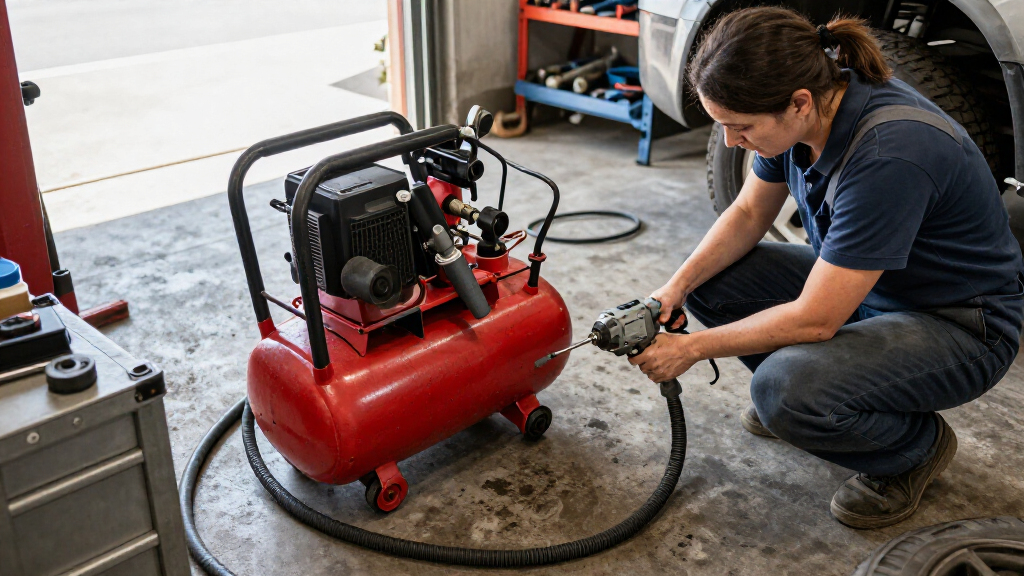
I ranked these compressors around the jobs a garage owner is likely to ask of them: how well the stated pressure and airflow support tools, whether electrical requirements fit a typical shop, how much capacity and floor space the machine demands, and how much routine maintenance its design implies. I gave more weight to clearly stated airflow at working pressure than to maximum PSI or tank size alone, since those figures better indicate whether a compressor can keep up during repeated tool use.
The order favors models with a stronger match for sustained garage work, then balances capacity against installation, upkeep, and portability. That puts the Campbell Hausfeld two-stage 60-gallon model first for a properly wired permanent shop, while the DEWALT 60-gallon units remain compelling large-tank alternatives. Mid-size portable models and oil-free units follow for buyers with tighter space, simpler power needs, or lighter duty cycles. Product descriptions do not provide comparable airflow figures for every model, so I avoid treating missing specifications as proof of equal performance.
Factors to Consider When Choosing Heavy Duty Garage Air Compressors
Choosing a garage compressor starts with the tools and work pattern, not the biggest tank you can fit. These broader checks can help prevent an expensive mismatch between compressor, electrical supply, and the tasks you actually do.
Match Delivered Airflow to Your Tools
Look up each tool’s air consumption at its working pressure, then compare it with compressor delivery at the same pressure. A tool used in short bursts may work with less reserve than a sander, grinder, or spray gun running continuously. If several tools may run together, add their demand rather than sizing for one tool in isolation. A tank stores air for temporary peaks, but it cannot sustain a tool indefinitely when the pump’s output falls short. Leave a margin for duty cycle and leaks instead of selecting a unit whose published output only just meets the tool label. When a listing omits CFM at a useful pressure, seek the manufacturer’s spec sheet before buying for demanding work.
Check Power Before Choosing a Stationary Unit
A large stationary compressor can call for a dedicated circuit or 230V supply, so confirm the motor’s voltage, amperage, and startup requirements before arranging delivery. A 120V label does not automatically mean the unit will work well on a long extension cord or a shared garage circuit. Have a qualified electrician check the installation if the panel or wiring is uncertain. Buyers often choose tank capacity first and discover too late that the intended location lacks the right electrical service. Factor in the space for a disconnect, ventilation, and access for maintenance. Power compatibility can narrow the shortlist faster than tank size.
Treat Tank Size as Reserve, Not Output
A larger receiver gives the pump more stored air and can reduce how often it cycles during intermittent tasks. It does not raise the compressor’s sustained CFM, so it will not turn a modest pump into a continuous-duty machine. For tire inflation and occasional nailer use, a smaller tank may be sufficient and easier to store. For long paint sessions or air tools that draw steadily, pump output and duty rating matter more than an impressive gallon figure. Consider how long your typical tool run lasts and how much recovery time you can tolerate between runs. This distinction prevents overbuying a bulky tank that still struggles with the tool you care about.
Plan the Installation Footprint and Noise
Measure the compressor’s full footprint and leave clearance around the pump, motor, drain, and service points. Vertical tanks save floor area, but the machine still needs a stable surface and a route through doors or around vehicles. Stationary units are best placed where vibration and sound will not dominate the work area; a remote location may require a longer air line and attention to pressure drop. Quiet-operation claims can be useful for a shared garage, yet compare the stated noise level and conditions rather than relying on the word “quiet.” Also plan where condensate will drain, since tank water needs regular removal. A layout decision made before purchase can save awkward repositioning later.
Weigh Maintenance Against Duty Cycle
Oil-free designs reduce the need for oil changes and can appeal to buyers who want simpler upkeep. Oil-lubricated pumps can suit heavier use, but they require the owner to follow the manufacturer’s checks and service intervals. Neither label alone establishes service life, so examine warranty terms, parts availability, and the specified duty cycle. A compressor that runs only occasionally faces different wear than one used every day for long sessions. Check whether filters, belts, and drain components are accessible without dismantling the installation. The best maintenance tradeoff depends on how often you will use the machine and whether you are willing to perform routine service.
Budget for the Full Air System
The compressor is only one part of a working setup: hoses, fittings, regulators, filters, and water separation can affect tool performance and air quality. Spray finishing may call for more careful moisture control than general inflation or impact work. Long, narrow hoses and restrictive couplers can reduce pressure at the tool even when the compressor is capable. Buyers should also account for delivery, anchoring, electrical work, and any air-line installation when comparing ownership costs. Paying more for a larger compressor makes sense when it supports a real workload or future tool plans, but not simply to maximize PSI. Choose accessories to match the most demanding tool and the quality of air it needs.
Frequently Asked Questions
Is a 60-gallon compressor necessary for a home garage?
Not for every garage. A large receiver makes more sense when you use air tools for extended periods, want less frequent cycling, and have room and power for a stationary installation. Occasional tire inflation, brad nailing, or short bursts from an impact wrench may be handled by a smaller unit if its delivered airflow meets the tool’s needs. A bigger tank cannot compensate for a pump that lacks sustained output. Start with your tools’ CFM requirements and typical run time, then decide whether the extra storage is useful.
Can a 120V compressor run an impact wrench or spray gun?
It depends on the tool’s airflow demand and how continuously you use it, not voltage alone. Compare the compressor’s CFM at the tool’s working PSI with the tool maker’s stated consumption. Short bursts from an impact wrench may be more forgiving than a spray gun used through a long finish coat. The Klutch listing provides 5.1 CFM at 90 PSI, while several other models here do not include a comparable figure in their descriptions. Confirm the full specification and circuit requirements before treating a 120V unit as suitable for a particular tool.
Will a larger tank let me use air tools for longer?
It can extend a short run by providing more stored air, but the pump still has to replenish that air. If a tool consumes air faster than the compressor delivers it, pressure will eventually fall during sustained use. A larger tank also takes longer to refill and can add bulk to the installation. For intermittent jobs, reserve capacity may be helpful; for continuous sanding or spraying, prioritize delivered CFM and duty rating. The tank and pump work together, so neither number tells the whole story.
Should I choose an oil-free compressor for easier ownership?
Oil-free models can simplify routine care because they remove oil checks and changes from the maintenance schedule. That can suit owners who use a compressor occasionally or prefer a straightforward setup. It does not mean the compressor needs no maintenance: drains, filters, and other service items still matter. For frequent, demanding use, compare the specified duty cycle, warranty, and parts support as well as lubrication type. In this lineup, the oil-free VEVOR and Craftsman options emphasize simpler upkeep, while the larger stationary machines are aimed at a different scale of work.
What should I check before installing a 230V stationary compressor?
Verify the exact voltage, amperage, breaker requirements, and startup load from the manufacturer’s documentation, then check that your panel and wiring can support them. Confirm the location has enough clearance, a stable floor, airflow, and room to reach the drain and service points. Plan how the compressor will be anchored and how air lines will reach the tools without excessive pressure loss. If you do not already have suitable electrical service, include an electrician’s work in the installation plan. For a 230V two-stage model such as the Campbell Hausfeld, those checks are part of deciding whether its shop capacity fits your garage.
Conclusion
For a permanent shop with compatible 230V service and sustained air demand, I’d choose the Campbell Hausfeld 60-gallon two-stage as the best overall and premium fit. The Klutch 29-gallon is my value pick for buyers who want a stated 5.1 CFM at 90 PSI in a more manageable 120V format. Beginners doing occasional inflation and lighter garage tasks should look first at a smaller, simpler unit such as the Craftsman 20-gallon oil-free, after confirming its airflow suits their tools. For buyers prioritizing lower routine upkeep in a compact footprint, the VEVOR 13-gallon oil-free is the specific-use choice, though its 125 PSI maximum does not by itself establish sustained tool capacity. If your priority is a large stationary tank from a familiar lineup, compare the two DEWALT 60-gallon listings against their full manufacturer specifications and your electrical setup before deciding.