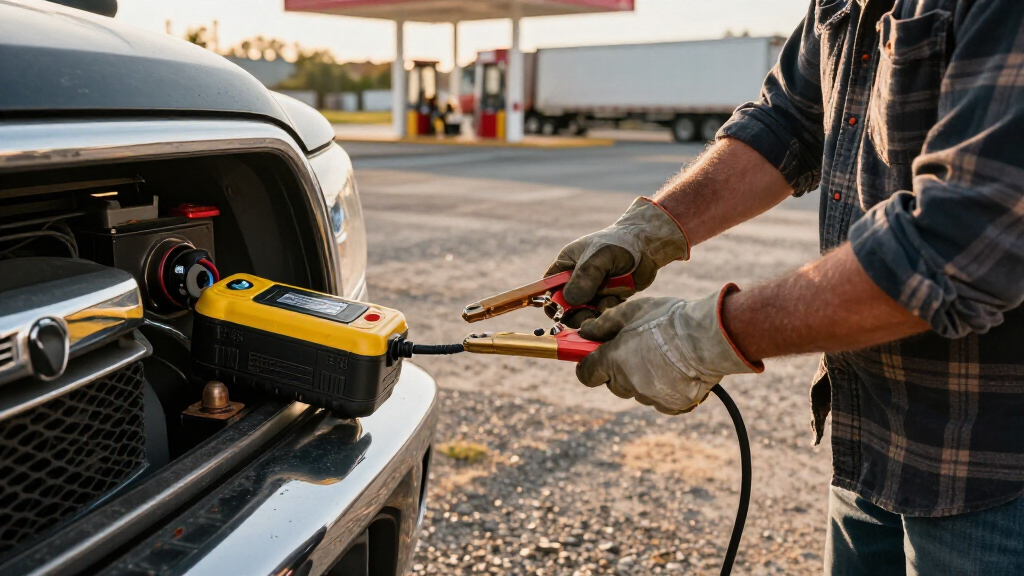

The right portable jump starter for trucks depends almost entirely on your engine: a gas half-ton is easy work for a 3000–4000A unit, while a cold diesel V8 or a semi demands serious cranking amps and a big battery bank. The GOOLOO GT Truck PRO 10000A stands out as the best overall pick for most truck owners thanks to its 64000mAh capacity and headroom for large diesel engines, while the ODUKAKO DM1264 and CAT797 12V/24V push into true commercial territory. The main tradeoff in this category is simple: raw power versus portability, with combo units adding built-in air compressors at the cost of size and jump capacity. Read on for the full breakdown of all 13 models.

Get business pricing on garage and car supplies
- Business-only prices and quantity discounts
- Tax-exempt purchasing
- Multiple users, one account, clear invoices
Complete the kit


Key Takeaways
- Peak amp ratings alone don’t tell the story — the 64000mAh battery banks in the GOOLOO GT Truck PRO and ODUKAKO DM1264 delivered far more real-world cranking endurance than smaller units with similar headline numbers.
- Built-in air compressors (ACMOUNT W160, GOOLOO A3, the 4500A combo unit) consistently trade away jump capacity and pack size; buyers should only pay that premium if they actually need roadside tire inflation.
- The 24V capability of the CAT797 is the only true path for semi trucks and heavy equipment in this lineup — every other unit here is 12V only, no matter how high the peak amps claim.
- 65W fast charging and USB-C power-bank output have become standard on mid-range and premium units (WOLFBOX, TREKURE, GOOLOO), making cheaper units without them feel dated.
- LCD displays showing remaining charge and output voltage separated the confident picks from the guessing-game units; an accurate charge gauge matters more on a truck starter that may sit unused for months.



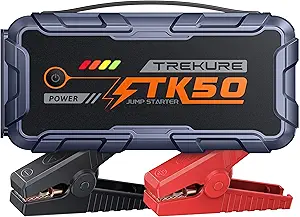

| portable jump starters for truck | Peak Current | Operating Temperature | Battery Capacity |
|---|---|---|---|
| WOLFBOX 4000A Jump Starter wit | 4000A | -4 to 140°F | 88.8Wh |
| OXILAM 6000A Jump Starter for | — | — | — |
| Car Battery Jump Starter with | — | — | — |
| GOOLOO GT Truck PRO 10000A Jum | — | — | — |
| TREKURE Beta04 8000A Car Batte | — | — | — |
| Povasee A30 5000A 12V Portable | 5000A | -22°F to 140°F | 74 Wh |
| ACMOUNT W160 5000A Jump Starte | 5000A | -4°F to 140°F | — |
| ODUKAKO DM1264 Heavy Duty Jump | 30000A | Down to -40°F | 64000 mAh (236.8 Wh) |
| GOOLOO A3 12V 3000A Portable J | 3000A | -4°F to 140°F | — |
| 7000A Jump Starter | 7000A | — | 8000 mAh |
| ZEVZO ET03 Car Jump Starter 40 | 4000A | 14°F to 140°F | 20,000mAh (74Wh) |
| TREKURE 8000A Car Battery Jump | 8000A | -4°F to 140°F | 26,800mAh |
| CAT797 12V/24V Heavy-Duty Lith | 30,000A | -40°F to 140°F | 64,000mAh |
More Details on Our Top Picks
WOLFBOX 4000A Jump Starter with 65W Quick Charger, LED Display, and LED Flashlight (MV24)
Most jump starters in this price territory force you to choose between amperage and convenience, but the WOLFBOX MV24 balances both. Its 4000A peak current covers up to 10L gas and diesel engines — enough for most half-ton and even three-quarter-ton pickup trucks — while the 1.3-hour full recharge outpaces the GOOLOO GT Truck PRO’s 3.7-hour cycle by a wide margin. That speed matters if you actually use this thing regularly rather than stashing it in a door pocket.
The tradeoff is headroom. Compared with the OXILAM 6000A, the MV24 gives up 2000A of cranking reserve, so owners of cold-soaked big-block diesels may want more margin. Still, the IP64 weather resistance and UL/FCC/CE certification give it a polish that cheaper generic boosters lack.
Pros:- Fast 1.3-hour recharge with included 65W PD charger
- Handles engines up to 10L gas and diesel
- IP64 rating plus UL, FCC, CE, and CA65 safety certifications
- Doubles as a 65W USB-C power bank with HD LCD display
Cons:- Only compatible with 12V vehicles
- Requires careful clamp polarity attention to avoid damage
- Less cranking reserve than higher-amp rivals like the OXILAM 6000A
Best for: Daily-driver truck owners who want a certified, fast-recharging unit for gas engines and mid-size diesels without paying premium prices
Not ideal for: Owners of 10L+ diesel trucks or commercial equipment — the 4000A rating leaves too little reserve in cold weather
- Peak Current:4000A
- Battery Capacity:88.8Wh
- Voltage:12V
- Engine Support:Up to 10L gas and diesel
- USB-C Port:65W Type-C in/out
- Full Charge Time:1.3 hours
- Operating Temperature:-4 to 140°F
- Safety Certifications:UL, FCC, CE, CA65
Our verdict“The smart middle-ground pick for truck owners who want certified safety and rapid recharging without paying for amp ratings they’ll never use.”
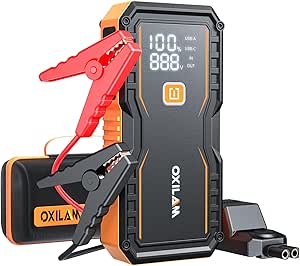
OXILAM 6000A Jump Starter for Gas and 12L Diesel Engines
The OXILAM 6000A earns its spot by stretching diesel coverage to 12L engines, which puts full-size diesel pickups and many medium-duty work trucks squarely in range. With up to 60 jumpstarts per charge, it outlasts most mid-tier rivals on endurance — you can leave it on a shop shelf through a busy season without babysitting the battery meter.
Where it trails the pack is convenience. The 10 intelligent safety protections are solid, but unlike the WOLFBOX MV24’s 1.3-hour recharge and 65W charging, the OXILAM tops out at 12V/1.5A input — expect multi-hour plug-in times. And the requirement of at least 50% charge before jumping means you can’t run it low powering phones and still count on it for a start.
Pros:- 6000A peak current covers all gas engines and 12L diesels
- Up to 60 jumpstarts per full charge
- 10 intelligent protections against shorts, reverse polarity, and sparks
- 800-lumen flashlight with 3 modes in a compact waterproof shell
Cons:- Requires minimum 50% charge to jump start a vehicle
- Must be recharged every 3 months when idle
- Slower input charging than 65W rivals like the WOLFBOX MV24
Best for: Diesel truck owners and fleet operators who prioritize maximum starting attempts per charge over charging speed
Not ideal for: Anyone who wants a set-and-forget glovebox unit — the mandatory recharge every 3 months makes it higher maintenance
Our verdict“A workhorse choice for diesel truck owners who need repeated jumpstarts per charge and can live with slower recharging and a strict maintenance schedule.”
Car Battery Jump Starter with Air Compressor, 4500A 150PSI Portable Jump Box with Tire Inflator, Jumper Cables and LED Light
For truck owners, a dead battery is only half the roadside story — the other half is a slow leak on a trailer tire. This 8-in-1 unit answers both problems in one case: 4500A of cranking power plus a built-in 150PSI air compressor with auto shut-off. The Force Start function can revive completely flat batteries, something the standard mode on the OXILAM 6000A won’t attempt.
The compromises are real, though. At 4500A it sits below the TREKURE Beta04’s 8000A, and the compressor adds bulk that pure jump-starter buyers won’t want to carry. The battery also needs to stay above 50% charge for jumping, and compressor sessions drain toward that threshold faster than you might expect. If your truck work involves tires — farm, towing, off-road — the trade is worth it; if not, a dedicated booster serves you better.
Pros:- 8-in-1 design combines jump starter, 150PSI inflator, power bank, and emergency light
- Force Start revives completely dead or low-voltage batteries
- Auto shut-off prevents over-inflation with 5 inflation modes and 4 nozzles
- Up to 24 months standby with 1000+ recharge cycles
Cons:- Battery must exceed 50% charge to jump start
- Requires recharging every 2-3 months in storage
- Not suited for extended high-temperature use
Best for: Towing, farm, and off-road truck owners who need both jump starting and tire inflation in a single roadside kit
Not ideal for: Buyers who only need a jump starter — the compressor adds size, weight, and battery drain you’ll never use
Our verdict“The only pick here that fixes a flat and a dead battery from the same box — ideal for truck owners whose emergencies rarely come one at a time.”
GOOLOO GT Truck PRO 10000A Jump Starter, 64000mAh with 65W Fast Charging
If this roundup has a ceiling-crasher, it’s the GOOLOO GT Truck PRO. The 10,000A peak output and eight automotive-grade LiFePO4 cells put it in a different class from the OXILAM 6000A or TREKURE Beta04 — this is the unit for large diesel trucks, construction machinery, and brutally cold mornings where lesser boosters stall. Up to 80 starts per charge means a fleet could work off one unit for weeks.
The LiFePO4 chemistry also brings longer cycle life and better thermal stability than the lithium polymer packs in cheaper models, and it works down to -40°C with a forced start mode. The cost: weight, size, and a 3.7-hour recharge that makes the WOLFBOX MV24’s 1.3-hour cycle look luxurious. It’s also 12V-only, so semi truck owners running 24V systems need to look at the CAT797 instead.
Pros:- 10000A peak current handles large trucks and construction machinery
- 64000mAh LiFePO4 pack supports up to 80 starts per charge
- 10-layer BMS with UL94 V0 and RoHS certifications
- Operates from -40°C to 60°C with cold-weather forced start
Cons:- 12V vehicles only — no 24V semi truck support
- Requires 75% or more charge (3 LEDs) before jump starting
- 3.7-hour recharge is slower than smaller rivals
Best for: Heavy-duty truck, equipment, and cold-climate operators who need maximum cranking power and start-count endurance
Not ideal for: Commuters with a gas sedan or small SUV — this is far more booster than a passenger car ever needs, at a size that fills a tool bag
Our verdict“The definitive pick for big-truck owners who refuse to gamble on amp ratings — just confirm you don’t need 24V capability before buying.”
TREKURE Beta04 8000A Car Battery Jump Starter with 27000mAh Power Bank, 65W Fast Charging, 160W DC Output, and LED Light
The TREKURE Beta04 is the roundup’s Swiss Army knife done right. Its 8000A output covers all gas engines and 12L diesels, but the standout is the 160W DC output — rare at this size — which runs 12V accessories like coolers, inverters, and work lights when a job site or campsite loses power. The 3.3-inch color display and 8 AWG cables give it a more professional feel than the budget-tier 4500A compressor unit.
Compared with the GOOLOO GT Truck PRO, you trade 2000A and LiFePO4 longevity for a lighter, more versatile package. Frustrations: no wall adapter in the box (you need your own 18W+ charger), and the Force Start mode demands a careful multi-step procedure for dead batteries that beginners may fumble. Like the OXILAM, it wants a top-up every three months.
Pros:- 8000A handles all gas and up to 12L diesel engines
- 160W DC output runs 12V accessories — rare in this class
- Rugged waterproof, dustproof, shockproof casing with 10-layer protection
- 65W USB-C fast charging and bright 4-mode 600-lumen light
Cons:- Wall adapter not included — needs a third-party 18W+ charger
- Force start mode requires a careful multi-step procedure
- Must be recharged every three months to maintain lifespan
Best for: Truck owners who split time between roadside duty and off-grid power needs — job sites, towing, overlanding
Not ideal for: Buyers who want a plug-and-play kit out of the box — the missing wall adapter and fiddly force-start procedure add friction
Our verdict“A premium all-rounder for diesel truck owners who want jump starting plus real accessory power — provided you can supply your own charger.”
Povasee A30 5000A 12V Portable Car Jump Starter
This option stands out as the value-focused choice for light-duty truck owners who want jump-starting muscle without paying for extras they won’t use. Its 5000A output covers up to 10L gasoline and 8L diesel engines, which handles most half-ton and three-quarter-ton pickups comfortably. Compared with the ACMOUNT W160, which costs more largely because of its built-in air compressor, the Povasee trades inflation capability for simplicity and a lighter 2.2 lb frame that stores easily in a door pocket or glovebox. The 60 starts per charge rating is generous for this class, and the 400-lumen light with SOS mode adds real roadside utility. The tradeoffs are honest ones: no AC adapter in the box, so buyers need to supply their own charger, and the USB-C port is input-only for charging the unit. For diesel trucks beyond 8L, the ODUKAKO DM1264 is the better fit.
Pros:- 5000A output handles up to 10L gas and 8L diesel engines
- Roughly 60 jump starts per charge with a 74Wh battery
- Lightweight 2.2 lb design with a protective carrying case
- Three-mode 400-lumen LED light including SOS for roadside emergencies
Cons:- No AC adapter included, so the unit needs a charger you already own
- No USB-C output — the Type-C port is only for recharging the unit
Best for: Owners of gasoline or light diesel pickups who want a compact, affordable jump starter for occasional dead-battery emergencies
Not ideal for: Owners of heavy diesel trucks or semi rigs — the 8L diesel ceiling and 12V-only design won’t crank big commercial engines
- Peak Current:5000A
- Voltage:12V
- Compatible Engines:Up to 10L gas / 8L diesel
- Starts Per Charge:About 60
- Battery Capacity:74 Wh
- USB Outputs:5V/2.4A and QC3.0 (5–12V)
- LED Light:400 lumens; flashlight, strobe, SOS
- Operating Temperature:-22°F to 140°F
- Weight:2.2 lbs
Our verdict“This pick makes the most sense for light-truck owners who want dependable jump-starting power and basic emergency features at the lowest complexity.”
ACMOUNT W160 5000A Jump Starter with 150PSI Air Compressor
For truck owners who understand that roadside emergencies are rarely just dead batteries, this model’s built-in 150PSI air compressor is the headline feature. The preset inflation modes with auto shut-off let you top off truck tires without babysitting a gauge, and the display shows real-time pressure alongside remaining battery power. Its 5000A cranking output matches the Povasee A30 on paper, but the W160 bundles tire duty into the same box, making it the more complete glovebox tool — at the cost of added bulk. Compared with the GOOLOO A3, which also inflates, the ACMOUNT offers slightly higher peak current and up to 60 starts per charge, though both require disciplined maintenance charging. The 10 built-in safety protections make spark-free connections the default. Drawbacks are practical: no power adapter ships in the box, the battery needs recharging every 2–3 months in storage, and reliable jumps demand at least 50% charge remaining.
Pros:- Built-in 150PSI compressor with preset modes and automatic shut-off
- 5000A output starts up to 9L gas and 8L diesel engines up to 60 times per charge
- Display screen shows both battery level and real-time tire pressure
- 10 safety protections for spark-free operation
Cons:- Charging adapter not included
- Requires recharging every 2–3 months when idle, and 50%+ charge for reliable starts
Best for: Daily-driver truck owners who want one device covering dead batteries and slow tires on the road
Not ideal for: Set-it-and-forget-it buyers — the 2–3 month recharge schedule and 50% minimum charge requirement demand regular attention
- Peak Current:5000A
- Max Air Pressure:150 PSI
- Voltage:12V
- Engine Compatibility:Up to 9L gas / 8L diesel
- Inflation Modes:Car, motorcycle, bicycle, basketball, custom
- Jump Starts Per Charge:Up to 60
- Operating Temperature:-4°F to 140°F
- Safety Features:10 built-in protections
- Warranty:1 year
Our verdict“This model is better suited to truck owners who see tires and batteries as equally likely roadside problems and want one tool for both.”
ODUKAKO DM1264 Heavy Duty Jump Starter for Semi Trucks, 12V 30000A Peak, 64000mAh
When the job is starting a Class 8 semi or a 50L V12/V24 engine, consumer-grade units simply aren’t in the conversation. This model’s 30,000A peak and 3,000A CCA put it in a different category from options like the 7000A booster elsewhere in this roundup, and its IP65 waterproof rating plus -40°F operation mean it survives the conditions commercial trucks actually face — job sites, northern winters, and open yards. The automatic battery diagnostics with error code display help identify battery faults rather than masking them, and 12-layer BMS protection with spark-proof clamps keeps high-current work safe. The tradeoffs come with that capacity: it is larger and heavier than consumer jump starters, the 236.8Wh battery demands maintenance discipline (long low-power storage can permanently damage it, and it needs recharging within 4 hours after use), and error-code interruptions can stall a jump if the clamps read a marginal connection.
Pros:- 30,000A peak / 3,000A CCA output for Class 8 semis and engines up to 50L
- IP65 waterproof/dustproof housing rated to -40°F
- Automatic battery diagnostics with error codes and LCD display
- Full accessory kit including AC adapter, cigarette lighter charger, and EVA case
Cons:- Long-term low-power storage over one month can permanently damage the battery
- Must be recharged within 4 hours after use; error codes may interrupt jumps
Best for: Fleet operators, owner-operators, and ranchers running semis, tractors, or heavy equipment who need commercial-grade cranking power
Not ideal for: Commuters with a single light-duty pickup — it’s oversized, heavier, and demands more battery care than a household jump starter
- Peak Current:30000A
- Cold Cranking Amps:3000A CCA
- Battery Capacity:64000 mAh (236.8 Wh)
- Voltage:12V
- Max Engine Size:Up to 50L (V12/V24)
- Jump Starts Per Charge:Up to 20
- Operating Temperature:Down to -40°F
- Warranty:5-year technical support
Our verdict“This is the pick when the vehicle being started is a commercial rig rather than a pickup — nothing else in this lineup cranks a 50L diesel.”
GOOLOO A3 12V 3000A Portable Jump Starter with Air Compressor
This option stands out as the most balanced do-everything unit for truck owners whose real-world needs skew toward convenience. Its 7-in-1 design — jump starter, tire inflator, power bank, flashlight, and pressure gauge — covers the two most common roadside failures without the bulk of a dedicated commercial unit. At 3000A with a BOOST mode for dead batteries, it handles gas engines to 9.0L and diesels to 6.5L, which trails the ACMOUNT W160’s 8L diesel ceiling and the Povasee A30’s ratings, but compensates with up to 8 car tires inflated per charge and 45 minutes of continuous pumping. The 1000+ charge-cycle rating also suggests a longer service life than most one-season emergency gadgets. The maintenance demands are its weak spot: it needs recharging at least every 3 months in storage, and both operating and charging are locked to specific temperature ranges, which limits winter reliability in cold climates.
Pros:- 7-in-1 design combining jump starter, 150 PSI inflator, power bank, flashlight, and pressure gauge
- BOOST mode for completely drained batteries
- Inflates up to 8 car tires per charge with 5 modes and 5 nozzles
- 10 safety protections with an 18-month warranty
Cons:- Requires recharging every 3 months during storage to maintain performance
- Cannot operate below -4°F or charge below 14°F, limiting deep-winter use
Best for: Households with a mix of trucks, cars, bikes, and trailers who want one device for batteries and tires in the trunk
Not ideal for: Heavy diesel truck owners or buyers in extreme-cold regions — the 6.5L diesel limit and -4°F floor are real constraints
- Peak Current:3000A
- Supported Engines:Up to 9.0L gas / 6.5L diesel
- Max Air Pressure:150 PSI
- Air Flow:35L/min
- Continuous Inflation Time:Up to 45 minutes per charge
- Operating Temperature:-4°F to 140°F
- Safety Features:10 protections
- Warranty:18 months
Our verdict“This pick makes the most sense for multi-vehicle families who value all-around roadside coverage over maximum cranking power.”
7000A Jump Starter – 12V Portable Car Battery Booster with 800 Lumen Flashlight
Sitting between the 5000A consumer units and the ODUKAKO’s commercial-grade output, this model carves out a sensible middle ground: 7000A peak current that covers all gas engines and diesels up to 12.0L, with a forced start button that works below 9V battery voltage — a feature the Povasee A30 and ACMOUNT W160 can’t match for deeply discharged batteries. That forced-start capability matters most for trucks that sit for weeks at a time. The 800-lumen three-mode light is the brightest in this batch, genuinely useful for nighttime roadside work, and 14 integrated safety protections exceed the 10 found on most rivals here. The compromises are real, though: the 8000mAh capacity means the USB ports, capped at 5V/2A, charge phones slowly and tablets more slowly still, and the 12.0L diesel ceiling rules out anything approaching commercial-duty engines — the ODUKAKO DM1264 is the answer there.
Pros:- 7000A peak current covers all gas engines and diesels up to 12.0L
- Forced start button enables ignition below 9V battery voltage
- 800-lumen LED with flashlight, strobe, and SOS modes
- 14 integrated safety protections
Cons:- USB output limited to 5V/2A, slow for larger devices
- May struggle with diesel engines larger than 12.0L
Best for: Owners of full-size diesel pickups up to 12L who want strong cranking power and a forced-start option for deeply drained batteries
Not ideal for: Anyone planning to use it as a primary power bank — the 8000mAh capacity and 5V/2A output charge devices slowly
- Peak Current:7000A
- Battery Type:Lithium Ion
- Battery Capacity:8000 mAh
- Voltage:12V
- Compatible Engines:All gas engines, diesel up to 12.0L
- Flashlight:800 lumens, 3 modes
- Safety Features:14 integrated protections
- Weight:2.2 lbs
- Warranty:24 months
Our verdict“This is the choice for full-size diesel truck owners who need forced-start capability and strong output but not semi-truck-class power.”
ZEVZO ET03 Car Jump Starter 4000A – 74Wh Portable 12V Jump Box
Not every truck owner needs a brick-sized booster in the glovebox, and that is exactly the gap the ZEVZO ET03 fills. At 1.4 pounds and roughly the size of a paperback, it is dramatically easier to stash than the GOOLOO GT Truck PRO or the CAT797, while still carrying enough 4000A peak current to turn over a 7.0L diesel. Compared with the TREKURE 8000A, it gives up roughly half the cranking power, but most half-ton and light-duty diesel trucks will never miss it. The tradeoff is real, though: lithium output sags in genuine cold, so buyers in northern climates may want the extra headroom a larger unit provides.
- Also works as a 74Wh power bank for phones and tablets
Pros:- Genuinely pocketable at 1.4 lbs with a storage case included
- 4000A handles gas engines to 8.0L and diesels to 7.0L
- Doubles as a 74Wh power bank with dual USB ports
- 500-lumen flashlight with SOS mode and 10 safety protections
Cons:- Cannot jump a completely dead 0V battery until recharged above 14V
- Cold-weather cranking performance falls short of larger units like the TREKURE 8000A
Best for: Daily drivers of gas trucks or smaller diesels who want a glovebox-sized emergency booster they will actually carry
Not ideal for: Cold-climate diesel owners or anyone with a fully drained 0V battery — it needs a recharge above 14V before it will jump a dead cell
- Peak Current:4000A
- Battery Capacity:20,000mAh (74Wh)
- Engine Compatibility:Up to 8.0L gas / 7.0L diesel
- Weight:1.4 lbs
- USB Output:2x 5V/2A
- Operating Temperature:14°F to 140°F
- Warranty:2 years
Our verdict“Buy this if you want a grab-and-go booster for a light-duty truck; skip it if you face sub-zero mornings with a big diesel.”
TREKURE 8000A Car Battery Jump Starter, 26800mAh Portable Power Bank
The TREKURE 8000A hits a sweet spot that the ZEVZO ET03 cannot reach: enough 8000A peak current to crank diesels up to 12L at a price and size well below commercial-grade units like the CAT797. For owner-operators of medium-duty trucks, this is the sensible middle rung on the ladder — noticeably more capable than the Povasee A30 or the standard 7000A boosters in this roundup, without the heft of a 30,000A flagship. The rugged shell (waterproof, dustproof, V-0 flame-retardant) also outclasses the compact picks here. The FORCE START function is the differentiator for stubborn, deeply discharged batteries, but it demands careful cable connection order, and the 18W USB port is modest next to the TREKURE Beta04’s 65W charging.
Pros:- 8000A peak current covers diesels up to 12L
- FORCE START mode for deeply discharged batteries
- Waterproof, dustproof, shock-resistant V-0 flame-retardant shell
- Operates down to -4°F with 800-lumen three-mode lighting
Cons:- Requires strict cable connection order to engage safely
- Only 18W USB charging, far slower than rivals with 65W output
Best for: Medium-duty diesel truck owners who want 12L-capable cranking power and a durable case without paying for a 30,000A flagship
Not ideal for: Buyers who want fast top-ups of laptops or gear — the 18W USB output lags well behind 65W-class competitors
- Peak Current:8000A
- Battery Capacity:26,800mAh
- Engine Compatibility:All gas engines; diesels up to 12L
- Operating Temperature:-4°F to 140°F
- USB Charging:18W
- Light Output:800 lumens, 3 modes
- Recharge Cycles:1000+
Our verdict“This is the smart pick for big-diesel work trucks when you need serious cranking amps but not a commercial 24V system.”
CAT797 12V/24V Heavy-Duty Lithium Jump Starter
When the job is a semi truck, bus, or piece of heavy equipment, a 12V-only booster is the wrong tool, and the CAT797 is built precisely for that reality. Its 30,000A peak current and automatic 12V/24V voltage detection put it in the same class as the ODUKAKO DM1264, but it goes further with a 2,000-lumen red-blue warning strobe — genuinely useful when you are roadside on a highway shoulder at night. The 64,000mAh power bank with 45W USB-C also makes it a jobsite charger, something the TREKURE 8000A cannot match. The tradeoffs are weight, cost, and a short 1-year warranty for a tool this expensive — plus the gasoline engine rating is inconsistent between the title and description, which is worth verifying before you rely on it.
Pros:- Dual 12V/24V support with automatic voltage detection
- 30,000A peak current rated for diesels up to 50L
- Massive 64,000mAh power bank with 45W USB-C output
- Rated from -40°F to 140°F with 2,000-lumen emergency lighting
Cons:- Only a 1-year limited warranty for a heavy-duty investment
- Listed gasoline engine capacity is inconsistent between title and description
- Far more bulk and cost than a typical pickup owner needs
Best for: Fleet operators and semi truck drivers who need one unit that handles both 12V and 24V systems in extreme conditions
Not ideal for: Light-duty truck owners — it is oversized, overpowered, and overpriced for a half-ton pickup, and the 1-year warranty is thin
- Peak Current:30,000A
- Voltage:12V / 24V with automatic detection
- Battery Capacity:64,000mAh
- Engine Support:Diesel up to 50L
- USB Output:45W USB-C / 18W USB-A
- Operating Temperature:-40°F to 140°F
- LED Light:2,000 lumens; steady, SOS, warning strobe
- Recharge Time:4 hours
- Warranty:1-year limited
Our verdict“If your fleet mixes 12V pickups with 24V semis or heavy equipment, this dual-voltage unit earns its spot — everyone else should buy something smaller.”
How We Picked
I ranked these jump starters around one question: can it reliably crank a truck engine, especially a diesel, in real conditions? That meant weighting peak and cranking amps against the size of the internal battery, checking each manufacturer’s stated engine-size limits (gas versus diesel liters), and favoring units with reverse-polarity protection, spark-proof clamps, and clear error indication. Units that sit in a truck cab for months between uses also earned credit for slow self-discharge protection, charge-state displays, and rugged casings.
Beyond raw starting power, I judged practicality: cold-weather performance claims, built-in flashlights, air compressor integration, USB power-bank output, and how heavy each unit is to actually carry. Value was assessed relative to capability — a budget unit that covers gas trucks honestly ranked above an overpriced unit chasing diesel buyers with insufficient amps. The ranking prioritizes power-to-purpose fit: light-duty boosters for gas engines, high-capacity units for diesels, and 24V-capable models reserved for commercial rigs.
Factors to Consider When Choosing Portable Jump Starters For Trucks
Before locking in a pick, it helps to understand what actually separates a truck-capable jump starter from a car unit, and where buyers most often go wrong. These are the factors I weighed hardest when ranking the 13 models above.Match Peak Amps to Your Engine, Not the Marketing
The single most common mistake is buying on the biggest amp number. Peak amps describe a brief surge, not sustained cranking — and diesel trucks need 10–30 seconds of continuous cranking on cold mornings, which drains the internal battery, not the amp rating. A 3000A unit is plenty for a gas V8, but a 6.7L diesel really wants 4000A or more backed by a battery bank of 20000mAh and up. Check the manufacturer’s stated engine limits for both gas and diesel, and treat diesel ratings as the honest ceiling. Also remember that lithium batteries lose cranking strength in freezing weather; a unit that’s marginal at 70°F may refuse to start your diesel at 20°F. Buying about 50% more capacity than you think you need is the cheapest insurance in this category.
12V Versus 24V: The Semi-Truck Question
If you drive a semi, heavy equipment, or any rig with two batteries wired in series, no amount of peak amps on a 12V unit will help — you need a true 24V-capable starter, like the CAT797 in this lineup. Attempting to jump a 24V system with a 12V unit is ineffective at best and can damage the electronics at worst. Conversely, 24V units are heavier, pricier, and overkill for pickup owners, so don’t pay that premium unless your electrical system demands it. Check your truck’s battery configuration before buying: two 12V batteries wired in parallel (common in diesels) still only need a 12V jump starter with high capacity. This is the one spec where guessing wrong means the product simply won’t work.
Is a Built-In Air Compressor Worth It?
Combo units with 150PSI compressors sound like a two-for-one deal, and for fleet drivers or off-roaders they genuinely are — a slow tire leak on a loaded truck is far more common than a dead battery. But the tradeoffs are real: the compressor adds bulk, weight, and cost, and combo units usually carry less battery capacity per dollar than dedicated jump starters. A 150PSI compressor is also adequate for topping off a pickup tire but slow and strained for large truck tires or anything above 60–70 PSI. If you run a work truck where flats and dead batteries are both plausible on the same job site, a combo makes sense. If your truck starts fine 364 days a year, put the money into more cranking capacity instead.
Standby Time and Charge Maintenance
A jump starter lives in your door pocket or toolbox for months between emergencies, and lithium cells self-discharge during that time. The best units hold a usable charge for 6–12 months; cheaper ones can bleed down to a level too low to crank a big engine within a season. That’s why I favored models with LCD charge gauges over vague LED bars — you can glance at it and know whether a top-up is due. Build a simple habit: check the gauge at every oil change and recharge when it drops below 70%. Also consider whether the unit charges via USB-C at 65W (fast, one cable for everything) or an old barrel charger (slow, easy to lose). Heat and cold both accelerate discharge, so storage location matters more than most buyers expect.
Safety Features That Aren’t Optional
Connecting clamps to a live system backwards is the most common way jump starts go wrong, and on modern trucks it can fry sensitive modules. A quality unit includes reverse-polarity protection, spark-proof clamps, short-circuit cutoff, and over-voltage protection — and these features vary more than any marketing would suggest. Look for clear indicators that tell you when protection has tripped rather than a silent failure. Heavy clamps with strong springs and long cables also matter more on trucks, where battery terminals are often buried and clamp reach is tight. Cheap units with thin-gauge cables can heat up under sustained diesel cranking. Safety features aren’t a premium upgrade here; they’re the floor.
Size, Weight, and Where You’ll Actually Store It
Capacity and portability pull in opposite directions: the 64000mAh units that crank big diesels are brick-sized and heavy, while pocketable 74Wh units barely cover a gas V6. Think about where the unit will live — under a truck seat, behind the cab, or in a toolbox — because a jump starter left at home protects nothing. Work-truck owners who also want a power bank for phones, laptops, and 12V accessories should weight capacity even higher, since a 27000–64000mAh unit doubles as jobsite power. Weekend drivers who only want peace of mind can accept a smaller unit and skip the extras. The right size is the one that’s actually in the truck when you need it.
Frequently Asked Questions
How many peak amps do I need to jump start a diesel truck?
For most diesel pickups — a 6.0L to 6.7L Power Stroke, Cummins, or Duramax — I’d recommend 4000A minimum with a 20000mAh-plus battery bank, and more if you regularly see freezing temperatures. Peak amps get the starter motor spinning, but sustained cranking endurance comes from the internal battery size, which is why two units with the same amp rating can behave very differently on a stubborn diesel. If you tow heavy, plow, or park outside in cold climates, stepping up to an 8000–10000A class unit buys real margin for a small price difference. For gas engines, anything from 3000A up is comfortable.
Can I use a regular car jump starter on my semi truck?
Not reliably, and sometimes not safely. Most semis run a 24V system built from two 12V batteries in series, and a 12V-only jump starter simply can’t generate the voltage needed to crank the engine — no amp rating changes that. You need a unit with a genuine 24V mode, like the CAT797 in this roundup. The one exception is a semi with a standard 12V setup, which some lighter-duty commercial trucks use; check your battery configuration before buying. Assuming all big trucks are 24V, or assuming none are, is the most expensive guess you can make in this category.
Are jump starter and air compressor combos any good for trucks?
They can be, if your tires and expectations match. The 150PSI compressors on units like the ACMOUNT W160 and GOOLOO A3 handle topping off pickup and trailer tires well, but they’re slow on large truck tires and will struggle with high-pressure commercial rubber. The honest tradeoff is capacity: combo units pack a compressor, motor, and hose alongside the battery, which usually means fewer amp-hours devoted to starting. For a work truck that sees both flats and dead batteries, that versatility wins. If starting power is your only real concern, a dedicated high-capacity unit gives you more cranking ability for the same money and size.
How long do portable jump starters hold a charge in a truck?
Quality lithium units typically retain a usable charge for six months to a year in moderate conditions, but truck cabs are not moderate — summer heat and winter cold both accelerate self-discharge and age the cells. A unit stored in a hot cab may need recharging every two or three months to stay cranking-ready, especially the high-capacity banks that diesel owners rely on. This is the strongest argument for models with a real LCD charge gauge: you can verify readiness at a glance instead of discovering a dead jump starter when you need it most. Build a habit of checking at every oil change and recharging below about 70%.
Can a portable jump starter damage my truck’s electronics?
A properly functioning modern unit is actually safer than jumper cables, because it delivers clean DC power through protected clamps with no alternator spike involved. The risk comes from units lacking reverse-polarity and short-circuit protection — hooking clamps backward on a truck full of sensitive modules can be costly. That’s why every pick I ranked highly includes full protection circuitry, and it’s the one place I’d never buy the cheapest option on the shelf. Follow the sequence in the manual (usually clamps on, wait for the ready indicator, then crank) and don’t crank for more than 10 seconds at a stretch. If the unit’s error indicator trips, stop and re-check connections rather than forcing it.
Conclusion
The right pick here maps cleanly to what you drive and how you use it. For most truck owners, the GOOLOO GT Truck PRO 10000A is the best overall choice — its 64000mAh bank covers big diesels with headroom and doubles as serious USB power. Best value goes to the Povasee A30 and the 7000A flashlight-equipped booster, which cover gas and light-duty diesel trucks without the premium price. At the top end, the ODUKAKO DM1264 is the premium pick for heavy-duty work trucks, and the CAT797 is the only real option for 24V semi and commercial systems.
For beginners who want simplicity, the ZEVZO ET03’s clear LCD and included case remove the guesswork, while the WOLFBOX MV24 suits drivers who want a polished all-rounder with fast USB-C charging. Specific needs round it out: the ACMOUNT W160 and GOOLOO A3 for combo jump-and-inflate duty, and the TREKURE models for buyers who want jobsite-grade power-bank output alongside starting capability. Whatever you choose, size the capacity to your actual engine, keep it charged, and keep it in the truck.
Fall Picks
fall essentials
As an affiliate, we earn on qualifying purchases.