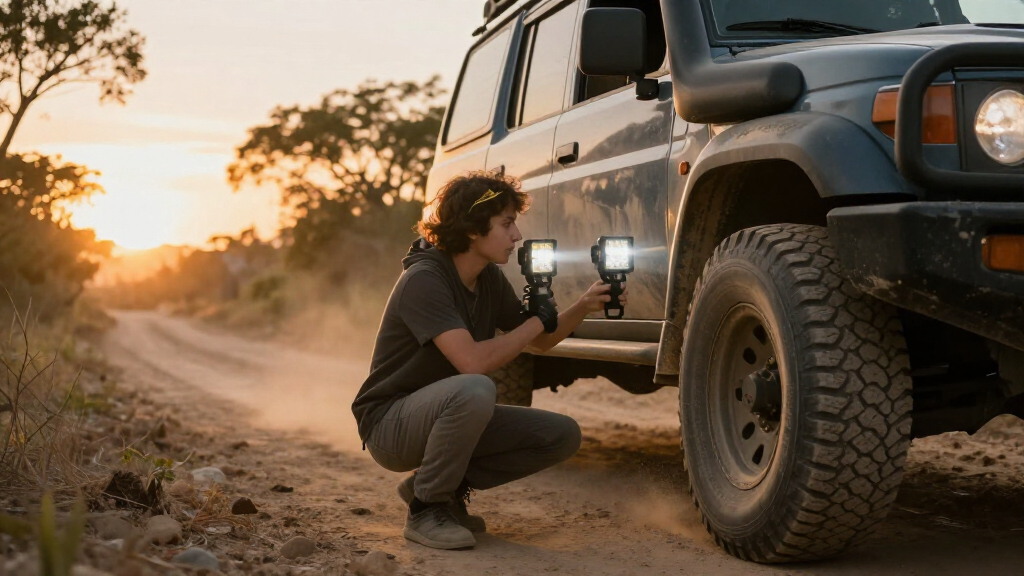
Choosing an off-road LED light bar is less about finding the brightest advertised number and more about deciding where you need light. A spot-beam bar throws a concentrated beam farther ahead; a flood-beam bar illuminates more of the trail’s width and nearby terrain. That distinction affects how early you can see an obstacle, how much of a tight bend or campsite you can see at once, and how useful the bar is at your usual speed.

Get business pricing on garage and car supplies
- Business-only prices and quantity discounts
- Tax-exempt purchasing
- Multiple users, one account, clear invoices

Nilight ZH409 20 Inch 420W Triple Row LED Light Bar with Wiring Harness
- ✔ Length: 20 inches
- ✔ Stated power: 420W
- ✔ Stated brightness: 42,000 lumens
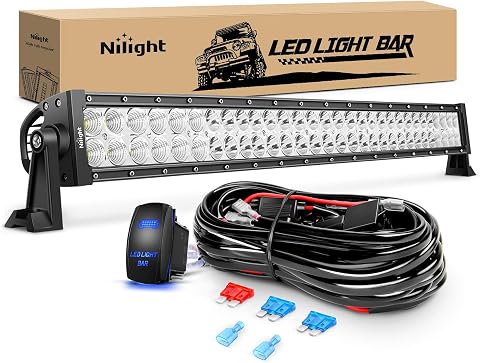
Nilight 32-Inch 180W LED Light Bar with Wiring Harness Kit, White
- ✔ Length: 32 inches
- ✔ Stated power: 180W
- ✔ Voltage: 12V

Nilight 20" 420W Triple Row LED Light Bar with 2x 4" 60W Cube Pods and Wiring Harness Kit
- ✔ Main bar length: 20 inches
- ✔ Main bar power: 420W
- ✔ Pods: Two 4-inch cube lights, 60W each
Neither pattern is universally better, and product quality, mounting position, regulations, and beam design all matter. Still, the core tradeoff is clear: reach versus spread. Choose spot for open routes and faster travel where distant hazards matter most; choose flood for slow, technical trails where rocks, ruts, and trail edges sit close to the vehicle. Drivers who need both may be better served by a combination-beam bar or a separate spot-and-flood setup.
At a Glance
| Criteria | Spot-beam LED light bars | Flood-beam LED light bars | Winner |
|---|---|---|---|
| Beam distance | Longer, more concentrated reach | Shorter useful reach | A |
| Beam width and nearby coverage | Narrower illuminated area | Broad coverage close to the vehicle | B |
| Best driving conditions | Open terrain and faster night driving | Slow trails, wooded routes, and work areas | Depends |
| Cornering and technical terrain | Less coverage to the sides at close range | Better view of trail edges and nearby obstacles | B |
| Glare and beam control | Focused beam, but can be intense straight ahead | Broad spill can light the surroundings but may reflect off dust or vegetation | Depends |
| Mounting and setup | Works well as a forward-facing roof or bumper light | Useful where wide forward coverage is needed; aim carefully | Tie |
| Value | Best value when distant visibility is the main need | Best value when lateral and close-range visibility matter | Depends |
Nilight ZH409 20 Inch 420W Triple Row LED Light Bar with Wiring Harness
The Nilight ZH409 is the most balanced standalone choice in this group: a 20-inch triple-row bar with a stated 420W output, a flood/spot combo beam, and a wiring harness in the package. That combination makes it a more straightforward pick than the 32-inch model for buyers who want a compact front-mounted bar, while avoiding the extra lights and wiring branches included with the bar-and-pod kit.Its listed 42,000-lumen output is a prominent specification, but we should not treat a claimed lumen figure as a guarantee of useful distance, beam uniformity, or performance on a particular trail. The combo beam is intended to balance forward reach with a broader spread; buyers who need to direct light to the sides may still prefer the separate cube pods in the third kit. The adjustable sliding bracket also gives more positioning flexibility than a fixed-fit assumption would, though the vehicle’s mounting points remain decisive.For rough-weather use, the ZH409 lists an IP67 rating and die-cast aluminum housing, and it includes a two-year warranty. Those details make its package more fully specified than the 32-inch listing, which does not provide an IP rating in the supplied data. The tradeoff is that this is still only one bar: it does not provide the multi-position lighting of the pod kit, and buyers should verify available space, wiring compatibility, and local rules before installation. The product information also does not establish long-term reliability independently, so we would avoid choosing it on lifespan claims alone.
Pros:
- 20-inch triple-row format with a stated flood/spot combo beam
- Includes a wiring harness and adjustable sliding mounting bracket
- Lists IP67 protection and die-cast aluminum housing
- Product information specifies a two-year warranty
Cons:
- No separate pods are included for additional mounting positions
- The stated lumen and lifespan figures are not independent performance verification
- Fit and wiring still need to be checked against the vehicle
Best for: Drivers who want one compact 20-inch combo-beam bar with a harness, adjustable bracket, and stated IP67 protection.
Not ideal for: Buyers who need a longer light span or want separate side-mounted pods for additional angled coverage.
Bottom line: We rank the ZH409 first for its well-specified, self-contained 20-inch package, though buyers needing wider placement options should choose the pod kit instead.
“We rank the ZH409 first for its well-specified, self-contained 20-inch package, though buyers needing wider placement options should choose the pod kit instead.”
Nilight 32-Inch 180W LED Light Bar with Wiring Harness Kit, White
Where the ZH409 prioritizes a compact 20-inch footprint and a stated combo beam, this 32-inch Nilight bar is the lineup’s choice for buyers with room to mount a longer light across a vehicle. Its defining advantage is physical span, not the highest stated power: the listing specifies 180W, compared with 420W for each of the other two bars. We should not infer actual illumination from wattage alone, but the difference is a useful reminder that a longer housing does not automatically mean a more powerful unit.The package includes a 12-foot wiring harness and 5-pin rocker switch, which gives buyers a defined starting point for routing and switching the light. Its stated 12V requirement makes it appropriate only where the vehicle’s electrical system and installation plan support that supply. The harness may help, but installation can still require technical skill, secure wiring, and suitable mounting brackets. Compared with the ZH409, the supplied details describe a sturdy side mounting bracket rather than an adjustable sliding bracket.The product is described as waterproof and dustproof, but the supplied specifications do not name an IP rating or housing material. That makes its environmental protection less specific on paper than the IP67-listed ZH409 and pod kit. This model makes the most sense when a longer, single-bar format is the priority; it is less compelling for buyers seeking a compact 20-inch fit, a stated 420W bar, or multiple lighting positions. We would also check the available mounting width and installation requirements before choosing it simply because it is longer.
Pros:
- 32-inch format suits vehicles with room for a longer single bar
- Includes a 12-foot wiring harness and 5-pin rocker switch
- Designed for 12V vehicle applications
- Described as waterproof and dustproof
Cons:
- Listed at 180W, unlike the 420W bars in the other two packages
- No IP rating or housing material is specified in the supplied details
- Installation may require technical skill and vehicle-specific mounting work
Best for: 12V vehicle owners with enough mounting width for a 32-inch bar who want the supplied harness and rocker switch.
Not ideal for: Buyers with limited mounting space, those seeking the stated 420W bars in this comparison, or anyone who needs separately positioned pods.
Bottom line: We recommend this model when a 32-inch mounting span matters more than a compact footprint or a package with separately mounted pods.
“We recommend this model when a 32-inch mounting span matters more than a compact footprint or a package with separately mounted pods.”
Nilight 20" 420W Triple Row LED Light Bar with 2x 4" 60W Cube Pods and Wiring Harness Kit
This kit is the most expansive package in the roundup: alongside a 20-inch, 420W triple-row bar, it includes two 4-inch, 60W cube pods and a 3-lead wiring harness with a 12-foot extension. That makes it a better fit than the ZH409 for buyers planning to place lights in more than one location. A bar can provide the main forward beam, while separate pods give the installer the option of adding light from other mounting points; the exact coverage depends on placement and aim.The main bar is described as a spot/flood combo, with a nest reflector cup design and side reflective plates. The package also lists IP67 protection and aluminum housing. Those details make it more completely described for a multi-light setup than the 32-inch option, whose supplied specifications omit a particular IP rating. Still, more included lighting also means more decisions: buyers need to plan mounting positions, wiring branches, switching, and electrical capacity rather than treating the extra pods as a guaranteed plug-and-play upgrade.Compared with the ZH409, this kit gives us more flexibility but less simplicity. Its bracket mount may require additional hardware for some vehicles, and the supplied 12-foot extension does not eliminate the need to check cable routing and connections. The listing also gives an unusual 1.5 A amperage figure without enough context to interpret it against the stated wattages, so we would confirm electrical requirements with the complete product documentation before installation. Choose this package for its included pods, not on the assumption that its claimed brightness or multi-angle illumination will suit every mounting arrangement.
Pros:
- Includes a 20-inch spot/flood combo bar and two 4-inch cube pods
- Supplies a 3-lead harness with a 12-foot extension
- Lists IP67 protection and aluminum housing
- Specified for a range of 12V vehicle types
Cons:
- Bracket mounting may require additional vehicle-specific hardware
- Multiple lights can make mounting and wiring more involved than the ZH409
- The supplied amperage figure needs clarification against the stated wattages
Best for: Off-road vehicle owners who want a 20-inch main bar plus two separate cube pods and can plan a multi-light installation.
Not ideal for: Drivers who want the simplest one-bar installation or lack suitable mounting points and wiring capacity for additional lights.
Bottom line: We choose this kit over the ZH409 when separate pods are worth the added installation planning and over the 32-inch bar when multi-position lighting matters more than span.
“We choose this kit over the ZH409 when separate pods are worth the added installation planning and over the 32-inch bar when multi-position lighting matters more than span.”
As an Amazon Associate we earn from qualifying purchases.
Key Differences
The beam pattern determines how light is distributed, not simply how much light the bar produces. A spot bar puts more of its output in a narrow forward zone, which can make distant features easier to pick out. That is useful on open tracks, desert routes, and long straight approaches. Its limitation is equally practical: a narrow beam may leave the sides of a close obstacle or a turning trail dimmer than you want.
A flood bar distributes light over a wider field, giving better awareness of trail edges, nearby rocks, and the ground beside the vehicle. This helps at low speeds, on tight trails, and when working around a parked vehicle. It cannot match a spot pattern’s concentrated reach, and broad light can bounce back from dust, fog, or nearby brush. If the route regularly shifts between distant sightlines and tight obstacles, a combo bar or separate lights may serve better than expecting one pattern to do everything.
In either case, judge the whole setup rather than a single brightness claim. Optics, beam cutoff, mounting height, aim, electrical installation, durability, and local road-use rules affect real-world usefulness. For most drivers, the right choice is the pattern that addresses the visibility problem they encounter most often—not the one with the most impressive specification in isolation.
Detailed Comparison
Beam distance (Spot-beam LED light bars wins — major)
Spot wins; the difference is major when distant visibility matters. Its concentrated output helps reveal terrain farther ahead on open routes, giving a driver more time to react at speed. A flood beam spreads its output across a wider area, so it generally gives up some reach. On slow, winding trails, that lost distance may not matter; on long, fast approaches, it can.
Beam width and nearby coverage (Flood-beam LED light bars wins — major)
Flood wins by a major margin for lateral and close-range coverage. A wide pattern makes trail edges, nearby obstacles, and the area around the vehicle easier to see at once. A spot beam can leave side areas comparatively dark, especially at close range. Drivers who spend most of their time on narrow, technical trails are more likely to benefit from flood coverage than extra distance.
Driving conditions (major difference)
The winner depends on route and speed. Spot is the stronger fit for open terrain where the driver needs to see a long way ahead. Flood makes more sense for low-speed travel through wooded or winding routes, where the useful view is broad and close. This is a major practical difference: the wrong pattern can leave the area where hazards actually appear poorly lit, even if the bar itself is powerful.
Cornering and technical terrain (Flood-beam LED light bars wins — moderate)
Flood wins by a moderate margin. A wider field helps reveal rocks, ruts, and trail edges beside the vehicle, particularly when negotiating tight turns slowly. A spot beam’s forward concentration is less helpful when the next hazard is off to one side. A well-aimed spot setup can still illuminate the route ahead, but it is less suited to providing broad awareness on technical ground.
Glare and beam control (moderate difference)
Neither wins in every setting; the difference is moderate. A spot beam concentrates light in one direction, which can create a harsh bright zone if it is aimed poorly. A flood beam spreads light wider, but light reflecting from dust, fog, or brush can reduce visibility and cause glare. Correct aiming and responsible use matter more than the label alone. These auxiliary lights may also be restricted on public roads, so check local rules and avoid dazzling other drivers.
Mounting and setup (minor difference)
Tie; the difference is usually minor. Both patterns can be mounted on a bumper, grille, or roof, provided the bar fits the vehicle and is installed securely with suitable wiring and protection. Mounting height and aim change where the light falls: a high bar may illuminate a longer forward view but can reflect more light in some conditions. Choose position based on the desired coverage, vehicle design, and legal restrictions, not beam pattern alone.
Value (moderate difference)
Depends on the use case; the difference is moderate. A spot bar is better value if the main problem is seeing farther down open tracks. A flood bar is better value if the driver repeatedly needs to see the trail’s sides and nearby ground. Paying extra for a combo pattern or higher-output model is worthwhile only if the added coverage solves a real need and the mounting and electrical setup support it. A bright but poorly matched beam is not good value.
Spot-beam LED light bars: Pros and Cons
Pros:
- Concentrates light for better long-range visibility
- Well suited to open terrain and long straight approaches
- Can help drivers spot distant features earlier
Cons:
- Narrower coverage can leave nearby side areas dark
- Less useful for seeing around tight turns and beside the vehicle
- A badly aimed beam can create an intense bright spot
Flood-beam LED light bars: Pros and Cons
Pros:
- Covers a wider area close to the vehicle
- Helps reveal trail edges and nearby obstacles
- A strong fit for slow, technical, or wooded routes
Cons:
- Does not concentrate light as far ahead as a spot pattern
- Wide spill may reflect off dust, fog, or vegetation
- Can provide less useful distance on open routes
Who Should Choose What
Choose Spot-beam LED light bars if:
- You drive open desert tracks, long access roads, or other routes where distant hazards matter.
- You travel at speeds where seeing farther ahead is more useful than broad close coverage.
- Your existing headlights already provide adequate side coverage and you want to add forward reach.
Choose Flood-beam LED light bars if:
- You crawl along narrow, wooded, or winding trails.
- You want a better view of rocks, ruts, and trail edges close to the vehicle.
- You use the bar for nearby work or visibility around a stationary vehicle.
Skip both if: Skip a single-pattern bar if your routes demand both strong long-range reach and wide close coverage; compare a combo-beam bar or separate spot and flood lights instead. Also skip either option if you cannot mount and wire it securely or use it legally.
Value for Money
Paying more makes sense only when the added optics, build quality, weather protection, or output improve the job the light must do. For a driver who regularly crosses open ground at night, spending more on a well-made spot bar can be worthwhile because useful reach is the point of the purchase. For someone crawling through tight trails, a similarly well-made flood bar may offer more usable visibility per dollar.
Do not pay a premium simply for a larger brightness claim or a longer bar. Confirm that the beam pattern matches your route, that the bar fits the vehicle, and that the electrical system and mounting hardware are appropriate. A combo bar can cost more and provide broader utility, but it is not automatically better: if you only need one kind of coverage, a quality single-pattern bar is often the better value.
Final Verdict
Choose a spot-beam LED light bar if your priority is seeing farther down open routes; choose a flood-beam bar if your priority is seeing more of the trail close to the vehicle. For most slow-speed technical off-roading, flood is the more practical single-bar choice because nearby edges and obstacles are often the main challenge. For open terrain and faster travel, spot is the clearer recommendation.
The biggest deciding factor is where hazards appear and how quickly you approach them. If your routes vary enough that neither pattern covers the job, buy a suitable combo or separate lights rather than expecting a single beam to excel at both. In all cases, careful aiming, secure installation, and compliance with local lighting rules matter as much as the pattern.
Frequently Asked Questions
Are spot or flood LED light bars better for off-roading?
Spot bars are better for long-distance visibility on open routes. Flood bars are better for broad, close-range coverage on technical or winding trails. The better choice depends on where you drive most.
Is a combo-beam light bar better than either pattern?
A combo bar can provide both forward reach and wider coverage, making it useful for mixed routes. It may cost more and may not deliver the same focused reach or broad spread as dedicated lights. Choose it when you genuinely need both patterns.
Does a brighter light bar always let you see farther?
No. Beam shape and optical design determine where light goes. A high-output flood bar can still have less useful long-range reach than a well-designed spot bar, while poor aim can undermine either pattern.
Can I use an off-road LED light bar on public roads?
Rules vary by location and vehicle. Auxiliary light bars may be restricted or required to be covered or switched off on public roads. Check the rules where you drive and aim the bar to avoid dazzling other road users.
Halloween Picks
halloween
As an affiliate, we earn on qualifying purchases.