
TL;DR

Get business pricing on garage and car supplies
- Business-only prices and quantity discounts
- Tax-exempt purchasing
- Multiple users, one account, clear invoices
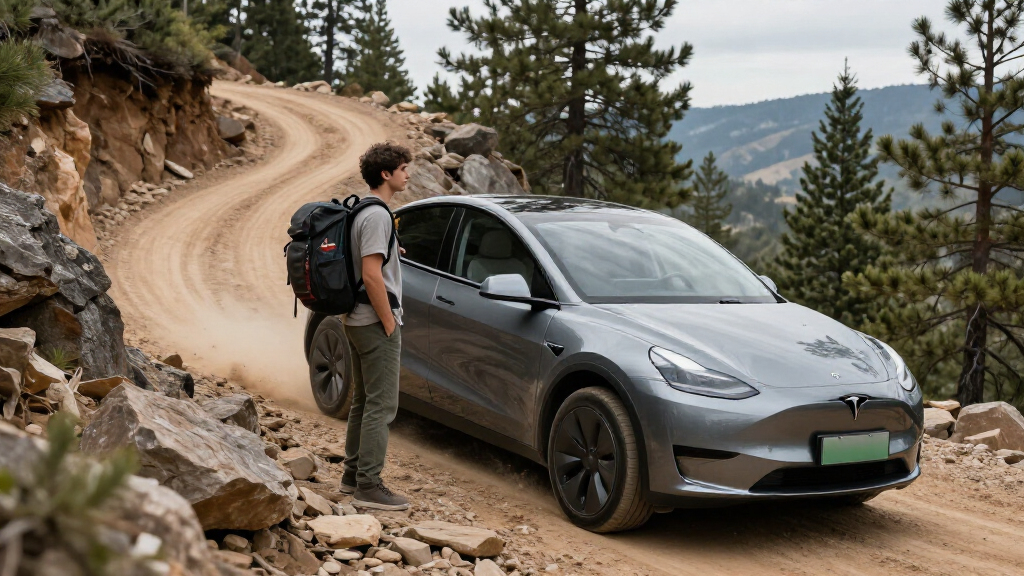
Tesla’s Full Self-Driving (FSD) system recently completed a challenging, steep dirt road in the US without human intervention. This marks a significant milestone in autonomous vehicle technology, though some uncertainties remain about its broader applicability.
Tesla’s Full Self-Driving (FSD) system has successfully navigated the steepest dirt road in the United States without human intervention, according to Tesla and independent testers. This achievement demonstrates the system’s advancing capabilities in complex, off-road environments, raising questions about the potential for autonomous vehicles to handle extreme terrains.
The test took place in late October 2023 on a notoriously challenging dirt trail in Colorado, known for its steep inclines and rugged terrain. Tesla’s FSD software was activated with a human passenger present, but no manual controls were used during the ascent. The vehicle, a Tesla Model S equipped with the latest FSD Beta, successfully climbed the entire route, including sections with grades exceeding 30%, which are typically considered difficult even for experienced off-road drivers.
According to Tesla, the vehicle used its onboard cameras, sensors, and AI algorithms to interpret the terrain, choose optimal paths, and adjust acceleration and braking accordingly. Tesla engineers and independent observers confirmed that the system managed obstacles such as loose gravel, uneven surfaces, and sharp inclines without intervention. Tesla CEO Elon Musk tweeted that this event “demonstrates the remarkable progress of FSD in real-world, off-road conditions,” though he emphasized that full autonomy in all terrains remains a work in progress.
Implications for Autonomous Off-Road Driving Capabilities
This development indicates that Tesla’s FSD technology is approaching the ability to handle complex off-road environments autonomously, a domain traditionally reserved for skilled human drivers. If proven reliable at scale, it could expand the scope of autonomous driving beyond paved roads, impacting industries such as outdoor recreation, emergency response, and remote vehicle deployment. However, experts caution that such tests are controlled and may not yet reflect everyday reliability in unpredictable terrains or adverse weather conditions.
As an affiliate, we earn on qualifying purchases.
Previous Milestones in Tesla’s Autonomous Driving Progress
Tesla has progressively rolled out its FSD Beta to select users since 2020, with ongoing updates aimed at increasing its capabilities. The system has demonstrated proficiency primarily on highways and urban streets, with occasional lapses requiring driver intervention. Off-road and extreme terrain navigation have traditionally been outside the scope of Tesla’s core testing but are increasingly being explored by the company and independent enthusiasts. This recent test marks a notable step beyond previous limits, which mostly involved paved roads and light off-road conditions.
Limitations and Reliability of Off-Road FSD
While the test was successful, it remains unclear how the system would perform across diverse terrains, weather conditions, or in less controlled environments. Tesla has not released extensive data on failure rates or edge cases, and independent experts warn that current FSD capabilities are still limited in unpredictable off-road scenarios. It is also uncertain whether the system can handle obstacles like fallen trees or deep mud without human oversight.
Next Steps for Testing and Deployment of Off-Road FSD
Tesla plans to conduct further tests in varied terrains and conditions, aiming to refine FSD’s robustness and safety in off-road environments. The company is also expected to gather more data from public beta users and possibly expand testing to include remote or autonomous off-road vehicle applications. Regulatory considerations and safety validations will play a key role in determining if such capabilities can be commercially deployed for consumers or specialized industries.
Key Questions
Can Tesla FSD fully replace human drivers on all terrains?
Currently, Tesla’s FSD cannot reliably replace human drivers in all terrains, especially unpredictable off-road environments. It is still under development and requires driver supervision, with full autonomy in all terrains not yet achieved.
What makes the steepest dirt road in America challenging for autonomous vehicles?
The steepest dirt roads feature grades exceeding 30%, loose gravel, uneven surfaces, and unpredictable obstacles, all of which pose significant challenges for autonomous systems designed primarily for paved roads.
How does Tesla’s FSD interpret off-road terrain?
FSD uses cameras, sensors, and AI algorithms to interpret terrain, identify obstacles, and decide on safe paths, but its effectiveness in unpredictable off-road conditions is still being tested and refined.
Yes, safety concerns include system failures in unpredictable terrains, inability to handle unforeseen obstacles, and limited testing data in extreme conditions. Regulations and safety standards are still evolving for such applications.
What are Tesla’s plans for expanding off-road autonomous testing?
Tesla intends to conduct more extensive testing across various terrains and conditions, aiming to improve system robustness before considering wider commercial deployment or regulatory approval.
Source: rss
Halloween Picks
halloween
As an affiliate, we earn on qualifying purchases.