TL;DR
Off-road builder Zeph Gage created a custom portal axle for the rear of his XJ Jeep using Humvee geared hubs, a Ford 9-inch axle housing and a differential flipped upside down. The reported build cost about one-fifth of a typical $20,000 commercial portal-axle set, but it required extensive custom fabrication and is not an off-the-shelf kit.
Off-road builder Zeph Gage has fitted a custom portal axle to the rear of his XJ Jeep, using Humvee geared hubs and a Ford 9-inch differential flipped upside down to reduce the cost of a setup that can add ground clearance. The project, shown in an Outdoor Auto video and reported by The Drive, is a one-off fabrication rather than a ready-made conversion kit.

Get business pricing on garage and car supplies
- Business-only prices and quantity discounts
- Tax-exempt purchasing
- Multiple users, one account, clear invoices
The build combines a Ford 9-inch axle housing, geared hubs from a Humvee and HMMWV portal adapters made by Jesse Haines Fabrication. The Drive reports that the parts and build cost about one-fifth of a typical $20,000 portal-axle set. That figure is presented as the cost of Gage’s project; the source does not give a detailed itemized budget or specify which expenses are included.
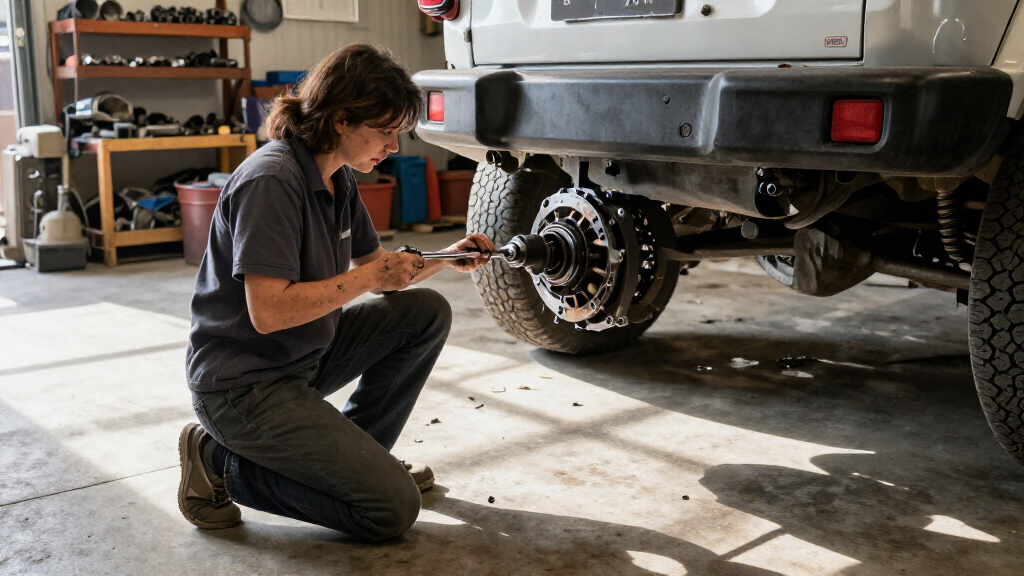
Portal axles use gearing at the wheel hubs to position the axle shafts higher than they would sit in a conventional axle. In Gage’s setup, the two-gear Humvee portals reverse the input rotation, so he turned the Ford differential upside down to make the driveline rotate in the required direction. A Yukon Gear and Axle third member is bolted to the housing, creating what the report describes as a budget high-pinion arrangement from low-pinion components.
The Drive says the modification provides about six inches of additional clearance while retaining full shock travel. The installation also required custom brackets and tapped plates, plus a two-piece brake rotor paired with a Ford Fusion caliper. Gage chose the Fusion hardware in part because it includes an integrated electric parking-brake mechanism and fits the available space.
A Lower-Cost Route to Rear Clearance
The build illustrates how a resourceful fabricator can adapt existing parts to address a familiar off-road problem: a vehicle’s underbody or axle can catch on obstacles even when the tires and front end can clear them. By raising the rear axle’s vulnerable components, Gage’s setup is intended to reduce the chance of the Jeep’s rear end hanging up after the front has passed an obstacle.
Its reported price also draws attention because commercial portal systems can be expensive. But the comparison does not mean the conversion is a straightforward bargain for most owners. The design depends on specialized parts, custom machining and fabrication, and the source offers no full accounting of labor, testing or long-term maintenance. The project is best understood as a demonstration of a particular engineering approach, not proof that a similar axle can be built cheaply or safely without comparable expertise.
Gage installed portals only at the rear. That choice avoids some of the packaging and suspension-travel constraints that can arise when converting the front axle, while keeping the vehicle’s overall stance more moderate than a four-corner portal setup might. It also means the front and rear driveline have to work together, including matching their gearing.
Products Worth Considering

DEWALT 20V MAX Cordless Drill and Impact Driver Combo Kit (DCK277D2)

NOCO Boost X GBX155 4250A 12V Lithium Jump Starter

NOCO Boost GBX45 1250A 12V Lithium Jump Starter
As an affiliate, we earn on qualifying purchases.
How the Upside-Down Differential Works
In a conventional axle, the differential and axle shafts sit below the vehicle’s frame line. Portal gearing moves the final drive reduction to each wheel hub, allowing the axle shafts to sit higher and creating additional room beneath the vehicle. The approach is used on some specialized off-road vehicles, but commercial systems are costly, according to The Drive.
Gage’s design takes advantage of the rotation change produced by the Humvee portal gears. Rather than use a different differential arrangement, he flipped the Ford 9-inch housing and its differential to make the input direction work with the portal hubs. The report says that this also creates a high-pinion effect from parts that would ordinarily be configured as low-pinion components.
Using portals only at the rear is not presented as a new idea in every vehicle category. The Drive compares the choice with a common approach in remote-control rock crawling, where builders may use different axle arrangements front and rear. For Gage’s full-size Jeep, the rear-only installation also avoids front-end fitment constraints. The project still required substantial vehicle-specific fabrication.
“A set of portal axles from companies like 74Weld costs about $20,000.”
— The Drive, describing typical commercial portal systems
Cost, Durability and Testing Details
The source does not provide an itemized cost breakdown, explain whether the reported figure includes labor, or state how the build’s price was calculated against commercial systems. It also does not provide extended-use results, independent testing or a detailed assessment of how the custom assembly performs under sustained loads.
The Drive characterizes the differential as likely to be highly robust, but that is an assessment, not a documented durability finding in the supplied material. The article does not report a confirmed service life, failure rate or independent verification of the build’s strength. It also does not give the front and rear gear ratios, although the Outdoor Auto video is identified as a source for more details on how Gage matched them.
The Build Video Shows More
The Outdoor Auto video, titled “Budget Portal Axles in Less Than 4 Days – Crazy,” is the cited source for the fabrication process and additional technical details, including how Gage matched the Jeep’s front and rear gearing. The supplied report does not identify a planned production run, commercial kit or follow-up test schedule.
For now, the development is a custom build rather than a product announcement. Further information about its real-world durability, final costs and performance over time would be needed before readers could judge whether the approach can be repeated beyond Gage’s Jeep.
Key Questions
What is a portal axle?
A portal axle places reduction gears at the wheel hubs, allowing the axle shafts to sit higher than in a conventional axle and increasing clearance beneath the vehicle.
What parts did Gage use?
The reported build uses a Ford 9-inch axle housing, Humvee geared hubs, Jesse Haines Fabrication HMMWV portal adapters and a Yukon Gear and Axle third member, alongside custom brackets and brake components.
Why did he flip the differential upside down?
The report says the Humvee portal gears reverse the input rotation. Gage flipped the differential so the driveline would rotate in the direction needed by the portal setup.
How much did the custom axle cost?
The Drive reports that the build cost about one-fifth of a typical $20,000 commercial portal-axle set. It does not provide a detailed budget or specify the full cost basis.
Can Jeep owners buy this as a kit?
Not according to the report. Gage’s setup is described as custom fabricated, with vehicle-specific brackets, plates and brake hardware; no off-the-shelf kit or production plan is identified.
Source: thedrive.com