TL;DR

Get business pricing on garage and car supplies
- Business-only prices and quantity discounts
- Tax-exempt purchasing
- Multiple users, one account, clear invoices
Rivian said its Adventure Network had 1,185 DC fast-charging ports at 165 U.S. stations in the third quarter of 2026. Port count rose 39% from a year earlier, while the station count increased 26%. Its slower Waypoint network remains much smaller and grew more slowly, according to Department of Energy data cited by InsideEVs.
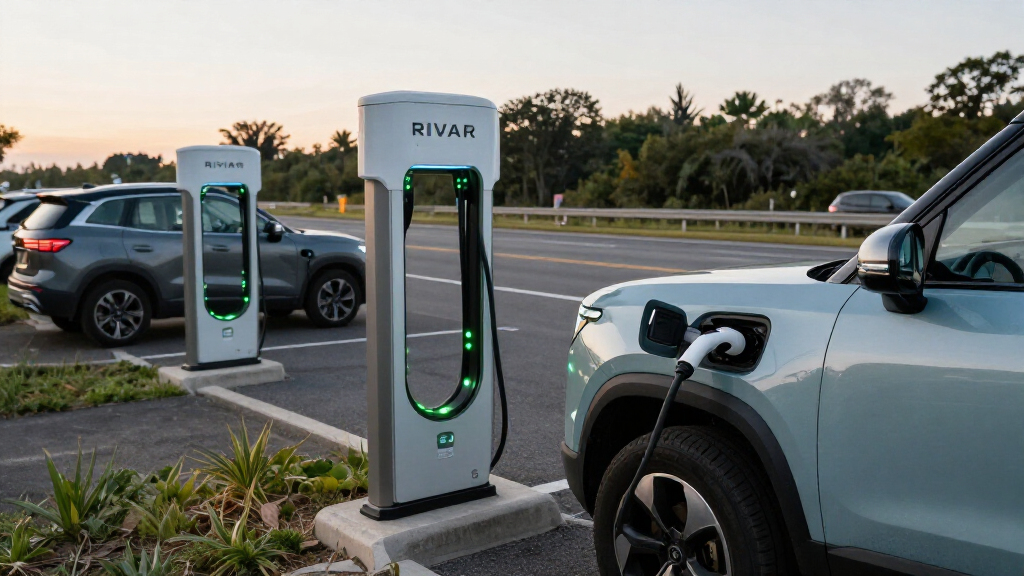
Rivian’s Adventure Network reached 1,185 DC fast-charging ports at 165 U.S. stations in the third quarter of 2026, the company said in its earnings report. The port count was 39% higher than a year earlier, giving Rivian owners more company-operated fast-charging locations as the automaker continues to build out its charging footprint.
The reported total refers to individual charging ports, not stations: Rivian said its network had 165 stations, up 26% from the end of Q3 2025. Its chargers can deliver up to 300 kilowatts, according to the company. The difference between the growth rates means the port count rose faster than the station count over the comparison period; the report does not specify how many ports were added at each site.
Rivian also says electricity delivered through Adventure Network chargers is matched with 100% renewable energy. As InsideEVs explains, that matching does not necessarily mean the electricity physically flowing from a specific charger comes directly from a nearby wind or solar facility. Renewable generation may be elsewhere, with energy use balanced through matching arrangements.
The slower Waypoint Level 2 network received no mention in the latest company documents discussed by InsideEVs. Department of Energy Alternative Fuels Data Center records cited in that report show Rivian installed 10 chargers rated at 11 kilowatts during the year, including two that came online in October. The report puts the overall Waypoint total at 540 chargers across 208 U.S. locations.
More Rivian Fast-Charging Sites
A larger proprietary network can give Rivian drivers more options for charging on longer trips, particularly at sites designed for the company’s vehicles. The increase also shows that Rivian is continuing to spend on charging infrastructure even though its passenger vehicles can use many other public DC fast chargers, including Tesla Superchargers equipped with the NACS standard.
The figures do not, by themselves, show how often Rivian stations are used, whether drivers can reliably find an available port, or whether the network is financially sustainable. Scale also remains a major limitation: InsideEVs reports that Tesla operates more than 40,000 U.S. fast-charging ports at nearly 3,300 locations. Rivian’s expansion is meaningful for its customers, but its footprint remains far smaller than that of the largest U.S. charging operator.
Products Worth Considering

DEWALT 20V MAX Cordless 1/2-Inch Impact Wrench Kit (DCF900P1)
Nextbase iQ 4K Smart HD Dash Cam Pro with 64GB microSD Card – Front and Rear View, 1440p, Smart Sense Parking, Emergency SOS, Roadwatch AI

Chemical Guys 14-Piece Arsenal Builder Car Wash Kit with Foam Blaster
As an affiliate, we earn on qualifying purchases.
Adventure Network Versus Waypoint
Rivian operates two types of branded charging infrastructure. The Adventure Network consists of DC fast chargers, intended to charge vehicles more quickly during travel. Waypoint chargers are Level 2 units that provide slower charging, often suited to places where vehicles remain parked longer. The latest reported growth is concentrated in the fast-charging network.
InsideEVs reported that Rivian’s Adventure Network crossed 1,000 ports as it expanded over the 12 months ending in Q3 2026. The company’s figures give the more precise current count: 1,185 ports at 165 stations. The same report describes Waypoint growth as much slower, based on federal station data, rather than a comparable growth figure supplied by Rivian.
“The network had 1,185 ports capable of delivering up to 300 kilowatts, up 39% compared with the third quarter of 2025.”
— Rivian, in its third-quarter 2026 earnings report, as described by InsideEVs
Usage And Network Economics
The published figures do not establish how many Adventure Network ports were newly opened during each quarter, how many are routinely available, or how much charging demand they serve. Rivian’s reported growth is a count of ports and stations, not a measure of utilization, uptime, customer satisfaction, or revenue.
It is also unclear from the cited materials how the company plans to expand the Waypoint network or whether it considers that slower growth temporary. The available Department of Energy data cited by InsideEVs records charger installations, but does not explain Rivian’s investment priorities. The renewable-energy statement is likewise a company claim about matching, not a site-by-site accounting of where power is generated.
Next Network Figures To Watch
Rivian’s next earnings update should show whether the Adventure Network continues to add ports and stations and whether the gap between those growth rates persists. Investors and drivers will also be looking for more information on charging use, availability, and the company’s infrastructure spending, none of which is detailed by the headline growth figures.
For Waypoint, future Department of Energy Alternative Fuels Data Center updates may offer a way to track new installations. Until Rivian provides further figures or strategy details, the 540-charger, 208-location total and the 10 installations cited for the year are the clearest available indicators of its slower Level 2 buildout.
Key Questions
How many Rivian Adventure Network chargers were reported?
Rivian reported 1,185 DC fast-charging ports at 165 U.S. stations in Q3 2026. A port is an individual charger connection; it is not the same as a station.
What does the 39% growth figure compare?
It compares the Adventure Network’s port count in Q3 2026 with its port count in Q3 2025. Rivian separately reported that stations increased 26% from the end of Q3 2025.
How fast can Rivian’s Adventure Network chargers deliver power?
The company says the network’s DC fast-charging ports can provide up to 300 kilowatts. Actual charging speed can depend on the vehicle and charging conditions; the cited figures do not report typical speeds.
Is Rivian’s Waypoint network growing at the same rate?
No comparable growth rate is given. InsideEVs cites Department of Energy data showing 10 new 11-kilowatt Waypoint chargers installed during the year and a total of 540 chargers at 208 U.S. locations.
Source: insideevs.com