
TL;DR

Get business pricing on garage and car supplies
- Business-only prices and quantity discounts
- Tax-exempt purchasing
- Multiple users, one account, clear invoices
Tesla engineering leaders described the Cybercab’s production process in a factory tour with Munro & Associates. The system builds and tests major sections separately, then joins them with much of the wiring and interior already installed; Tesla says the line is about 78% automated and can produce up to 125,000 vehicles a year.
Tesla has shown how it builds the Cybercab using an “unboxed” process: separate factory lines assemble and test major vehicle sections before robots join them near the end of production. In a video tour with engineering firm Munro & Associates, Tesla engineering chief Lars Moravy and Cybercab lead Eric Earley described a method intended to make components easier to reach and reduce the work done on a nearly completed car.
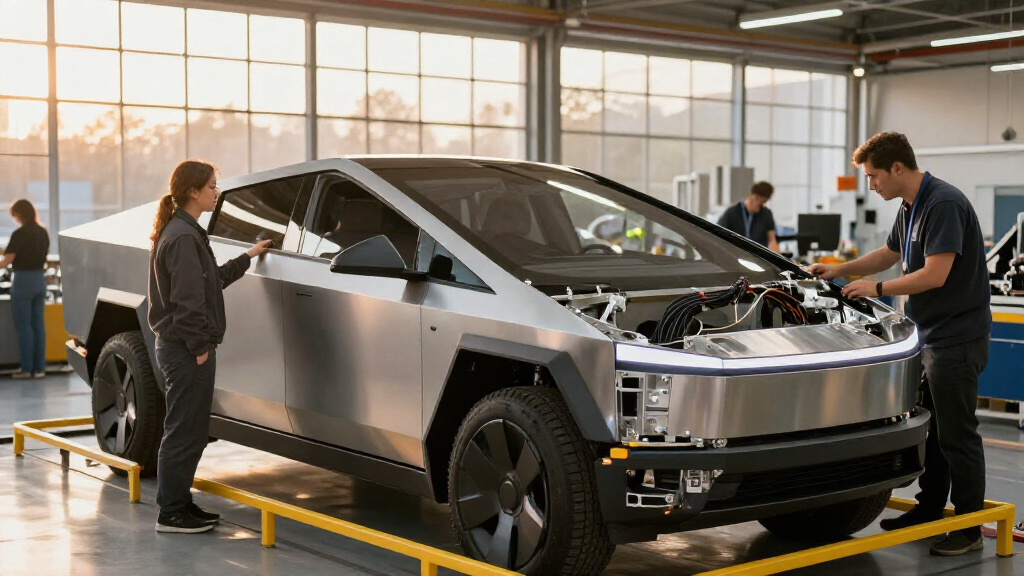
Rather than build a complete body, paint it and then install most systems along one long line, Tesla prepares the Cybercab’s front, rear, sides and floor as separate assemblies. The sections arrive at an automated framing line with wiring, hoses and other components already fitted. Robots position and join them; the vehicle then moves through a final line of about 25 stations.
The front module holds roughly half the vehicle’s parts and content, according to the report. Its drive unit, suspension and thermal hardware are placed on a positioning pallet, and the front structure—with the dashboard already installed—is lowered over them. Other tasks happen in parallel: side structures can be assembled flat, overhead components fitted at a comfortable height, and seats and carpet attached to the battery pack. The pack’s top cover also serves as the cabin floor.
Tesla says the line is about 78% automated. Moravy compared its final assembly with the Model Y’s, saying the Cybercab has about 25 stations against roughly five to 10 times that number for the Model Y. The wheels are fitted at the second-to-last station, and the car first stands on them as it rolls off the line near the end. Tesla says the production line is capable of making 125,000 vehicles per year; that is a stated capacity, not a report of current output.
A Different Route Through the Factory
The approach changes where assembly work happens. By fitting components to smaller sections before those sections meet, Tesla says workers and robots have better access than they would inside a nearly complete vehicle. That could reduce the need for long final-assembly sequences and allow factory stations to sit closer together. The production design matters because it is meant to make vehicle manufacturing faster and use less factory space, though the company’s description does not by itself establish how much time or cost the process saves in practice.
Skipping a conventional paint shop is another part of the layout. The Cybercab’s plastic exterior panels receive color during molding, instead of being painted after the body is assembled. Tesla says this avoids a paint-shop stage that would otherwise interrupt the separate-module flow. The company also says scratches can be repaired in a way similar to conventional paint, but the tour does not provide repair costs, durability comparisons or long-term results.
Products Worth Considering

Autel MaxiCOM MK900BT Bidirectional Automotive Diagnostic Scanner

Innova 5610 OBD2 Bidirectional Scan Tool

Autel MaxiCOM MK808S Bidirectional Automotive Diagnostic Scanner
As an affiliate, we earn on qualifying purchases.
From Unboxed Concept to Texas Line
Tesla has discussed its unboxed manufacturing concept for years. Moravy said in the video that work on the idea began about six years ago, after the company struggled to automate existing vehicle designs and concluded that the design itself was part of the problem. Breaking a car into smaller assemblies was meant to give production equipment more room to work and make each section easier to handle.
The Cybercab line puts that approach into practice at Tesla’s Texas factory. It also shares a broader manufacturing goal with Ford, which is developing a separate process it calls an “assembly tree” for its Universal Electric Vehicle platform. The two companies’ approaches are not described as identical; the comparison is that both seek alternatives to a conventional single-flow assembly line.
Testing is staged along with assembly. Tesla says components are checked before they become part of larger modules and are tested again afterward. The front module reaches the framing line with its computers connected and systems already checked, according to the company. This sequence is intended to help identify a faulty component before it is difficult to access inside the finished vehicle.
“The idea began about six years ago, when Tesla was stuck trying to automate existing designs and concluded the problem was the car.”
— Tesla engineering chief Lars Moravy, in the Munro & Associates video
Capacity Is Not Current Output
The tour does not give a current Cybercab production rate, factory utilization figure or independently verified cost and time savings. Tesla’s stated 125,000-vehicle annual capacity describes what the line can produce at full pace, not how many cars it is currently making. The report says the factory does not run every day because Tesla can produce Cybercabs faster than it is deploying them; the company did not provide operating schedules or deployment totals in the material provided.
Other open questions include how the molded exterior panels hold up over time and how their repair costs compare with painted panels. Tesla says scratches remain repairable, but the tour does not provide comparative testing. The video also does not establish whether the process will reach the stated capacity or how production will change as Cybercab deployment grows.
Production Depends on Deployment
The immediate marker to watch is whether Tesla increases Cybercab production and deployment enough to keep the Texas line running more often. The factory tour provides a look at the assembly system, but does not set a timeline for higher output or give a production ramp schedule. Tesla has described the line’s maximum capacity, while its real operating pace remains unclear.
Further information on actual output, deployment plans, factory uptime and vehicle repairs would help show how the process performs outside the design description. Until those figures are available, the unboxed method is a detailed account of how Tesla intends to build the Cybercab—not proof that its projected capacity or manufacturing benefits have been achieved.
Key Questions
What does Tesla mean by “unboxed” manufacturing?
It means building major sections—such as the front, rear, sides and floor—on separate lines, then joining them later rather than carrying one mostly assembled vehicle through every production step.
How many stations are on the Cybercab’s final assembly line?
Tesla’s factory-tour description puts the final line at about 25 stations. Moravy said the Model Y has roughly five to 10 times that number, though the report does not provide a precise Model Y count.
Does Tesla currently make 125,000 Cybercabs a year?
No. 125,000 vehicles per year is Tesla’s stated maximum capacity for the line at full pace. The material does not provide current annual output.
Why does the Cybercab not use a conventional paint shop?
Tesla says the Cybercab’s plastic exterior panels are colored during molding. That avoids a conventional paint-shop stage, which the company says would interrupt the unboxed production flow.
What remains unknown about the process?
Current production rates, factory utilization, verified cost savings and the long-term durability and repair costs of the molded panels have not been established in the material provided.
Source: insideevs.com