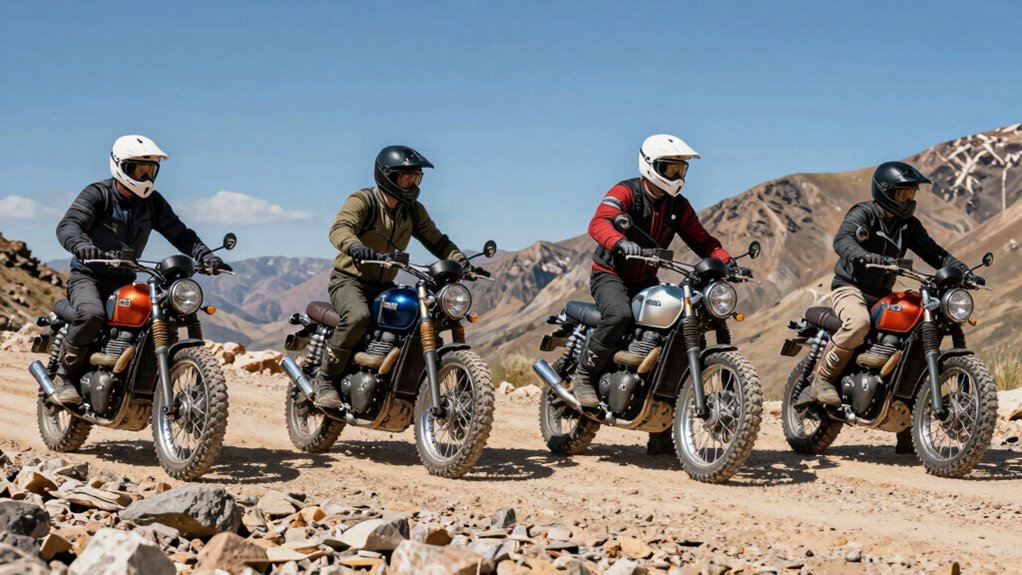
Triumph rider modes fine-tune your bike’s performance by adjusting throttle response, engine power, ABS, traction control, and suspension settings to suit off-road terrains like rocky, muddy, or loose trails. For example, off-road modes soften throttle and suspension, enhance traction, and loosen ABS thresholds for better control. Sport and Road modes boost power and responsiveness. Mastering these modes helps you optimize safety and handling, with details on how each setting impacts your ride clearly explained beyond basics.
Key Takeaways
- Triumph rider modes adjust throttle response, power delivery, ABS, and traction control to optimize off-road performance and safety.
- Modes like Off-Road soften suspension and damping, enhancing control over rocky or uneven terrains.
- Electronic controls modify engine mapping and intervention thresholds based on selected mode for better terrain handling.
- Suspension settings, including damping and ride height, are tailored per mode to improve traction and obstacle clearance.
- Mastering mode adjustments allows riders to improve traction, stability, and confidence across diverse off-road conditions.

CruzTOOLS RTTR2 RoadTech TR2 Tool Kit for Triumph Motorcycles , black
- CruzTOOLS RTTR2 RoadTech TR2 Tool Kit for Triumph…
As an affiliate, we earn on qualifying purchases.
As an affiliate, we earn on qualifying purchases.
What Are Triumph Rider Modes and How Do They Improve Off-Road Riding
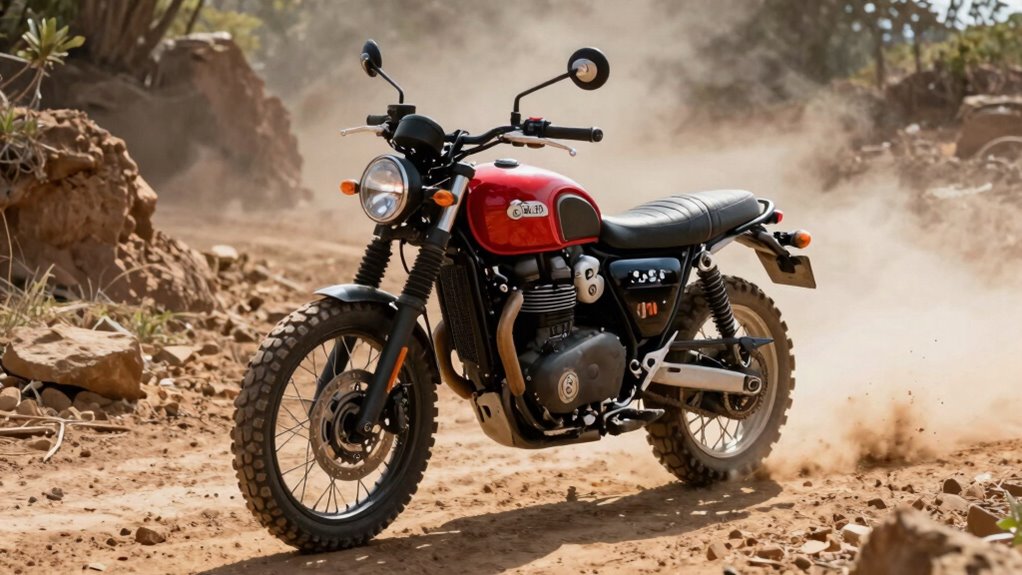
Triumph Rider Modes are electronically controlled settings that optimize motorcycle performance by adjusting parameters such as throttle response, ABS, traction control, and engine power delivery. These modes tailor the bike’s behavior to different riding conditions, enhancing off-road capability. When engaged, Rider Modes modify how the engine delivers power, ensuring smoother torque application over uneven terrain. They also calibrate ABS and traction control systems to prevent wheel slip, maintaining stability on loose or rugged surfaces. By fine-tuning these parameters, Rider Modes improve control and confidence, reducing rider fatigue during challenging off-road rides. Additionally, utilizing advanced rider assistance systems can further improve safety by providing real-time feedback and adaptive control adjustments. The precise adjustments enable you to adapt your motorcycle’s performance quickly, making it more responsive and manageable without sacrificing safety or efficiency on diverse terrains. Furthermore, integrating European cloud innovation can enhance data management and rider assistance systems, further supporting off-road riding safety and performance.
How Do Rider Modes Change Power Delivery and Throttle Response on Trails
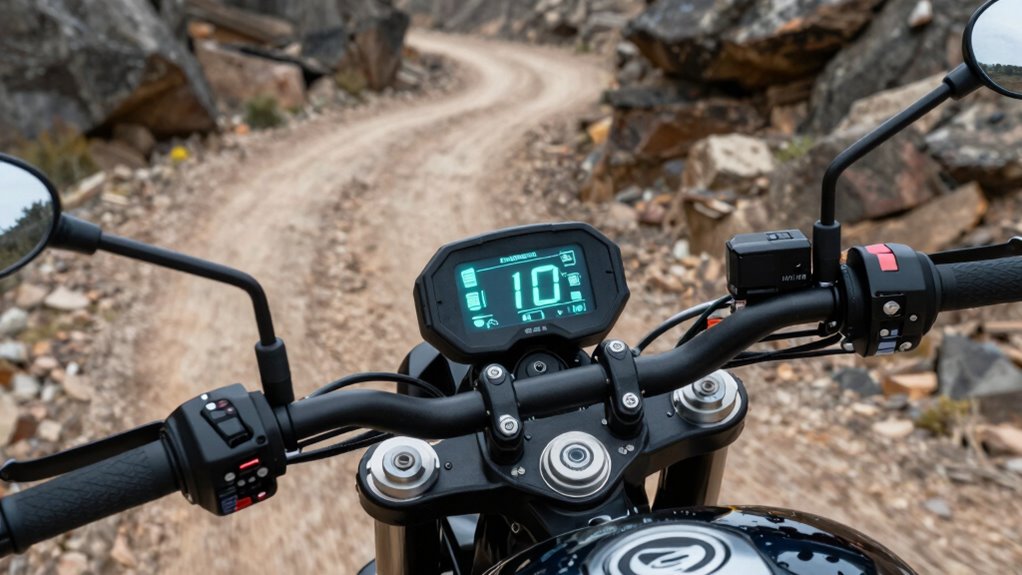
When engaging different Rider Modes on trails, the motorcycle’s power delivery and throttle response are precisely calibrated to match the riding conditions. In off-road settings, modes like Off-Road or Enduro typically soften throttle response, providing smoother, more predictable power application to enhance control over uneven terrain. Power delivery is restricted or reduced in some modes to prevent abrupt acceleration, aiding stability. Sport or Road modes offer more immediate throttle response with higher power output, suitable for smoother trail sections or advanced riders. Electronic control units adjust fuel mapping and ignition timing, optimizing torque delivery for each mode. This allows you to fine-tune your ride, ensuring consistent and manageable power flow, regardless of trail complexity or rider skill level. Rider Modes are specifically designed to optimize performance and safety in various riding environments, especially off-road.
How Do Rider Modes Affect ABS and Traction Control for Off-Road Safety
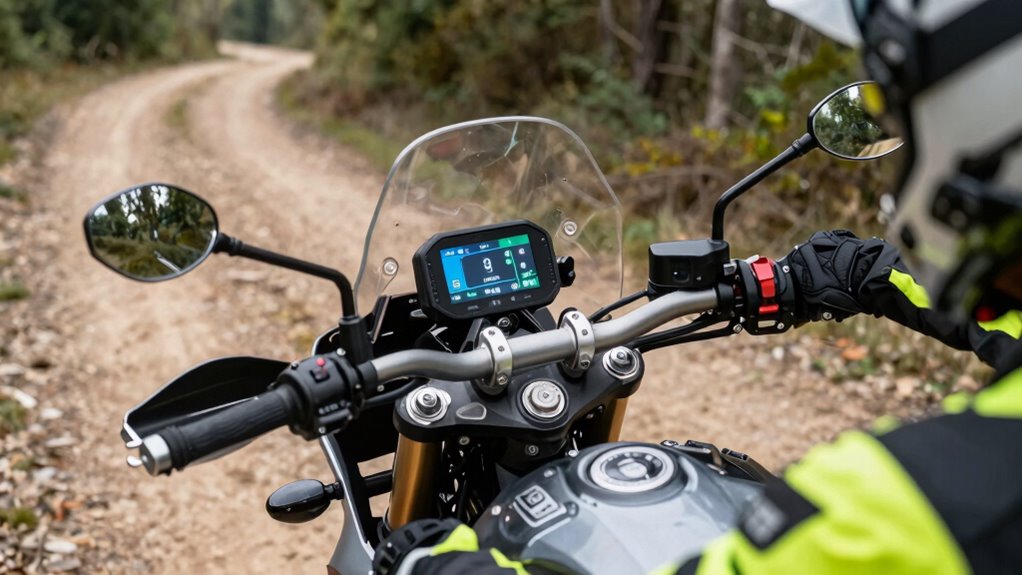
Rider modes directly influence the behavior of ABS and traction control systems to enhance off-road safety by adapting to varying terrain conditions. In off-road settings, modes typically reduce the intervention threshold, allowing for controlled wheel slip that improves traction on loose, uneven surfaces. For example, a gravel or off-road mode may partially disable or soften ABS to prevent abrupt wheel lockups, while traction control settings are adjusted to permit manageable wheel spin, aiding in obstacle navigation. These adjustments ensure ideal grip without compromising stability. By recalibrating sensor sensitivity and intervention levels, rider modes maintain traction and braking performance tailored to off-road challenges. Additionally, some advanced systems may incorporate market-specific features that optimize performance based on regional terrain types, further supporting rider confidence and safety. Understanding how these settings interact with different terrains can help riders choose the appropriate mode for various off-road adventures. Furthermore, sensor calibration plays a crucial role in ensuring these systems respond accurately across diverse conditions, contributing to a safer riding experience. Incorporating advanced software algorithms can further enhance responsiveness and adaptability in unpredictable environments.
How Do Rider Modes Adjust Suspension Settings for Different Terrains
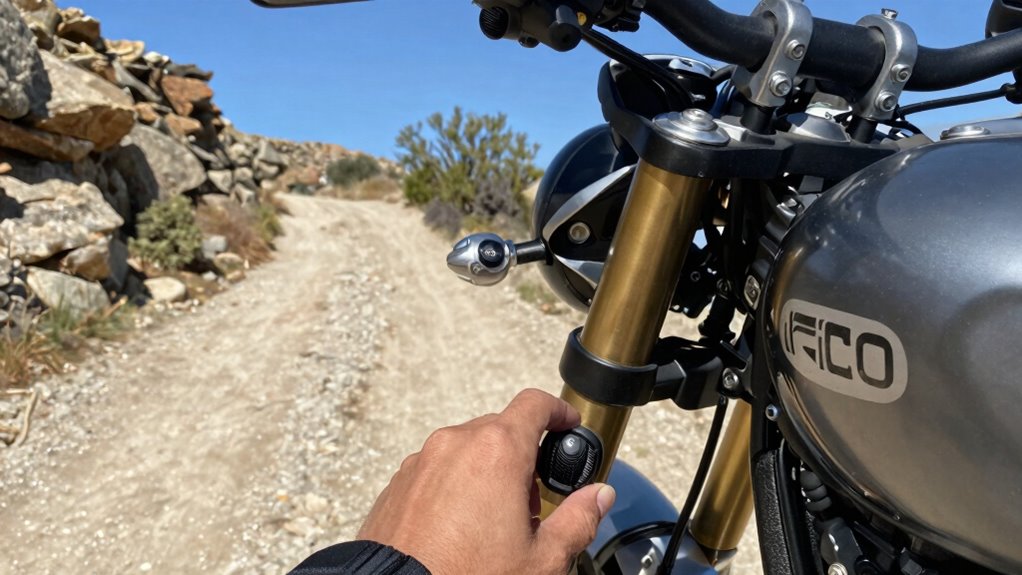
Rider modes modify suspension parameters such as damping adjustments, ride height, and compression and rebound settings to optimize performance on various terrains. These changes guarantee the suspension responds appropriately to differing surface conditions, enhancing stability and control. Understanding these adjustments helps you tailor your ride for maximum safety and comfort across diverse environments. Additionally, suspension hardware choices directly impact how effectively these settings translate into real-world handling. Being aware of how suspension tuning interacts with rider modes can further improve your off-road experience by allowing more precise customization.
Suspension Damping Adjustments
Adjusting suspension damping is essential for optimizing ride quality across different terrains, and rider modes facilitate these modifications automatically. They alter how quickly the suspension responds to bumps, ensuring stability and comfort. In off-road conditions, softer damping absorbs impacts, preventing harsh feedback. Conversely, firmer damping enhances control on smoother surfaces. Rider modes precisely adjust compression and rebound settings to match terrain demands. The following table illustrates typical damping adjustments:
| Mode | Compression Damping | Rebound Damping |
|---|---|---|
| Off-Road | Softer | Softer |
| Road | Moderate | Moderate |
| Sport | Firmer | Firmer |
| Rain | Softer | Softer |
These calibrations optimize suspension response, improving traction and rider confidence across varying terrains. Proper suspension tuning ensures the rider can adapt seamlessly to diverse off-road conditions.
Ride Height Variations
Different terrains require specific suspension ride heights to maximize handling and stability. Rider modes adjust ride height by modifying suspension preload and geometry, guaranteeing ideal contact patch and clearance. These adjustments typically include:
- Lower Ride Height: Improves stability on paved or smooth surfaces by lowering the center of gravity, enhancing cornering precision.
- Standard Ride Height: Balances ground clearance and stability for mixed terrains, providing versatile handling.
- Increased Ride Height: Raises the chassis for off-road conditions, improving obstacle clearance and traction on uneven surfaces.
These modifications are achieved through electronically controlled preload settings, which shift the suspension’s static position. Precise ride height adjustments ensure optimal handling, stability, and safety tailored to each terrain type. Additionally, understanding the role of suspension geometry can help riders fine-tune their setup further for different conditions.
Compression and Rebound Tuning
Suspension compression and rebound settings play a pivotal role in tailoring ride quality to specific terrains. Compression damping controls how quickly the suspension absorbs impacts from bumps or uneven surfaces, while rebound damping manages the speed at which the suspension extends back after compression. Rider modes adjust these parameters by altering damping force profiles, optimizing performance for off-road conditions. For example, in off-road modes, compression damping is reduced to allow more wheel travel and better impact absorption, while rebound damping is softened to prevent excessive oscillations. Conversely, on smooth surfaces, damping is increased for stability and precision. These adjustments ensure the suspension responds appropriately to terrain variations, providing improved traction, control, and rider confidence across diverse off-road environments. Additionally, damping force profiles are fine-tuned within each mode to match specific riding needs, enhancing overall suspension responsiveness.
How to Choose the Best Rider Mode for Rocky, Muddy, or Loose Trails

Choosing the appropriate rider mode for rocky, muddy, or loose trails requires understanding how each setting alters your bike’s response. Select a mode that enhances traction, moderates power delivery, and adjusts throttle sensitivity to suit challenging terrain. Consider these factors:
Select rider modes that optimize traction, power, and throttle response for rocky, muddy, or loose trails.
- Traction Control Setting – increases intervention to prevent wheel spin on loose surfaces.
- Power Delivery – moderates throttle response for controlled acceleration over uneven terrain.
- ABS Sensitivity – adjusts braking assistance to optimize stopping power without compromising maneuverability.
- Customizable Settings—many bikes allow fine-tuning these parameters to match specific trail conditions and rider preferences.
Matching these parameters to trail conditions ensures ideal grip and stability. For rocky sections, prioritize modes with aggressive traction control and moderate power. For muddy or loose terrain, favor settings that maximize slip control while maintaining smooth throttle response. Correct mode selection improves safety and ride confidence in unpredictable off-road environments.
Tips for Switching and Customizing Rider Modes for Optimal Off-Road Performance
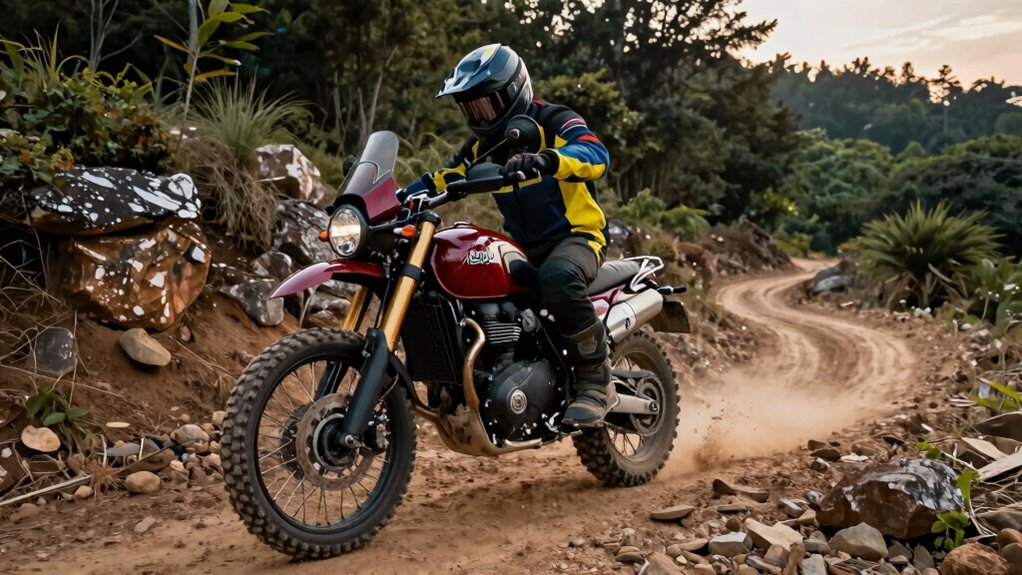
To enhance your off-road performance, mastering how to switch and customize rider modes is essential, as it allows you to tailor your bike’s response precisely to varying trail conditions. Begin by familiarizing yourself with the specific parameters each mode adjusts, such as throttle response, traction control, and ABS settings. Use the onboard display to access the rider mode menu, and perform mode changes when the bike is stationary or at low RPM to prevent unintended responses. For customization, access the rider mode configuration via the bike’s electrical system or dedicated app, adjusting parameters incrementally to match your skill level and terrain. Always test new settings in controlled conditions, making fine adjustments based on real-world feedback to achieve ideal traction, control, and comfort during off-road rides. Additionally, understanding the trusted resources available can help you stay informed about the latest rider mode features and updates. Knowing how to evaluate performance adjustments can further optimize your riding experience and safety, especially when integrating off-road riding techniques into your practice. Being aware of technology integrations can also provide insights into how electronic systems respond during diverse trail conditions, and exploring advanced customization options can help fine-tune your setup for specific terrain challenges.
Frequently Asked Questions
Can Rider Modes Be Customized Beyond Factory Settings?
Yes, you can customize rider modes beyond factory settings on Triumph motorcycles. Using the dedicated software or dealer tools, you can adjust parameters like throttle response, ABS, and traction control to suit your riding style. This allows for a tailored experience, especially off-road. However, make certain you have the proper equipment and knowledge, or consult a professional, to avoid compromising safety and warranty conditions.
Do Rider Modes Impact Fuel Efficiency Off-Road?
A stitch in time saves nine, and adjusting rider modes can influence your fuel efficiency off-road. When you select modes like Off-Road or Rain, the bike optimizes throttle response and fuel delivery, often reducing overall consumption. By fine-tuning power delivery for specific terrains, rider modes can enhance efficiency, but aggressive settings may increase fuel use. Tailoring your mode choice based on terrain ensures ideal balance between performance and fuel economy.
Are Rider Modes Adjustable While Riding?
Yes, rider modes are adjustable while riding if your Triumph model features on-the-fly mode switching. You can typically access this function via handlebar-mounted switches, allowing you to change settings without stopping. This capability enables real-time tuning of throttle response, traction control, and ABS, optimizing performance for varying off-road conditions. Always consult your owner’s manual for specific instructions, as some models may require stopping to change modes.
How Do Rider Modes Influence Bike Weight Distribution?
Rider modes subtly influence your bike’s weight distribution like adjusting a camera’s focus. When you switch modes, the electronic systems recalibrate throttle response, ABS, and traction control, which can shift how the bike balances under acceleration or deceleration. While it doesn’t physically move weight, it optimizes the bike’s handling characteristics, making the front or rear feel more planted or agile, depending on the mode selected.
Do Rider Modes Affect Rider Comfort During Long Off-Road Sessions?
Yes, rider modes markedly impact comfort during long off-road sessions by adjusting throttle response and engine power delivery, which helps maintain control and reduces fatigue. Modes like Off-Road or Enduro typically soften throttle response and optimize traction, allowing you to ride more smoothly over uneven terrain. These adjustments make handling less strenuous, enhancing comfort and reducing rider strain, especially during extended periods of off-road riding.
Conclusion
Understanding Triumph rider modes allows you to tailor your off-road experience precisely. By subtly adjusting power delivery, safety features, and suspension, each mode gently guides you through challenging terrains with confidence. Selecting and customizing these settings guarantees optimal performance and safety without overwhelming your riding style. Embrace these technical nuances to open your bike’s full potential, transforming obstacles into opportunities for mastery and enjoyment on every trail.