Choosing the best automotive tools depends on the job: turning fasteners, inspecting hidden spaces, or tracing an electrical problem. I’ve selected three tools with distinct roles rather than treating them as substitutes. The Amazon Basics 201-Piece Mechanic’s Socket Tool Set is the broadest starting point for routine mechanical work, while the Daxiongmao Endoscope Camera helps inspect areas a hand or mirror cannot reach. For diagnosing vehicle circuits, the WINAMOO Digital Test Light supplies a voltage reading without the bulk of a full socket kit.

Get garage and car supplies delivered free — and shop member deals
- Fast, free delivery on millions of items
- Access to Prime Big Deal Days deals on October 6–7
- Prime Video, Amazon Music and more included
The main tradeoff is versatility versus specialization. The socket set covers many fastener types but is heavy; the endoscope sees into confined spaces but cannot save photos or video; and the test light is direct and compact in purpose, yet only covers 3–48V systems. I rank them by how much useful automotive work each supports within its role, how clearly its design matches that work, and what limitations buyers should accept before choosing.
Complete the kit


Key Takeaways
- Choose the Amazon Basics 201-piece set if one purchase needs to cover a wide range of SAE and metric fasteners across three drive sizes.
- The Amazon Basics kit is the most general-purpose pick here, but its 16.5-pound weight makes it less convenient for a small roadside kit.
- The Daxiongmao endoscope is the specialist choice for viewing concealed areas, and its screen works without a phone or app.
- Skip the Daxiongmao if you need to document an inspection: it does not capture photos or video.
- The WINAMOO test light suits circuit checks on 3–48V systems; it does not replace a socket kit or cover systems outside that range.
| Amazon Basics 201-Piece Mechanic’s Socket Tool Set with Case |  | Best Overall for General Mechanical Work | Piece count: 201 | Drive sizes: 1/4, 3/8, and 1/2 inch | Size systems: SAE and metric | VIEW LATEST PRICE | See Our Full Breakdown |
| Daxiongmao 1080P HD Endoscope Camera with Light | 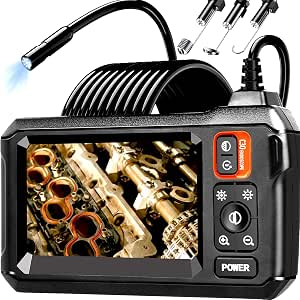 | Best for Hard-to-Reach Visual Inspections | Display: 4.3-inch color LCD | Resolution: 1080P | Probe diameter: 8 mm | VIEW LATEST PRICE | See Our Full Breakdown |
| WINAMOO Automotive Test Light with 3–48V Digital Voltage Display |  | Best for Basic Automotive Circuit Checks | Voltage range: 3–48V | Display resolution: 0.1V | Probe material: Stainless steel | VIEW LATEST PRICE | See Our Full Breakdown |
More Details on Our Top Picks
Amazon Basics 201-Piece Mechanic’s Socket Tool Set with Case
The Amazon Basics 201-piece set takes the top position because it covers the broadest range of tasks in this three-tool lineup. Its sockets span SAE and metric sizes, and the 1/4-, 3/8-, and 1/2-inch drives give buyers options across smaller and larger fasteners. Hex keys and screwdriver bits add further flexibility. Compared with the WINAMOO, which is built around electrical checks, this kit is the stronger foundation for someone who expects to work on a variety of mechanical fasteners.
The kit’s chrome-vanadium steel construction and polished, plated chrome finish are suited to the wear and storage demands of a home tool set. The included case keeps the pieces together and makes the set easier to transport than loose tools, though portability has a limit: the complete set weighs 16.5 pounds. That is manageable for a garage or workshop, but a meaningful penalty if the goal is a compact vehicle emergency kit.
Its main advantage is coverage, not specialist precision. Unlike the Daxiongmao endoscope, it will not help you see behind an obstruction, and it has no dedicated voltage-testing function like the WINAMOO. Buyers should also resist assuming that a large piece count guarantees the exact size or tool they need for every repair; the supplied specifications describe broad coverage, not an exhaustive fit for every vehicle. Still, among these choices, it is the clearest first purchase for routine maintenance involving fasteners.
I’d choose it for a home mechanic building a general kit or a vehicle owner who wants one organized case for common mechanical jobs. I’d skip it if you already own a capable socket collection and need a focused diagnostic tool, or if carrying weight is the priority. Its strongest case is versatility; its clearest compromise is bulk.
Pros:- Covers SAE and metric fasteners with three drive sizes.
- Includes sockets, hex keys, and screwdriver bits for varied routine tasks.
- Chrome-vanadium steel and a polished chrome finish suit regular tool storage and use.
- Comes with a case to keep the 201 pieces organized and portable as a set.
Cons:- At 16.5 pounds, it is heavy for a compact vehicle kit.
- Its wide assortment does not replace a dedicated endoscope or circuit tester.
Best for: Home mechanics and vehicle owners who need a broad mix of SAE and metric sockets, multiple drive sizes, and basic bits in one organized case.
Not ideal for: Buyers who need a lightweight roadside kit, already have a socket collection, or mainly need inspection and electrical-diagnostic tools.
- Piece count:201
- Drive sizes:1/4, 3/8, and 1/2 inch
- Size systems:SAE and metric
- Material:Chrome-vanadium steel
- Finish:Polished, plated chrome
- Included tools:Sockets, hex keys, and screwdriver bits
- Item weight:16.5 pounds
- Model number:AMZ1702
Our verdict“I’d make this my first pick for broad, routine mechanical work, provided the buyer can accept a heavy case.”
Daxiongmao 1080P HD Endoscope Camera with Light
The Daxiongmao endoscope is the most specialized pick here, aimed at the moments when a problem is hidden from direct view. Its 8 mm probe sits at the end of a 16.5-foot semi-rigid cable, and the built-in 4.3-inch LCD means I can use it without pairing a phone or opening an app. That makes it a different kind of automotive tool from the Amazon Basics socket set: instead of loosening or tightening fasteners, it helps inspect confined spaces before deciding what to do next.
Visibility features matter in areas that are dark or difficult to access. The camera offers eight adjustable LED lights, a 120-degree field of view, and a stated best observation distance of 1.5–5 inches. Its IP67 water-resistance rating supports use in wet environments, while the supplied hook, magnet, and side mirror extend its usefulness beyond simple viewing. In comparison, the WINAMOO is for electrical readings rather than visual inspection; this camera fills a different diagnostic gap.
The biggest limitation is clear: it cannot take photos or videos. That rules it out for buyers who need a record to share with a mechanic, save for later, or attach to a report. Its 3.5-hour battery life also makes it a task-focused device rather than something to leave running through extended inspection sessions. Fast charging is not supported, so buyers should plan around charging time instead of expecting a quick top-up.
I’d pick it for a DIY owner who frequently needs to inspect hidden spaces and values an independent screen and included retrieval attachments. I would not buy it as a substitute for a scan tool or as a documentation camera. Compared with the socket set, it handles far fewer types of work, but for seeing into an obstructed area, its design is much more directly suited to the job.
Pros:- The built-in 4.3-inch display works without a phone or app.
- Semi-rigid cable and 8 mm probe help reach confined inspection areas.
- Adjustable LED lighting and an IP67 rating suit dark or wet locations.
- Hook, magnet, and side mirror attachments support different inspection tasks.
Cons:- Does not support photo or video capture.
- The stated battery life is 3.5 hours, and fast charging is not supported.
Best for: DIY mechanics and vehicle owners who need to inspect concealed or poorly lit areas without relying on a smartphone.
Not ideal for: Anyone who needs to save or share inspection photos or video, or wants one tool for general mechanical repairs.
- Display:4.3-inch color LCD
- Resolution:1080P
- Probe diameter:8 mm
- Cable length:16.5 ft semi-rigid cable
- LED lights:8 adjustable
- Water resistance:IP67
- Best observation distance:1.5–5 in
- Battery life:3.5 hours
- Photo and video capture:Not supported
Our verdict“I’d choose this camera when access and visibility are the problem, but not when inspection records matter.”
WINAMOO Automotive Test Light with 3–48V Digital Voltage Display
The WINAMOO digital test light is the most focused tool in this roundup. It is designed to check 3–48V vehicle systems, with a digital display showing voltage at 0.1V resolution. That gives it a clear role when a buyer needs to check a battery, charging system, fuse, light, or other circuit. The Amazon Basics set wins on mechanical range, but it cannot provide this kind of electrical reading; the WINAMOO makes sense as a targeted addition to a toolkit rather than a replacement for general hand tools.
Its 96-inch spring wire and large alligator clip give the user room to work around a vehicle while maintaining a connection, and the stainless steel probe is suited to contacting test points. Polarity is shown by color—red for positive and green for negative—so the display and indicator provide information beyond a simple pass-or-no-pass light. For someone troubleshooting basic electrical questions, that reading can help distinguish a circuit issue from a mechanical problem.
The range is useful but bounded. This tester is specified for 3–48V systems, so it should not be treated as a general-purpose meter for voltages outside that range or as a substitute for tools with other measurement functions. The probe is sharp, which helps with contact but requires careful handling and safe storage. Compared with the Daxiongmao, it gives no visual access to hidden spaces; compared with the socket set, it addresses a much narrower slice of vehicle maintenance.
I’d recommend it to owners who already have basic hand tools and want a dedicated way to check common vehicle circuits. It is less compelling as a first automotive purchase if fastener work is the buyer’s priority, and it is not the right choice for someone who needs broader electrical measurements. Its appeal is direct, readable circuit testing, not all-around coverage.
Pros:- Digital display provides voltage readings at 0.1V resolution.
- Specified for 3–48V systems and common vehicle circuit checks.
- A 96-inch spring wire and large alligator clip allow flexible placement.
- Polarity indication uses red for positive and green for negative.
Cons:- Its 3–48V operating range limits use outside that span.
- The sharp probe needs careful handling and secure storage.
Best for: Vehicle owners and DIY mechanics who need a dedicated tester for 3–48V automotive circuits, batteries, fuses, lights, or charging checks.
Not ideal for: Buyers seeking a general-purpose multimeter, a mechanical tool kit, or testing outside the stated voltage range.
- Voltage range:3–48V
- Display resolution:0.1V
- Probe material:Stainless steel
- Wire length:96 inches
- Polarity indication:Red for positive; green for negative
- Body material:ABS
Our verdict“I’d add this focused tester to an existing kit for vehicle circuit checks, but I would not make it my only automotive tool.”

How We Picked
I chose these three products to represent different kinds of automotive work: mechanical fastening, visual inspection, and electrical testing. That makes the ranking more useful than comparing unrelated tools as though every buyer needs the same thing. A socket kit can help with fasteners, but it cannot show what is hidden behind a panel; a camera can reveal a hard-to-see area, but it cannot diagnose voltage. Each pick earns its place by addressing a clear task.
For the overall position, I gave the most weight to breadth of routine usefulness. The Amazon Basics set offers SAE and metric sockets in 1/4-, 3/8-, and 1/2-inch drive sizes, alongside hex keys and screwdriver bits. This coverage gives it the widest range of mechanical applications in this lineup. Its weight is a real drawback, but the set remains the most adaptable choice for someone assembling a basic workshop toolkit.
I ranked the Daxiongmao as the inspection specialist because its 4.3-inch built-in display, semi-rigid 16.5-foot cable, adjustable lighting, and included attachments serve a distinct need: seeing into cramped or dark spaces. Its inability to record means it is less suitable for documentation or sharing findings. The WINAMOO earns the electrical-diagnosis role through its 3–48V range, 0.1V display resolution, long lead, and polarity indication. Its narrower function places it below the socket set for general-purpose value, not below it for circuit testing.
I also considered the practical limits buyers encounter while working: size and portability, operating range, visibility, and the task each tool can actually perform. The supplied descriptions do not establish performance in every vehicle or repair situation, so I avoid treating a listed feature as a guarantee of results. These are tools for particular jobs, not a complete professional workshop. The best choice is the one that fills a gap in your current kit without asking it to do work outside its stated purpose.
Factors to Consider When Choosing Best Automotive Tools
I’d start by matching the tool to the job that is currently slowing you down. These three products solve different problems, so ranking them does not mean one can replace the others. A practical choice comes from deciding whether your priority is fastener coverage, hidden-area inspection, or electrical testing, then checking whether the tool’s limits fit the way you plan to work.Start With the Task, Not the Piece Count
A large assortment can look like the safest first purchase, but the number of pieces only matters if the set includes the types of tools your jobs require. The Amazon Basics kit has the broadest mechanical scope here: SAE and metric sockets in three drive sizes, plus hex keys and screwdriver bits. That makes it the most natural starting point for routine fastener work. If your main challenge is a hidden component or an electrical fault, though, a socket set will not solve it.
I’d write down the work I expect to do before buying. For fasteners, look for the drive size and size system that match the jobs at hand. For inspection, focus on probe diameter, cable length, lighting, and how the image is viewed. For circuits, confirm the voltage range and the type of reading provided. This simple task-first approach helps avoid paying for breadth that will sit unused or choosing a specialist tool for a general repair role.
Choose a Socket Set for Coverage and Organization
The 201-piece set stands out when a buyer needs a variety of socket sizes and wants them stored together. SAE and metric coverage reduces the chance of being limited to one sizing system, while 1/4-, 3/8-, and 1/2-inch drives give the kit a wider mechanical spread than a single-drive assortment. The included case is useful for organization and carrying the set between a shelf and work area.
The tradeoff is the case’s 16.5-pound weight. If the set will live in a garage, weight may matter less than having pieces in one place. If it will remain in a car for emergencies, bulk and carrying comfort matter more. I’d also treat a broad kit as a foundation, not a promise that every repair will call for a tool included in the box. Buyers with an established collection may get more from filling a specific gap than duplicating common sockets.
Use an Endoscope When Access Is the Problem
An endoscope is useful when a part or space is difficult to inspect directly. The Daxiongmao combines a 4.3-inch screen, 8 mm probe, and 16.5-foot semi-rigid cable, giving it a different job from either hand tool. Adjustable LEDs can help illuminate dark areas, while the hook, magnet, and side mirror provide options for retrieving or viewing around an obstruction. Its built-in display also avoids the need to connect a phone.
Before choosing this camera, decide whether live viewing is enough. This model does not record photos or video, so it cannot create a saved visual record for a mechanic or for later comparison. The stated 3.5-hour battery life and lack of fast charging also make it a tool to prepare for a specific inspection, rather than one to depend on for uninterrupted long sessions. Its water-resistance rating is useful in wet environments, but buyers should still follow the product’s instructions for handling and care.
Match Electrical Tools to the System You’ll Test
The WINAMOO is aimed at basic checks on 3–48V systems. It displays voltage at 0.1V resolution, indicates polarity by color, and uses a long spring wire with a large clip to support positioning around a vehicle. This makes it more relevant than the other picks when the question concerns a battery, fuse, light, or charging circuit.
A stated voltage span does not make a test light a substitute for every electrical instrument. Consider whether you need functions beyond the supplied voltage reading before choosing it. Its probe is sharp, so safe handling and storage belong in the decision as much as its display. Buyers who need to inspect a confined space should look at the Daxiongmao; buyers who need to turn fasteners should begin with the socket set. The tester earns its place when circuit checks are the actual task.
Think About Portability, Power, and Storage
Tools that stay in a workshop can be larger or heavier than tools expected to travel in a vehicle. The socket set includes a case but still weighs 16.5 pounds; the endoscope has a cable and screen to store and needs charging; and the test light is defined by its probe, lead, and electrical range. Consider where the tool will live, whether it needs to be ready at short notice, and how easy it is to keep its accessories together.
I’d also account for the limits that affect a real work session. The endoscope’s battery life is stated as 3.5 hours, and it lacks fast charging. The test light’s long lead aids reach but calls for care around moving or hot parts. The socket kit’s case helps keep pieces organized, yet its mass may make it inconvenient to move often. These practical details can matter more than a feature list once the tools are in regular use.
Build a Small Kit in Useful Stages
Buyers starting from scratch do not need to pretend that one purchase covers every kind of repair. I’d begin with the tool that supports the most common work planned for the vehicle. For general mechanical jobs, that points to the Amazon Basics socket set. For someone already equipped with sockets but frequently unable to see a hidden area, the endoscope may be a more meaningful next addition. If electrical faults are the recurring problem, the WINAMOO fills that specialized need.
As a kit grows, I’d keep the categories separate: tools for mechanical work, tools for inspection, and tools for electrical checks. That makes it easier to spot what is missing and reduces the temptation to use a specialist tool outside its intended task. The right order depends on your work, but the principle is consistent: buy for a known capability gap, and accept each tool’s limits rather than expecting a single purchase to be a complete garage.
Frequently Asked Questions
Which of these is the best first automotive tool purchase?
For someone who needs broad coverage for routine mechanical work, I’d start with the Amazon Basics 201-piece socket set. It includes SAE and metric sockets across three drive sizes, plus hex keys and screwdriver bits. It is not the right first choice if the main need is electrical diagnosis or looking into a concealed area; in those cases, the WINAMOO or Daxiongmao is more directly matched to the task.
Can the endoscope replace a diagnostic scanner?
No. The Daxiongmao is a visual inspection camera with a probe, screen, and lights; the supplied details do not describe scan-tool functions or vehicle-code reading. It can help you see a hard-to-reach area, but it cannot replace a tool designed to read diagnostic data. I’d choose it for visual access, not electronic fault-code diagnosis.
Does the Daxiongmao camera save inspection images?
No. This model does not support photo or video capture, so the screen is for viewing during the inspection rather than creating a saved record. That may be fine for a quick look at an inaccessible area, but it is a clear reason to skip this model if you need to share images with a mechanic or compare findings later.
What does the WINAMOO test light measure?
The WINAMOO is specified for 3–48V systems and has a digital display with 0.1V resolution. It is intended for checks involving vehicle batteries, charging systems, lights, fuses, and other circuits. The supplied details do not describe broader meter functions, so I would not choose it as a replacement for an instrument that needs to measure outside that range or perform additional types of electrical testing.
Are these three products alternatives to one another?
Not really: each handles a different category of work. The socket set is for mechanical fasteners, the endoscope is for visual access to concealed areas, and the test light is for basic circuit checks. A buyer might choose just one based on an immediate need, but someone building a fuller automotive kit may eventually want tools from more than one category.
Conclusion
I’d choose the Amazon Basics 201-piece set if I needed a broad foundation for routine mechanical work and could store a 16.5-pound case. I’d pick the Daxiongmao endoscope if my main problem were seeing into dark or obstructed spaces and live viewing were enough without saved images. For someone focused on batteries, lights, fuses, or other 3–48V circuits, the WINAMOO test light is the clearest match.
The ranking reflects breadth, not a claim that one tool can do every job. The socket kit is my overall pick because it covers the widest range of common mechanical tasks in this group; the other two rank as valuable specialists for different diagnostic needs. Choose the tool that fills your actual gap, and treat its stated limits—weight, no recording, or a bounded voltage range—as part of the decision.
Halloween Picks
halloween
As an affiliate, we earn on qualifying purchases.