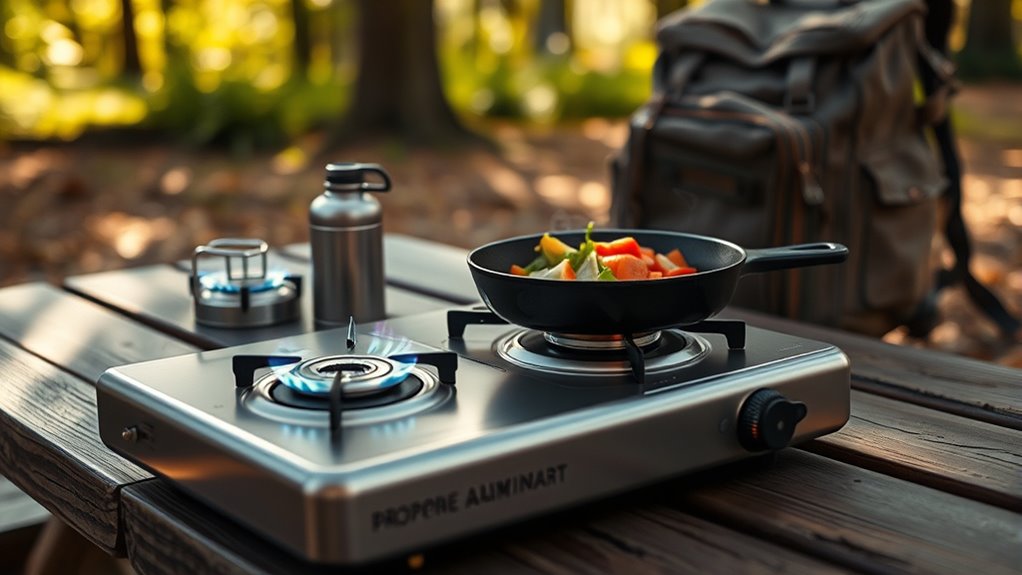

Among these propane camping stoves, I rank the Coleman Triton+ 2-Burner as the best overall for its practical two-burner setup and match-light-free ignition. The Camp Chef Everest 2X suits cooks who want a more performance-focused portable stove, while the Gas One GS-3400P offers the flexibility of propane or butane. The main choice is between compact, simple burners and larger stoves that offer more cooking room but take up more space. Burner output alone does not tell you how well a stove will suit your pots, wind exposure, or meal routine. Read on for the full comparison and recommendations by camping style.

Get business pricing on garage and car supplies
- Business-only prices and quantity discounts
- Tax-exempt purchasing
- Multiple users, one account, clear invoices
Complete the kit


Key Takeaways
- The Coleman Triton+ leads as an everyday camp kitchen pick: its two-burner format and InstaStart ignition suit common campsite meals without the footprint of a freestanding cooker.
- The Camp Chef Everest 2X is the performance-oriented portable option: it is a stronger match for cooks who prioritize cooking capacity and control over a minimal pack size.
- Dual-fuel models solve a specific supply problem: the Gas One GS-3400P and 15,000 BTU Gas One accept propane or butane, which can help when fuel availability varies.
- High BTU figures favor demanding outdoor cooking, not every trip: the BESTFIRE 150,000 BTU two-burner setup and high-pressure single burners are better suited to large cookware and open-air use than delicate simmering.
- Portability comes in different forms: the Coleman Bottletop and compact single burners reduce bulk, while models with removable legs or wider cooking surfaces better suit a stationary camp kitchen.


| camping stoves propane | Burners | Fuel | Dimensions | Weight |
|---|---|---|---|---|
| GasOne High-Pressure Single Pr | — | Propane | 10.4 × 10.4 × 5.6 in | — |
| Coleman Triton+ 2-Burner Propa | 2 independently adjustable | Propane | 13.7 × 5.7 × 22.6 in | 16 oz |
| Gas One GS-3400P Dual-Fuel Por | — | — | 13.5 × 11 × 4.45 in | 3.1 lb |
| BESTFIRE 2 Burner Camping Stov | 2 | Propane | — | — |
| Bestfire Single Burner Propane | 1 | Propane | — | — |
| GasOne 15,000 BTU Propane or B | 1 | — | — | — |
| Gonex Propane Camping Stove | 2 | — | 10.5 x 6 in | 4.2 lb |
| 2-Burner Portable Propane Camp | 2 adjustable brass burners | Propane | — | — |
| Gas One Propane Double Burner | 2 cast-iron burners | Liquefied petroleum gas | 30.75 x 15.75 x 28.5 in | 27 lb |
| Camp Chef Explorer Two-Burner | 2 | — | — | — |
| ODSD Portable 2-Burner Propane | 2 independently adjustable | Propane | — | 3.98 lb |
| Coleman Triton Portable 2-Burn | 2 independently adjustable | Propane | 15.9 × 7.8 × 24.8 in | 5 lb |
| Camp Chef Everest 2X Two-Burne | 2 cast-aluminum burners, 20,000 BTU each | Propane (liquefied petroleum gas) | 27 × 15.5 × 8.25 in | 15 lb |
| Coleman Bottletop Propane Stov | 1 adjustable burner | Propane (sold separately) | — | — |
More Details on Our Top Picks
GasOne High-Pressure Single Propane Burner with Heat Shield
The GasOne B-5120 suits campers who need one high-output burner for a large pot, boiling water, or outdoor cooking with room to work around the flame. Its cast-iron burner head and metal build make it a sturdier choice for a fixed campsite setup than the lighter Gas One GS-3400P, which prioritizes compact, dual-fuel convenience. The top heat guard helps shield the hose connection from flame and spills, while the bottom shield helps limit heat reaching the surface below. Those protections add useful separation, but they do not make this stove suitable for indoor use. It is also a single burner, so preparing multiple dishes at once takes more time. I would choose it for rugged, straightforward propane cooking, and skip it if portability or multi-burner flexibility matters most.
Pros:- High-output flame supports boiling and outdoor cooking
- Cast-iron burner head and heavy-duty metal construction
- Top heat guard helps shield the hose connection from flame and spills
- Bottom heat shield helps protect components and surfaces from heat
Cons:- Single burner limits simultaneous cooking
- Designed for outdoor use only
- Requires a propane fuel source
Best for: Campers and tailgaters who want a sturdy, high-output burner for large-pot cooking at an outdoor cooking station
Not ideal for: Backpackers or cooks preparing several dishes at once, since it is a single burner with a metal construction
- Brand:Gas One
- Model:B-5120
- Fuel:Propane
- Materials:Alloy steel and cast iron
- Dimensions:10.4 × 10.4 × 5.6 in
- Included:Propane burner and propane hose assembly
Our verdict“Choose the GasOne B-5120 for sturdy, shielded single-burner cooking at a campsite or tailgate.”
Coleman Triton+ 2-Burner Propane Camping Stove with InstaStart
For camp meals that need a pot and pan going together, I’d put the Coleman Triton+ ahead of single-burner options like the GasOne B-5120. Its two independently adjustable burners provide separate heat control, and the listed 22,000 BTU output gives it a more practical balance for everyday campsite cooking than the much higher-output BESTFIRE two-burner model, which is aimed at larger outdoor cooking jobs. Push-button InstaStart avoids carrying matches for routine lighting, while dual wind guards help keep the burners sheltered. The removable grate also makes cleanup simpler after a trip. Its main constraint is fuel runtime: with a 16-ounce cylinder, listed burn time is up to one hour on high, and the cylinder is sold separately. This is a convenient car-camping stove, not a long-running fuel-sipping choice.
Pros:- Two independently adjustable burners allow separate heat control
- Push-button InstaStart lights without matches
- Dual wind guards help shield burners outdoors
- Removable chrome-plated grate supports easier cleanup
Cons:- 16-ounce propane cylinder is sold separately
- Listed burn time is up to one hour on high per 16-ounce cylinder
Best for: Car campers who regularly cook two dishes at different temperatures and want push-button ignition
Not ideal for: Campers planning long stretches of high-heat cooking without carrying spare 16-ounce propane cylinders
- Fuel:Propane
- Burners:2 independently adjustable
- Maximum output:22,000 BTU
- Ignition:Push-button InstaStart
- Pan compatibility:10-inch and 12-inch pans
- Burn time:Up to 1 hour on high with a 16-ounce propane cylinder
- Dimensions:13.7 × 5.7 × 22.6 in
- Weight:16 oz
- Warranty:3-year limited
Our verdict“Pick the Coleman Triton+ for convenient two-pan campsite cooking with separate burner controls.”
Gas One GS-3400P Dual-Fuel Portable Camping Stove with Carrying Case
The Gas One GS-3400P is the flexible pick for campers who want a compact stove that can run on either an 8-ounce butane cartridge or a 16.4-ounce propane cylinder. That choice sets it apart from the propane-only Coleman Triton+: butane can suit a short, light cooking stop, while the included propane converter regulator opens the door to propane when that is the more practical fuel on hand. Automatic piezo-electric ignition and an adjustable heat dial keep operation simple, and the carrying case makes it easier to pack than the heavier-duty cast-iron BESTFIRE burners. The tradeoff is modest cooking capacity: it is a single burner, and no fuel is included. I’d choose it for adaptable, small-meal cooking, but not for feeding a group or running large cookware at high output.
Pros:- Runs on either an 8-ounce butane cartridge or 16.4-ounce propane cylinder
- Propane converter regulator and carrying case are included
- Automatic piezo-electric ignition
- Cartridge ejection and gas flow cutoff safety mechanisms
Cons:- Fuel cartridges and propane cylinders are not included
- Single burner limits cooking capacity
- Listed dimensions and 3.1-pound weight make it less suited to ultralight packing
Best for: Solo campers and couples who want one compact stove compatible with either butane cartridges or propane cylinders
Not ideal for: Group cooks or campers using large cookware who need two burners or the higher output of a heavy-duty stove
- Brand:Gas One
- Model:GS-3400P
- Fuel compatibility:8-ounce butane cartridge or 16.4-ounce propane cylinder
- Ignition:Automatic piezo-electric
- Safety features:Cartridge ejection system and gas flow cutoff
- Dimensions:13.5 × 11 × 4.45 in
- Weight:3.1 lb
- Included:Stove, propane converter regulator, and carrying case
- Warranty:1 year
Our verdict“Choose the GS-3400P if switching between butane and propane matters more than cooking capacity.”
BESTFIRE 2 Burner Camping Stove, 150,000 BTU High Pressure Outdoor Propane, 4ft 20 PSI Adjustable Regulator Hose with Removable Legs
With 150,000 BTU across two independently controlled burners, the BESTFIRE is built for outdoor cooking tasks that exceed the everyday camp-stove brief. Compared with the Coleman Triton+ and its 22,000 BTU output, this model is aimed at cooks who want substantially more heat for large-volume pots or demanding campsite meals. Its cast-iron construction and removable legs favor a sturdy cooking station, while the included four-foot, 20 PSI regulator hose gives the setup reach and adjustable regulation. That capacity comes with real costs: the stove may be heavy, it needs a separate propane tank and batteries, and easy assembly does not make it a small-pack option. I’d choose it for a group campsite or outdoor cooking area with room for a larger burner, not for a compact weekend kit.
Pros:- Two independently controlled burners
- 150,000 BTU total output suits demanding outdoor cooking
- Cast-iron construction
- Four-foot adjustable 20 PSI regulator hose and removable legs
Cons:- May be heavy for some users
- Propane tank and batteries are not included
- High output is more than many simple campsite meals require
Best for: Group campers and outdoor cooks who need two burners and high output for large-volume cooking
Not ideal for: Campers prioritizing light packing or quick meals on a compact stove, since this model may be heavy and needs a separate tank and batteries
- Fuel:Propane
- Burners:2
- Total output:150,000 BTU
- Regulator hose length:4 ft
- Regulator pressure:20 PSI
- Construction:Cast iron
- Legs:Removable
Our verdict“Choose the BESTFIRE when group cooking needs much more heat than a standard two-burner camping stove provides.”
Bestfire Single Burner Propane Stove for Outdoor Cooking
The Bestfire 80,000 BTU single burner is for cooks who want strong heat under one large pot without moving up to the two-burner BESTFIRE model’s 150,000 BTU total output. Its adjustable flame offers more control than a fixed high setting, and the listed uses—such as seafood boiling and turkey frying—signal its fit for large-cookware jobs at a campsite or tailgate. Against the compact Gas One GS-3400P, this stove trades flexible fuel options and a carrying case for much higher listed output and a cast-iron-and-reinforced-steel build. That makes it less appealing for lightweight travel, despite the description calling it portable. You will need to supply the propane tank, and it is intended for outdoor use. I’d pick it when a single large vessel matters more than compact packing or multi-pan cooking.
Pros:- 80,000 BTU output supports high-heat cooking
- Adjustable flame control
- Cast-iron and reinforced-steel construction
- Designed for outdoor cooking, camping, tailgating, and emergency use
Cons:- Propane tank is not included
- Heavy-duty build may reduce portability
- Designed primarily for outdoor use, not indoors
Best for: Outdoor cooks and tailgaters who need one adjustable high-output burner for a large pot
Not ideal for: Backpackers or campers wanting multiple cooking zones, since it is a single heavy-duty outdoor burner
- Fuel:Propane
- Burners:1
- Output:80,000 BTU
- Regulator pressure:5 PSI
- Materials:Cast iron and reinforced steel
- Use:Outdoor cooking, camping, tailgating, and emergency use
Our verdict“Pick this Bestfire for adjustable, high-heat cooking with one large pot at an outdoor site.”
GasOne 15,000 BTU Propane or Butane Stove Dual Fuel Portable Camping Stove with Carrying Case
For campers who want a small stove with fuel flexibility, I’d choose this GasOne over the single-fuel Gonex 2-Burner when packing space and the option to use butane matter more than cooking two dishes at once. Its 15,000 BTU burner suits boiling water and straightforward camp meals, while the piezo ignition avoids carrying a separate lighter for routine starts. A windblocker and pressure-sensing gas cutoff add useful support outdoors, and the case makes the unit easier to store with other gear. The tradeoff is that propane use requires fuel adapters, and the stove has only one burner, so meal prep is less flexible than with the Gonex. Fuel is not included, and this is intended for outdoor use.
Pros:- Compatible with propane and butane
- 15,000 BTU output for a portable single burner
- Piezo-electric ignition
- Carrying case and heavy-duty windblocker are included
Cons:- Propane use requires a fuel adapter
- Single burner limits simultaneous meal preparation
- Fuel is not included
Best for: Solo campers and emergency-kit owners who want one compact stove that can use either propane or butane.
Not ideal for: Groups cooking multiple dishes at once, or buyers who want to connect propane without sourcing the required adapter.
- Output:15,000 BTU
- Fuel compatibility:Propane and butane
- Ignition:Piezo-electric
- Burners:1
- Wind protection:Heavy-duty Windblocker
- Safety features:Pressure sensor and gas flow cutoff
- Included:Carrying case
Our verdict“Choose this GasOne for compact, dual-fuel camp cooking; pick the Gonex instead if two burners matter more than fuel flexibility.”
Gonex Propane Camping Stove, 2-Burner Portable Camp Stove, 20,000 BTU
The Gonex gives campers two cooking zones in a notably light 4.2-pound package. I’d place it ahead of the 30,000 BTU foldable two-burner stove for travelers who value easier carrying over higher listed output: its 20,000 BTU total is a more modest match for simple camp meals, and the two burners still let you warm one pot while cooking another. The compact 10.5 by 6 inch dimensions and padded bag make it easier to pack than the full-size Camp Chef Explorer, while the included hose, pot stands, and grill grates reduce accessory hunting. The compromise is propane-only operation and limited room compared with larger outdoor stoves. Its small footprint may also feel cramped when cooking for a group.
Pros:- Two burners support cooking separate dishes
- Light 4.2-pound listed weight
- Compact 10.5 x 6 inch dimensions
- Includes padded bag, propane hose, pot stands, and grill grates
Cons:- 20,000 BTU total output is lower than the 30,000 BTU foldable two-burner option
- Requires propane cylinders
- Compact cooking area may constrain larger pots
Best for: Car campers and overlanders who want two burners but need to keep stove weight and packed size down.
Not ideal for: Large groups or cooks who need generous burner spacing and higher total output for several substantial dishes.
- Output:20,000 BTU total
- Burners:2
- Weight:4.2 lb
- Dimensions:10.5 x 6 in
- Base:Stainless steel
- Included items:Padded carrying bag, propane hose, pot stands, and grill grates
Our verdict“Pick the Gonex when portability and two burners matter more than maximum heat or roomy cooking space.”
2-Burner Portable Propane Camping Stove, 30,000 BTU, Foldable Gas Stove
This foldable model is the stronger fit for campers who want more cooking power than the Gonex offers without moving up to a legged, full-size stove like the Camp Chef Explorer. Its 30,000 BTU across two adjustable brass burners gives more headroom for quicker heating and parallel cooking, while the magnetic closure is designed to speed setup. A windproof design helps address a common outdoor cooking annoyance, and the storage bag gives the folding format a defined place in the kit. Those gains come with a portability tradeoff: the listing says it may be heavy for ultra-light backpacking, and propane is the only stated fuel. Two burners also limit how many dishes can cook at once, so it is better suited to ordinary camp meals than large-scale outdoor cooking.
Pros:- 30,000 BTU total output
- Two adjustable brass burners
- Foldable design with magnetic closure
- Windproof design and storage bag
Cons:- May be too heavy for ultra-light backpacking
- Requires propane fuel
- Two burners can limit cooking for larger groups
Best for: Car campers who want a foldable two-burner stove with more listed output than the compact Gonex.
Not ideal for: Ultralight hikers, or large groups who need more than two cooking zones.
- Output:30,000 BTU total
- Burners:2 adjustable brass burners
- Materials:Cold-rolled steel and stainless steel
- Design:Foldable with magnetic closure
- Wind protection:Windproof design
- Included:Storage bag
- Fuel:Propane
Our verdict“Choose this model for foldable, higher-output camp cooking when a backpacking-light load is not the priority.”
Gas One Propane Double Burner Outdoor Camp Stove with Adjustable Regulator and Removable Legs
With 150,000 BTU maximum output and cast-iron burners, this Gas One is aimed at cooks who need much more heat than compact camp stoves provide. Compared with the Camp Chef Explorer’s two 30,000 BTU burners, it offers far greater stated output for tasks such as frying or boiling large quantities, while individual controls allow separate heat settings. The adjustable 0–5 PSI regulator, four-foot hose, windscreen, and detachable legs make it a more complete station for a campsite or outdoor cooking area. That power and equipment bring a real mobility cost: at 27 pounds and roughly 31 inches long, it is far less packable than the Gonex. I’d choose it for a vehicle-supported setup, not a hike-in campsite.
Pros:- Two cast-iron burners with individual controls
- 150,000 BTU maximum stated output
- Adjustable 0–5 PSI regulator and four-foot hose included
- Windscreen and detachable legs included
Cons:- 27-pound weight makes it cumbersome to carry
- Large 30.75 x 15.75 x 28.5 inch dimensions require storage space
- Designed for outdoor cooking
Best for: Tailgaters and vehicle campers who cook large batches outdoors and can transport a 27-pound stove.
Not ideal for: Backpackers or campers with limited storage who need a lightweight, compact stove.
- Model:B-4545
- Maximum output:150,000 BTU
- Burners:2 cast-iron burners
- Fuel:Liquefied petroleum gas
- Regulator:Adjustable 0–5 PSI
- Hose length:4 ft
- Dimensions:30.75 x 15.75 x 28.5 in
- Weight:27 lb
- Legs:4 detachable legs
Our verdict“Choose this Gas One for high-heat, vehicle-supported outdoor cooking; the Camp Chef Explorer is easier to manage for more typical camp meals.”
Camp Chef Explorer Two-Burner Stove
The Explorer makes sense when a camp stove needs to function like a full-size outdoor cooking station. Its two 30,000 BTU cast-aluminum burners provide substantial heat for parallel cooking, and the 14 by 32 inch cooking area offers more working room than the compact Gonex or the foldable 30,000 BTU stove. I’d rank it ahead of those smaller models for established camps where burner space and weather protection matter more than a small packed footprint. The included hose, windscreen, detachable steel legs, and accessory compatibility support a flexible setup. The tradeoff is its bulk: those legs and broad surface are useful at camp but make it a poor choice for backpacking or tight vehicle storage. Propane is required.
Pros:- Two 30,000 BTU burners
- 14 x 32 inch cooking area
- Windscreen and detachable steel legs
- Hose included and compatible with various accessories
Cons:- Heavy and bulky for backpacking
- Broad cooking surface needs substantial storage space
- Requires propane fuel
Best for: Families and group car campers who want two powerful burners and a roomy cooking surface at a fixed campsite.
Not ideal for: Backpackers or drivers with limited cargo space who need a compact stove.
- Model:EX60LW
- Burners:2
- Burner power:30,000 BTU each
- Cooking dimensions:14 x 32 in
- Burner material:Cast aluminum
- Windscreen:Included
- Legs:Detachable steel
- Hose:Included
Our verdict“Choose the Explorer for a roomy two-burner camp kitchen when transport and storage space can accommodate its full-size design.”
ODSD Portable 2-Burner Propane Camping Stove with Windshield, Coffee Stand and Carry Bag, Green
I’d choose the ODSD when a compact two-burner setup with useful extras matters more than maximum heat. Its 20,000 BTU combined output and independently adjustable burners let me cook two items at different temperatures, while the windshield helps steady flames outdoors. The griddle and coffee stand give it more ways to handle breakfast than the basic cooking setup of the Coleman Triton. At 3.98 pounds, it’s easier to carry than the 15-pound Camp Chef Everest 2X, and the included bag helps keep its parts together. The tradeoff is that its two burners share less total output than the Triton’s 22,000 BTU, and the folded 10.63 × 9.06 × 5.12-inch package still takes up space in a hiking pack. Propane is also required.
Pros:- Two independently adjustable burners support cooking at different temperatures
- Windshield helps protect the flame outdoors
- Includes a griddle, coffee stand, grates, gas pipe, and carry bag
- Folds to a compact package and weighs 3.98 pounds
Cons:- 20,000 BTU combined output is lower than the Coleman Triton’s 22,000 BTU
- Folded size and weight may be cumbersome for hiking
- Requires propane fuel
Best for: Car campers who want two independently controlled burners plus a griddle and coffee stand for varied campsite breakfasts
Not ideal for: Backpackers prioritizing a small, light pack, or cooks who need more output than 20,000 BTU combined
- Fuel:Propane
- Burners:2 independently adjustable
- Maximum output:20,000 BTU combined
- Folded dimensions:10.63 × 9.06 × 5.12 in
- Product dimensions:11.42 × 10.43 × 7.48 in
- Weight:3.98 lb
- Material:Cold-rolled steel plate with high-temperature spray coating
- Included components:2 grates, gas pipe, griddle, carry bag
Our verdict“Choose the ODSD if you want an easy-to-carry two-burner propane stove with breakfast accessories; skip it if high output or backpacking-size gear is your priority.”
Coleman Triton Portable 2-Burner Propane Camping Stove
The Coleman Triton is the straightforward pick for campers who want a familiar two-burner layout and less fuss after cooking. Its 22,000 BTU output edges past the ODSD’s 20,000 BTU, while two wind guards and separately controlled burners help keep meals moving when the campsite is breezy. The removable chrome-plated grate makes it easier to clear spills than a stove with a fixed cooking surface, and the latch holds it shut for storage. Compared with the Camp Chef Everest 2X, the Triton is much lighter at five pounds, though it gives up that model’s 40,000 BTU output and larger cooking area. Its listed dimensions are substantial, so the weight alone doesn’t make it a small-pack choice. A 16-ounce cylinder lasts up to one hour on high and is sold separately.
Pros:- Two independently adjustable burners offer separate heat control
- 22,000 BTU total output exceeds the ODSD’s 20,000 BTU
- Removable chrome-plated grate simplifies cleanup
- Wind guards and a heavy-duty storage latch are included
Cons:- A 16 oz. cylinder lasts up to one hour on high
- Propane cylinder is sold separately
- Listed dimensions make it a poor fit for space-constrained packs
Best for: Car campers who want independently controlled burners, wind guards, and a removable grate for easier cleanup
Not ideal for: Cooks who need long high-heat sessions from one small cylinder or a stove with maximum burner power
- Fuel:Propane
- Burners:2 independently adjustable
- Total output:22,000 BTU
- Wind guards:2
- Compatible pan sizes:10-inch and 12-inch
- Burn time:Up to 1 hour on high with one 16 oz. propane cylinder
- Dimensions:15.9 × 7.8 × 24.8 in
- Weight:5 lb
- Warranty:3-year limited
Our verdict“Pick the Triton for practical two-burner cooking and easier cleanup at a car campsite, but look elsewhere if you need extended high-heat runtime.”
Camp Chef Everest 2X Two-Burner Portable Propane Camping Stove
For cooks who want to run two pans hard at once, the Camp Chef Everest 2X stands apart with 40,000 BTU total output from two 20,000 BTU burners. Its 215-square-inch cooking surface fits two pans, and the three-sided windscreen shields the cooking area. Those advantages make it a stronger choice for larger meals than the Coleman Triton, whose total output is 22,000 BTU. The Everest 2X also has matchless ignition, a drip tray, and a carry handle, which help with setup and cleanup. The tradeoff is clear: at 15 pounds, it weighs three times as much as the Triton and is better suited to vehicle-based trips than carrying far from a trailhead. Its one-year warranty is also shorter than the Triton’s three-year limited warranty.
Pros:- Two 20,000 BTU burners deliver 40,000 BTU total
- 215 sq. in. cooking area accommodates two pans
- Three-sided windscreen helps shield the burners
- Matchless ignition, drip tray, and carry handle support campsite use
Cons:- 15-pound weight limits portability away from a vehicle
- One-year warranty is shorter than the Coleman Triton’s three-year limited warranty
- Requires propane fuel
Best for: Car campers cooking large meals in two pans who value high output and a broad cooking surface
Not ideal for: Backpackers and campers who need a lighter stove or prefer a longer listed warranty
- Fuel:Propane (liquefied petroleum gas)
- Burners:2 cast-aluminum burners, 20,000 BTU each
- Maximum output:40,000 BTU
- Cooking area:215 sq. in.
- Ignition:Matchless
- Windscreen:Three-sided
- Dimensions:27 × 15.5 × 8.25 in
- Weight:15 lb
- Warranty:One year
Our verdict“Choose the Everest 2X for high-heat, two-pan car-camping meals, and skip it if keeping your stove light is a priority.”
Coleman Bottletop Propane Stove, 7,650 BTU Camping Cooker
The Coleman Bottletop suits solo campers and simple meals where one burner is enough and pack space matters. Its space-saving design and wind baffles make it a more compact alternative to the two-burner Triton, but that smaller setup means you can’t simmer a side dish while heating a main pan. The adjustable burner and pressure regulator help manage heat, while the listed output is 7,650 BTU, with up to 10,000 BTU stated in the description. That is well below the Camp Chef Everest 2X’s 40,000 BTU combined output, so this is a choice for basic cooking rather than fast, high-volume meals. The listing gives up to 2.5 hours of runtime on a 16.4-ounce propane cylinder, sold separately. Its compact format still may not suit very small backpacking kits.
Pros:- Space-saving single-burner design
- Adjustable burner supports heat control
- Wind baffles help protect the flame
- Listed runtime is up to 2.5 hours on a 16.4 oz. cylinder
Cons:- One burner limits simultaneous cooking
- Listed 7,650 BTU output is far below the Camp Chef Everest 2X
- Propane cylinder is sold separately
Best for: Solo campers and minimalist car campers who need one adjustable propane burner for simple meals
Not ideal for: Groups cooking multiple dishes at once, or cooks who need the high output of a two-burner stove
- Fuel:Propane (sold separately)
- Burners:1 adjustable burner
- Listed output:7,650 BTU
- Output stated in description:Up to 10,000 BTU
- Runtime:Up to 2.5 hours on a 16.4 oz. propane cylinder
- Wind protection:Wind baffles
- Warranty:3-year limited; lifetime manufacturer’s warranty
Our verdict“Pick the Bottletop for compact, one-pan campsite cooking, but choose a two-burner stove if you regularly prepare meals for a group.”

How We Picked
I ranked these stoves by how well their design fits real propane-camping needs: burner count and layout, usable output, ignition and flame control, wind protection, portability, fuel flexibility, and the amount of setup or care they require. A high BTU rating can help heat larger cookware quickly, but it does not by itself indicate even cooking or reliable low-heat control. I also weighed whether the stove’s size, legs, hose, case, or accessories make sense for the kind of trip it targets.
The order favors versatile, portable two-burner stoves first, since they serve the broadest range of campsite meals. Specialized high-pressure and freestanding models rank lower for general use because their output and bulk suit narrower needs; compact or dual-fuel choices rise for travelers who value small size or fuel options. The list includes a mix of models, so buyers should check the exact included regulator, fuel compatibility, and accessories for the version they plan to buy.
| camping stoves propane | Fuel |
|---|---|
| GasOne High-Pressure Single Pr | Propane |
| Coleman Triton+ 2-Burner Propa | Propane |
| Gas One GS-3400P Dual-Fuel Por | — |
| BESTFIRE 2 Burner Camping Stov | Propane |
| Bestfire Single Burner Propane | Propane |
| GasOne 15,000 BTU Propane or B | — |
| Gonex Propane Camping Stove | — |
| 2-Burner Portable Propane Camp | Propane |
| Gas One Propane Double Burner | Liquefied petroleum gas |
| Camp Chef Explorer Two-Burner | — |
| ODSD Portable 2-Burner Propane | Propane |
| Coleman Triton Portable 2-Burn | Propane |
| Camp Chef Everest 2X Two-Burne | Propane (liquefied petroleum gas) |
| Coleman Bottletop Propane Stov | Propane (sold separately) |
Factors to Consider When Choosing Camping Stoves Propane
I would start by matching the stove to your cooking routine and campsite setup. These broader checks can prevent common mismatches that a product feature list alone may not reveal.
Choose Burner Count Around Your Meals
Think through a typical breakfast or dinner and count how many items you need hot at once. A two-burner stove lets you simmer a side while heating a main dish, which can shorten meal prep for groups. A single burner is easier to store and can be enough for boiling water or cooking one-pot meals. Two burners also need cookware that fits without blocking the neighboring flame or lid. Measure your largest pots and compare them with the stove’s cooking surface. Buying more burners than your routine needs adds bulk, while relying on one burner for a group can turn meal prep into a queue.
Read BTU Ratings Alongside Flame Control
BTU ratings describe heat output, but they do not tell the whole cooking story. High output can be useful with large pots or when heating food outdoors, while lower, steady control matters for sauces and keeping a meal warm. A high-pressure burner may suit a wok or large stockpot better than a small pan. Before choosing by the biggest number, check whether the stove also offers a controllable low flame and whether the burner spacing suits your cookware. Wind and cold can change how a stove performs at camp, so an exposed flame may need more shelter. Choose around the foods and pans you use rather than treating output as a universal score.
Plan for Wind and the Camp Surface
Wind can carry heat away from a flame and make cooking slower, even when the stove has ample rated output. Integrated windshields or side shields help protect the burner, but they do not replace a stable, sheltered cooking spot. Set the stove on a level, heat-resistant surface with clear space around it, and follow the maker’s instructions for outdoor use. Freestanding models with legs can work well at a dedicated camp kitchen, while tabletop designs need a secure table or bench. Avoid placing a stove inside a tent or enclosed shelter. Consider how exposed your usual campsite is before treating a windshield as an optional extra.
Match Portability to How You Travel
For car camping, a larger stove can be a sensible trade if the vehicle carries it and the cooking area benefits from more room. For backpacking, these propane camp stoves are generally bulky compared with compact backpacking systems, so check packed dimensions and total carried weight before buying. Removable legs, folding panels, and included carry cases can make transport and storage easier, though accessories add setup steps and parts to keep track of. A compact bottle-top design saves space but limits the cooking surface and may be less comfortable for large pans. Think about the distance from your vehicle to your cooking spot, not just the size of the stove in a product photo. Store the stove and fuel separately according to the manufacturer’s guidance.
Check Fuel Compatibility and Runtime Needs
Most options here are designed around propane, but a dual-fuel stove can also accept butane and may give you more choices when sourcing fuel. That flexibility is useful only if the fuel type is available where you travel and the stove is rated for the canister or connection you plan to use. Confirm whether a regulator or hose is included and which cylinder sizes the maker supports. Fuel consumption depends on burner setting and conditions, so BTU ratings alone cannot predict how long a cylinder will last. For a long trip, estimate meals and carry a reserve rather than assuming one cylinder will cover every use. Follow the stove’s connection and storage directions to avoid mismatched parts.
Frequently Asked Questions
Should I choose a two-burner stove if I usually cook for two?
Choose two burners if you regularly prepare dishes that need separate heat at the same time, such as boiling water while cooking a main dish. For simple one-pot meals, a single burner can save space and reduce setup. The practical difference also depends on pan size: two burners help only if your cookware fits without crowding. If your meals vary from quick breakfasts to more involved dinners, a portable two-burner model gives you room to adapt. Consider how much storage space you can spare between trips.
Does a higher BTU rating mean a stove is better?
No. A higher rating indicates greater heat output, which may help with large cookware or fast heating, but it does not guarantee even flame distribution or gentle simmering. A stove with easier flame adjustment may be more useful for foods that scorch easily. Match output to your cookware and cooking style, and look for clear information about control and burner layout. The very high output options in this roundup suit more demanding outdoor cooking than every campsite meal. Wind protection and pot fit also affect practical performance.
Is a dual-fuel propane and butane stove worth choosing?
It can be worthwhile if you travel where one fuel type may be hard to find or want more flexibility across trips. That flexibility does not automatically mean lower weight or simpler operation, so check what adapters or canisters are needed. Confirm the manufacturer’s approved fuel types and connection instructions before use. If propane is easy to source for your usual trips, a propane-only stove may be the simpler choice. Consider fuel availability at your destinations before paying for a capability you may not use.
Can I use a propane camping stove inside a tent or vehicle?
These outdoor cooking stoves should not be used inside a tent, vehicle, or other enclosed space. Combustion can produce carbon monoxide, and enclosed spaces also raise fire and heat hazards. Cook outside in a ventilated area, following the stove maker’s safety instructions and keeping the flame away from flammable materials. A covered campsite kitchen is suitable only if the location is open and the manufacturer permits that setup. If rain or wind is the concern, use an outdoor cooking area designed for safe ventilation rather than enclosing the stove.
What should I check before taking a new stove on a trip?
Read the manual and confirm the fuel, regulator, hose, and cylinder connections match the stove. At home, on a safe outdoor surface, check that the stove is stable and learn how its ignition and flame controls work. Look over the hose and connections for damage, and follow the maker’s leak-checking directions. Test how your usual pots sit on the burners so you can spot crowding before meal time. Pack any required accessories and keep fuel stored separately as directed by the manufacturer.
Conclusion
For most car campers, I recommend the Coleman Triton+ 2-Burner as the best overall balance of cooking room and portable setup. The Coleman Triton Portable 2-Burner is a practical value-oriented alternative for buyers who want a straightforward two-burner layout, while the Camp Chef Everest 2X is my premium pick for cooks who prioritize performance and capacity. Beginners may prefer the Triton+ for its familiar format and InstaStart ignition. Choose the Gas One GS-3400P when dual-fuel flexibility matters, the Coleman Bottletop when compact storage is the priority, or a high-pressure or freestanding model when your cooking calls for large cookware and a fixed camp kitchen.