A chain alignment tool laser for motorcycles helps check whether the rear sprocket and chain run in line, but laser visibility, mounting style, and compatibility vary. My best overall pick is the Tru-Tension Laser Monkey for riders seeking a dedicated wheel-alignment approach; the DOXOI Laser Chain and Sprocket Aligner and Tusk Chain Alignment Tool are also standouts for laser-based and straightforward mechanical checks. The main tradeoff is between a laser’s clear visual reference and a simpler tool that may be less sensitive to lighting or setup. Fit, repeatability, and ease of use matter as much as the word “laser” on the package. Read on for the full comparison and help choosing the right style for your motorcycle and maintenance routine.

Get business pricing on garage and car supplies
- Business-only prices and quantity discounts
- Tax-exempt purchasing
- Multiple users, one account, clear invoices
Complete the kit


Key Takeaways
- The Tru-Tension Laser Monkey stands out as the roundup’s best overall laser-focused pick, while the Tusk tool offers a simpler non-laser alternative for riders who value a direct mechanical check.
- Laser products are not interchangeable by name alone: the DOXOI, CHARMOION, and similarly described aligners need comparison on mounting method, adjustment, and practical fit rather than assumed performance.
- Several listings describe aluminum, multi-vehicle tools for motorcycles, ATVs, dirt bikes, scooters, or karts; buyers should confirm the tool’s contact points suit their sprocket and access space.
- The two KVAEY listings appear closely related, so their differences should be verified before choosing between them; wording such as “professional” does not establish a distinct measurement advantage.
- Simple alignment tools remain relevant even in a laser roundup: the Motorcycle and ATV, Rdxcv, Gearhead Zone, and YTFRL options give riders alternatives when laser features are not their priority.
| KVAEY Chain Alignment Tool for Motorcycle, Aluminum Sprocket Adjustment Tool, Suitable for ATV, Scooter, Dirt Bike |  | Best for Multi-Vehicle Use | Material: Aluminum alloy | Rod length: 7.2 inches | Compatibility: ATVs, dirt bikes, scooters, and street bikes | VIEW ON AMAZON | See Our Full Breakdown |
| Tusk Chain Alignment Tool |  | Best for Quick, Simple Checks | Tool type: Motorcycle chain alignment tool | Attachment point: Rear sprocket | Alignment method: Guiding rod | VIEW ON AMAZON | See Our Full Breakdown |
| Tru-Tension Laser Monkey Motorcycle Wheel Alignment Tool |  | Best Overall Laser Pick | Brand: Tru-Tension | Model: 014 | Tool type: Motorcycle wheel alignment tool | VIEW ON AMAZON | See Our Full Breakdown |
| DOXOI Laser Chain and Sprocket Aligner for Motorcycles, ATVs, and Go-Karts |  | Best for Protected Sprocket Contact | Brand: DOXOI | Model: LA-001 | Bracket material: CNC-machined 6061 aluminum alloy | VIEW ON AMAZON | See Our Full Breakdown |
| Motorcycle and ATV Chain Alignment Tool |  | Best for Broad Vehicle Coverage | Material: Metal | Weight: 2.08 ounces | Model number: Mekar-001 | VIEW ON AMAZON | See Our Full Breakdown |
| Laser Chain Alignment Tool for Motorcycles, ATVs, and Karts |  | Best Overall Laser Pick | Brand: Machotsl | Material: CNC aluminum | Finish: Anodized | VIEW ON AMAZON | See Our Full Breakdown |
| Aluminum Motorcycle Chain Alignment Tool for ATVs and Dirt Bikes |  | Best Lightweight Manual Pick | Material: Aluminum alloy | Color: Red | Dimensions: 7.17 x 2.36 x 1.38 inches | VIEW ON AMAZON | See Our Full Breakdown |
| KVAEY Chain Alignment Tool for Motorcycle, Aluminum Sprocket Chain Adjustment Tool, Quick & Accurate Professional Chain Alignment for ATV, Scooter, Dirt Bike |  | Best for Broad Manual Compatibility | Material: Aluminum alloy | Rod length: 7.2 inches | Compatibility: ATVs, dirt bikes, street bikes, and scooters | VIEW ON AMAZON | See Our Full Breakdown |
| CHARMOION Laser Chain and Sprocket Alignment Tool for Motorcycles, ATVs, and Karts |  | Best Compact Premium-Build Laser | Model: LA-002 | Material: 6061 T6 aluminum with stainless steel hardware | Finish: Hard anodized | VIEW ON AMAZON | See Our Full Breakdown |
| Rdxcv Motorcycle Chain Alignment Tool |  | Best for Tight-Space Manual Adjustments | Material: Aluminum alloy | Color: Blue/Red | Weight: 0.2 lb | VIEW ON AMAZON | See Our Full Breakdown |
| Laser Chain and Sprocket Aligner for Motorcycles, ATVs, and Go-Karts |  | Best for Fast Setup | Laser class: 3R | Laser output: Below 5 mW | Bracket material: 6061 aluminum alloy | VIEW ON AMAZON | See Our Full Breakdown |
| Gearhead Zone Motorcycle Chain and Sprocket Alignment Tool |  | Best for Specified Accuracy | Model: AT-101 | Body material: CNC-machined aluminum | Finish: Black anodized | VIEW ON AMAZON | See Our Full Breakdown |
| YTFRL Motorcycle Chain Alignment Tool, Aluminum, Blue |  | Best Compact Non-Laser Pick | Material: Aluminum alloy | Color: Blue | Weight: 0.2 lb | VIEW ON AMAZON | See Our Full Breakdown |
| chain alignment tool laser for motorcycle | Weight | Material |
|---|---|---|
| KVAEY Chain Alignment Tool for | — | Aluminum alloy |
| Tusk Chain Alignment Tool | — | — |
| Tru-Tension Laser Monkey Motor | 190 g | — |
| DOXOI Laser Chain and Sprocket | 8 ounces | — |
| Motorcycle and ATV Chain Align | 2.08 ounces | Metal |
| Laser Chain Alignment Tool for | 12.3 ounces | CNC aluminum |
| Aluminum Motorcycle Chain Alig | 1.83 ounces | Aluminum alloy |
| KVAEY Chain Alignment Tool for | — | Aluminum alloy |
| CHARMOION Laser Chain and Spro | 6.4 ounces | 6061 T6 aluminum with stainless steel hardware |
| Rdxcv Motorcycle Chain Alignme | 0.2 lb | Aluminum alloy |
| Laser Chain and Sprocket Align | — | — |
| Gearhead Zone Motorcycle Chain | 7.8 ounces | — |
| YTFRL Motorcycle Chain Alignme | 0.2 lb | Aluminum alloy |
More Details on Our Top Picks
KVAEY Chain Alignment Tool for Motorcycle, Aluminum Sprocket Adjustment Tool, Suitable for ATV, Scooter, Dirt Bike
The KVAEY is a practical pick for riders who want a sprocket-mounted alignment tool for more than one kind of machine. Its 7.2-inch rod provides a visible reference for checking the chain line, while the stable clamping design is intended to keep the tool in position during adjustment. Unlike the Tru-Tension Laser Monkey, which projects a beam along the chain or belt, this KVAEY uses a rod-based approach; buyers specifically seeking laser guidance should choose a laser model instead. Its aluminum-alloy construction offers a useful balance of low weight and resistance to corrosion, but the description does not give detailed fitment dimensions. I’d pick it for a mixed garage of motorcycles, ATVs, scooters, or dirt bikes, though newer users may need time to learn how to position it consistently.
Pros:- Aluminum-alloy construction is corrosion resistant.
- 7.2-inch rod gives a clear reference for checking chain alignment.
- Listed for ATVs, dirt bikes, scooters, and street bikes.
- Stable clamping design supports repeatable positioning.
Cons:- It is not a laser alignment tool, unlike the Tru-Tension Laser Monkey.
- Some familiarity may be needed to position and read the tool effectively.
- Fitment is not specified for individual models or sprocket dimensions.
Best for: Owners who maintain several compatible motorcycles, ATVs, scooters, or dirt bikes and prefer a rod-based alignment check.
Not ideal for: Buyers who specifically want a laser beam, or riders who need confirmed fitment for an unusual sprocket or vehicle model.
- Material:Aluminum alloy
- Rod length:7.2 inches
- Compatibility:ATVs, dirt bikes, scooters, and street bikes
- Tool type:Sprocket-mounted chain alignment tool
- Clamping design:Stable clamp
- Alignment method:Positioning rod
Our verdict“Choose the KVAEY if you want a corrosion-resistant rod-style tool for several common vehicle types and do not need laser guidance.”
Tusk Chain Alignment Tool
The Tusk Chain Alignment Tool keeps the process straightforward: attach it to the rear sprocket, then use its guiding rod to check the drive-chain line. That simple setup makes it a sensible choice for riders who want a direct mechanical reference without a laser, batteries, or extra alignment steps. Compared with the DOXOI Laser Chain and Sprocket Aligner, Tusk offers less documented construction and fewer stated details, so it is harder to judge its materials or fitment before buying. Its appeal is ease of use, not a long feature list. The available information does not state dimensions or vehicle compatibility, which makes this a less reassuring choice for owners of less common bikes. I’d favor it for routine checks on a familiar setup, but would choose a better-documented option when fit is uncertain.
Pros:- Attaches directly to the rear sprocket.
- Guiding rod provides a simple visual reference for the chain line.
- Designed for quick alignment checks.
- Mechanical operation avoids reliance on a laser.
Cons:- No detailed specifications or dimensions are provided.
- Compatibility is not clearly listed.
- Offers less documented construction detail than the DOXOI laser model.
Best for: Motorcycle owners who want a basic sprocket-mounted tool for occasional chain checks on a familiar bike.
Not ideal for: Buyers who need published dimensions, confirmed compatibility, or a laser beam to check alignment.
- Tool type:Motorcycle chain alignment tool
- Attachment point:Rear sprocket
- Alignment method:Guiding rod
- Intended use:Drive-chain and rear-wheel alignment
- Operating method:Manual, sprocket-mounted
- Dimensions:Not provided
Our verdict“Pick Tusk for uncomplicated checks on a bike you already know fits the tool, but choose a better-specified option if compatibility is a concern.”
Tru-Tension Laser Monkey Motorcycle Wheel Alignment Tool
The Tru-Tension Laser Monkey is the clearest match here for buyers who specifically want a laser chain alignment tool. It projects a beam along the chain or belt, letting you adjust the rear wheel until the beam lines up with the front sprocket. That method also suits belt-driven motorcycles, a broader use case than the rod-based KVAEY Chain Alignment Tool. The tool is listed for chain- and belt-driven motorcycles across makes and models, and its 190 g weight makes it a manageable workshop tool. The tradeoff is that the laser still depends on correct placement and careful interpretation: you must line it up with the center of the front sprocket. The listing provides limited detail about mounting or adjustment, so riders wanting a purely mechanical reference may prefer the Tusk tool’s simpler guiding-rod approach.
Pros:- Projects a laser along the chain or belt for a direct alignment reference.
- Listed for chain- and belt-driven motorcycles.
- Designed for quick rear-wheel adjustment.
- At 190 g, it is a relatively lightweight workshop tool.
Cons:- The beam must be lined up with the center of the front sprocket.
- The product information gives limited detail about mounting and setup.
- Its laser approach may be less appealing to riders who prefer a mechanical rod reference.
Best for: Motorcycle owners who want laser-guided wheel alignment and need a tool suited to either chain- or belt-driven bikes.
Not ideal for: Riders who prefer a simple rod-based check or want detailed mounting and setup instructions before purchase.
- Brand:Tru-Tension
- Model:014
- Tool type:Motorcycle wheel alignment tool
- Compatibility:Chain- and belt-driven motorcycles
- Weight:190 g
- Dimensions:6.69 × 2.36 × 10.24 inches
- Included component:One Model 014 alignment tool
Our verdict“Choose the Laser Monkey if laser guidance and belt-drive compatibility matter more to you than a simpler rod-based check.”
DOXOI Laser Chain and Sprocket Aligner for Motorcycles, ATVs, and Go-Karts
The DOXOI LA-001 stands out for the details around its sprocket contact and bracket. Its CNC-machined 6061 aluminum bracket is paired with a nylon-tip clamp, a useful choice for owners who want to reduce the chance of marking sprocket surfaces. Like the Tru-Tension Laser Monkey, it uses a beam rather than a positioning rod, but DOXOI also lists ATVs and go-karts alongside motorcycles. The laser is described as pre-adjusted and normally not needing recalibration, although the guidance still says to check beam consistency before use. Its Class 3R output is below 5 mW, so users must keep the beam away from eyes. This model makes sense for careful home mechanics, but buyers should be comfortable checking alignment and following laser-safety precautions.
Pros:- Nylon-tip clamp helps protect sprocket surfaces from marks.
- CNC-machined 6061 aluminum bracket is designed for stable positioning.
- Pre-adjusted laser normally does not require recalibration.
- Listed for motorcycles, ATVs, and go-karts.
Cons:- Beam consistency should be checked before use, and recalibration may be needed.
- The laser must not be directed into eyes.
- At 8 ounces, it is heavier than the 190 g Tru-Tension Laser Monkey.
Best for: Home mechanics working on motorcycles, ATVs, or go-karts who want a laser tool with a nylon contact tip.
Not ideal for: Riders who want a no-laser tool, do not want to check beam consistency, or are uncomfortable following laser-safety precautions.
- Brand:DOXOI
- Model:LA-001
- Bracket material:CNC-machined 6061 aluminum alloy
- Clamp tip:Nylon
- Laser class:Class 3R
- Laser output:Below 5 mW
- Weight:8 ounces
- Compatible vehicles:Motorcycles, ATVs, and go-karts
Our verdict“Choose the DOXOI if protecting sprocket surfaces and covering motorcycles, ATVs, or go-karts are priorities, and you are comfortable with laser precautions.”
Motorcycle and ATV Chain Alignment Tool
This Motorcycle and ATV Chain Alignment Tool is a mechanical option for owners whose garage extends beyond standard motorcycles. Its listed fitment includes ATVs, utility vehicles, snowmobiles, and scooters, giving it broader stated coverage than the Tusk Chain Alignment Tool, whose compatibility is not specified. A clamp attaches to the rear sprocket, and the positioning rod offers a direct reference for checking chain alignment. The metal construction and one-year warranty add practical reassurance, though the tool does not use a laser like the Tru-Tension Laser Monkey. Clamping it in place requires screws, so setup may be less convenient than a quick laser check, and the broad fitment wording does not confirm every model. I’d consider it for mixed-vehicle maintenance when a rod-based check is acceptable.
Pros:- Listed for motorcycles, ATVs, utility vehicles, snowmobiles, and scooters.
- Metal construction with a positioning rod for a direct chain-line reference.
- Clamps to the rear sprocket.
- Includes a one-year warranty.
Cons:- Requires screw clamping, which adds setup steps.
- It is a rod-based tool rather than a laser aligner like the Tru-Tension Laser Monkey.
- Fitment is described broadly, without confirmation for specific motorcycle models.
Best for: Owners maintaining motorcycles alongside ATVs, scooters, utility vehicles, or snowmobiles who want a mechanical alignment tool.
Not ideal for: Buyers who specifically require laser guidance or want model-by-model fitment confirmation before ordering.
- Material:Metal
- Weight:2.08 ounces
- Model number:Mekar-001
- Fitment:Motorcycles, ATVs, utility vehicles, snowmobiles, scooters, and other listed vehicles
- Included:Chain alignment tool set
- Warranty:One year
- Mounting method:Screw clamp to rear sprocket
- Alignment method:Positioning rod
Our verdict“Choose this tool for mixed-vehicle chain checks if its screw-mounted rod design suits your workflow and laser guidance is not required.”
Laser Chain Alignment Tool for Motorcycles, ATVs, and Karts
For riders who want a laser-based check rather than a manual sighting tool, the Machotsl Laser Chain Alignment Tool offers a clearly stated reference: 1 mm tolerance over 1 meter. It arrives pre-calibrated and uses one-touch activation, which keeps setup straightforward when checking chain and sprocket alignment. Its CNC aluminum body and nylon contact screws are aimed at repeated use while limiting the chance of marking a sprocket. Compared with the manual KVAEY Chain Alignment Tool, Machotsl provides a laser reference, but it is bulkier at 12.3 ounces and depends on the stated vehicle fit being suitable. The description covers most chain-driven motorcycles, ATVs, and karts—not every configuration—so I would verify fit before buying. This is my strongest all-around choice in this batch when a defined laser accuracy claim matters more than compactness.
Pros:- Pre-calibrated for alignment checks
- States 1 mm tolerance across a 1-meter alignment distance
- Nylon screws are designed to avoid scratching sprockets
- One-touch laser activation simplifies checking
Cons:- Compatibility covers most vehicles rather than every model or sprocket configuration
- At 12.3 ounces, it is heavier than the compact manual aluminum tools in this batch
Best for: Motorcycle and ATV owners who want a pre-calibrated laser tool with a stated alignment tolerance for routine garage checks
Not ideal for: Riders with unusual sprocket setups or vehicles outside the stated compatibility range, since fit is not guaranteed for every chain-driven model
- Brand:Machotsl
- Material:CNC aluminum
- Finish:Anodized
- Screw material:Nylon
- Alignment distance:1 meter (3.93 ft)
- Alignment tolerance:Within 1 mm (0.04 inch)
- Compatibility:Most chain-driven motorcycles, ATVs, and karts
- Weight:12.3 ounces
- Laser activation:One-touch
Our verdict“Choose Machotsl if you want a pre-calibrated laser reference and can confirm that its fit suits your sprocket setup.”
Aluminum Motorcycle Chain Alignment Tool for ATVs and Dirt Bikes
The standout here is portability, not a laser: this 1.83-ounce aluminum tool is easy to carry with a dirt-bike or ATV kit and is described as usable from either side. That makes it a practical choice for riders who want a compact manual alignment aid on the trail or in a small workshop. Unlike the Machotsl Laser Chain Alignment Tool, it does not offer a stated laser tolerance or one-touch optical reference; the product information instead flags the possibility of small manual measurement errors. Its broad application list includes motorcycles, ATVs, scooters, snowmobiles, utility vehicles, and private marine vehicles, though compatibility still depends on the specific setup. I would pick it for light weight and basic portability, not for buyers who need a quantified laser measurement or more repeatable reference.
Pros:- Very light at 1.83 ounces
- Compact dimensions suit portable tool kits
- Aluminum alloy construction
- Can be calibrated from either side
Cons:- Manual measurement can introduce small alignment errors
- No laser or stated accuracy tolerance is provided
Best for: Dirt-bike and ATV riders who want a very light manual alignment tool to keep in a portable maintenance kit
Not ideal for: Owners seeking a laser-based alignment reference or a stated accuracy tolerance, since this tool relies on manual measurement
- Material:Aluminum alloy
- Color:Red
- Dimensions:7.17 x 2.36 x 1.38 inches
- Weight:1.83 ounces
- Application:Motorcycles, ATVs, utility vehicles, scooters, snowmobiles, and private marine vehicles
- Adjustment:Quick calibration from either side
Our verdict“Pick this compact manual tool for portability, but choose Machotsl or CHARMOION if a laser reference and stated tolerance are priorities.”
KVAEY Chain Alignment Tool for Motorcycle, Aluminum Sprocket Chain Adjustment Tool, Quick & Accurate Professional Chain Alignment for ATV, Scooter, Dirt Bike
KVAEY is the more adaptable manual option for riders who maintain several common chain-driven vehicle types. Its 7.2-inch aluminum rod and stable clamping design support repeatable positioning, while the listed fit spans ATVs, dirt bikes, street bikes, and scooters. That range gives it an advantage over the Rdxcv Motorcycle Chain Alignment Tool, whose description also lists multiple vehicle types but emphasizes a positioning rod for tight spaces rather than the same broad application detail. Neither is a laser tool, so buyers looking specifically for a projected alignment line should choose Machotsl or CHARMOION instead. KVAEY also requires manual adjustment and securing screws, and its product information warns that non-standard sprockets may reduce effectiveness. I see it as a sensible workshop tool for conventional setups, with fit and clearance worth checking first.
Pros:- 7.2-inch rod supports positioning across common motorcycle setups
- Aluminum alloy construction resists corrosion and wear
- Stable clamping design supports straightforward adjustment
- Listed compatibility covers ATVs, dirt bikes, street bikes, and scooters
Cons:- Manual adjustment and securing screws take more setup than a one-touch laser
- May be less effective on non-standard sprockets
- The tool may be too large for very tight working spaces
Best for: Home mechanics maintaining standard sprockets across street bikes, dirt bikes, ATVs, or scooters who prefer a reusable manual clamping tool
Not ideal for: Riders who need a laser reference, work with non-standard sprockets, or have especially tight clearance around the sprocket
- Material:Aluminum alloy
- Rod length:7.2 inches
- Compatibility:ATVs, dirt bikes, street bikes, and scooters
- Clamping:Stable clamping design
- Adjustment:Manual adjustment with securing screws
Our verdict“Choose KVAEY for conventional multi-vehicle garage work, but look to a laser model if you want a projected reference instead of manual alignment.”
CHARMOION Laser Chain and Sprocket Alignment Tool for Motorcycles, ATVs, and Karts
CHARMOION combines a small body with a specific chain range, making it the most clearly defined compact laser choice here. The 2 x 2.2 x 3-inch housing is easier to store than the larger Machotsl package, while its coplanar laser design is stated to hold ±1 mm accuracy over 1 meter without calibration. The 6061 T6 aluminum body, hard-anodized finish, and stainless steel hardware give it a more detailed materials specification than the simpler aluminum manual tools, including KVAEY. Its fit is not universal, though: the listed chain range is #420–#530, so buyers should check their chain pitch. It also needs six included LR44 batteries. For riders with a compatible chain who value compact storage and a stated laser tolerance, CHARMOION is a strong alternative to Machotsl.
Pros:- Coplanar laser design with stated ±1 mm accuracy over 1 meter
- No calibration required
- Compact 2 x 2.2 x 3-inch body
- Hard-anodized 6061 T6 aluminum and stainless steel hardware
Cons:- Compatibility is limited to the listed #420–#530 chain range
- Requires six LR44 batteries, even though they are included
Best for: Motorcycle, ATV, or kart owners with #420–#530 chains who want a compact laser tool with a stated tolerance and no calibration step
Not ideal for: Riders with chain pitches outside #420–#530 or those who prefer a tool that does not rely on multiple button-cell batteries
- Model:LA-002
- Material:6061 T6 aluminum with stainless steel hardware
- Finish:Hard anodized
- Accuracy:±1 mm over 1 meter
- Chain compatibility:#420–#530 pitch chains
- Vehicle compatibility:Most chain-driven motorcycles, ATVs, and karts
- Weight:6.4 ounces
- Dimensions:2 x 2.2 x 3 inches
- Batteries:6 LR44 batteries, included
Our verdict“Choose CHARMOION over the larger Machotsl when compact storage and specified chain-pitch compatibility matter most.”
Rdxcv Motorcycle Chain Alignment Tool
Rdxcv is aimed at the mechanic who needs to position a manual alignment tool around a cramped rear sprocket. Its 7.2-inch positioning rod is specifically described as helping reach tight spaces, and the tool clamps to the sprocket for setup. Compared with the similar-length KVAEY tool, Rdxcv puts more emphasis on access and an even clamp; KVAEY gives a clearer list of compatible vehicle categories. This is not a laser aligner, so it cannot offer the projected line or stated distance-based tolerance found on Machotsl and CHARMOION. The aluminum alloy body is described as rustproof and wear-resistant, but the listing still advises checking compatibility, and the tool is limited to chain-driven vehicles. I would choose it for access in a crowded workspace, not for a laser-based accuracy check.
Pros:- 7.2-inch positioning rod is intended to reach tight spaces
- Clamp design is described as securing evenly to the rear sprocket
- Aluminum alloy construction is described as rustproof and wear-resistant
- Designed for motorcycles, ATVs, scooters, and dirt bikes
Cons:- Manual tool with no laser or stated alignment tolerance
- Compatibility should be checked before use
- Only suitable for chain-driven vehicles
Best for: Mechanics working around crowded rear sprockets who want a manual tool with a longer positioning rod and a clamp-on setup
Not ideal for: Buyers seeking laser alignment or those who need confirmed compatibility for an unusual vehicle or sprocket arrangement
- Material:Aluminum alloy
- Color:Blue/Red
- Weight:0.2 lb
- Rod length:7.2 inches
- Dimensions:1.7 x 1.2 x 1.4 inches
- Fit:Universal fit; motorcycles, ATVs, scooters, and dirt bikes
- Quantity:1
Our verdict“Choose Rdxcv for manual alignment where sprocket access is awkward, but select a laser model if a visual reference is your priority.”
Laser Chain and Sprocket Aligner for Motorcycles, ATVs, and Go-Karts
The DOXOI stands out for riders who want a laser tool that is ready to use with less initial setup. Its pre-adjusted laser can shorten the path from unpacking to checking alignment, while included recalibration instructions give owners a reference if accuracy needs attention later. The CNC-machined 6061 aluminum bracket provides a stable mounting base, and the nylon-contact tip helps avoid marking the sprocket. Compared with the Gearhead Zone AT-101, DOXOI emphasizes pre-adjustment rather than stating a quantified accuracy figure, so buyers who want a published tolerance may prefer Gearhead Zone. Its broad vehicle range is useful for mixed garages, but careful clamping and laser-safety precautions remain part of the job. This is a maintenance aid, not a replacement for a service manual or professional diagnosis.
Pros:- Pre-adjusted laser reduces setup time before routine alignment checks.
- CNC-machined 6061 aluminum bracket provides a durable, stable base.
- Nylon contact tip helps protect sprocket surfaces from contact marks.
- Application range includes motorcycles, ATVs, go-karts, bicycles, dirt bikes, and scooters.
Cons:- Careful handling is needed to avoid shifting the laser out of alignment.
- No numeric accuracy tolerance is specified in the product data.
- Laser safety precautions are needed, and the tool does not replace a service manual.
Best for: Home mechanics who maintain several chain-driven vehicles and want a pre-adjusted laser with a sprocket-contact tip designed to protect surfaces.
Not ideal for: Riders who need a stated alignment tolerance or prefer a non-laser tool; the supplied details give no numeric accuracy specification, and laser handling requires care.
- Laser class:3R
- Laser output:Below 5 mW
- Bracket material:6061 aluminum alloy
- Laser adjustment:Pre-adjusted; recalibration instructions included
- Clamp contact:Nylon tip with anti-slip knurled knob
- Applications:Motorcycles, ATVs, go-karts, bicycles, dirt bikes, and scooters
Our verdict“Choose the DOXOI if quick setup and a protective sprocket contact matter more to you than a published accuracy tolerance.”
Gearhead Zone Motorcycle Chain and Sprocket Alignment Tool
For buyers who want a measurable reference point, the Gearhead Zone AT-101 is the clearest choice in this group: its laser alignment is specified as within 1 mm over 1 meter. The maker also describes the laser centerline as coplanar with the clamp-face leg, a detail that connects the beam to the tool’s mounting geometry rather than leaving accuracy as a general claim. Its CNC-machined, black-anodized aluminum body gives it a durable, finished build. Compared with the DOXOI, Gearhead Zone supplies a numeric tolerance, while DOXOI has a pre-adjusted laser and nylon contact tip aimed at simpler setup and surface protection. The tradeoff here is power logistics: the AT-101 uses six included LR44 batteries. That is manageable for occasional checks, but an extra battery requirement is less appealing to riders seeking the simplest maintenance routine.
Pros:- Specified accuracy is within 1 mm over 1 meter.
- Coplanar laser centerline and clamp-face leg provide a defined alignment reference.
- CNC-machined aluminum body has a black-anodized finish.
- Designed for motorcycles, ATVs, and karts.
Cons:- Requires six LR44 batteries, adding a small-battery replacement task.
- Product details do not describe a nylon contact tip like the DOXOI’s.
- Its stated accuracy depends on correct clamping and setup during use.
Best for: Motorcycle and ATV owners who value a stated alignment tolerance and want a compact, machined aluminum laser tool for home maintenance.
Not ideal for: Riders who want a tool with fewer small batteries to manage or who prioritize a specifically described protective nylon contact tip.
- Model:AT-101
- Body material:CNC-machined aluminum
- Finish:Black anodized
- Weight:7.8 ounces
- Specified accuracy:Within 1 mm over 1 meter
- Applications:Motorcycles, ATVs, and karts
- Batteries:Six LR44 batteries, included
Our verdict“Pick the Gearhead Zone AT-101 if a published accuracy tolerance matters more to you than minimizing battery and setup details.”
YTFRL Motorcycle Chain Alignment Tool, Aluminum, Blue
The YTFRL takes a different route from the DOXOI and Gearhead Zone: the supplied details describe a positioning rod and sprocket clamp, not a laser. That makes it a compact option for riders who want a straightforward physical reference for chain alignment checks without choosing a laser-based tool. Its 0.2-pound aluminum construction and 7.2-inch rod suit a small toolkit, while the stated universal fit covers motorcycles, ATVs, dirt bikes, and scooters. Compared with the laser-equipped Gearhead Zone, it has no listed beam accuracy or laser power details; buyers who rely on a visible laser reference should choose another product. The main adjustment tradeoff is that the tool needs to be secured with screws. That extra fastening step can make quick checks less convenient, though it gives the user a clamped base during adjustment.
Pros:- Lightweight 0.2-pound aluminum construction is easy to carry in a toolkit.
- The 7.2-inch positioning rod provides a physical reference for alignment checks.
- Clamps to the rear sprocket for a stable base.
- Universal fit is listed for motorcycles, ATVs, dirt bikes, and scooters.
Cons:- Requires securing with screws during adjustment, adding setup steps.
- No laser is specified, unlike the DOXOI and Gearhead Zone options.
- No numeric accuracy tolerance is provided in the product data.
Best for: Riders who want a lightweight, compact rod-style alignment aid for several types of powersports vehicles and do not require a laser reference.
Not ideal for: Buyers specifically seeking a laser chain alignment tool or a published alignment tolerance; the supplied product details describe a positioning rod instead.
- Material:Aluminum alloy
- Color:Blue
- Weight:0.2 lb
- Rod length:7.2 inches
- Dimensions:1.7 × 1.2 × 1.4 inches
- Fit:Universal
- Model:08-0048
Our verdict“Choose the YTFRL if compact, lightweight construction matters more to you than having a laser beam or a stated accuracy tolerance.”
How We Picked
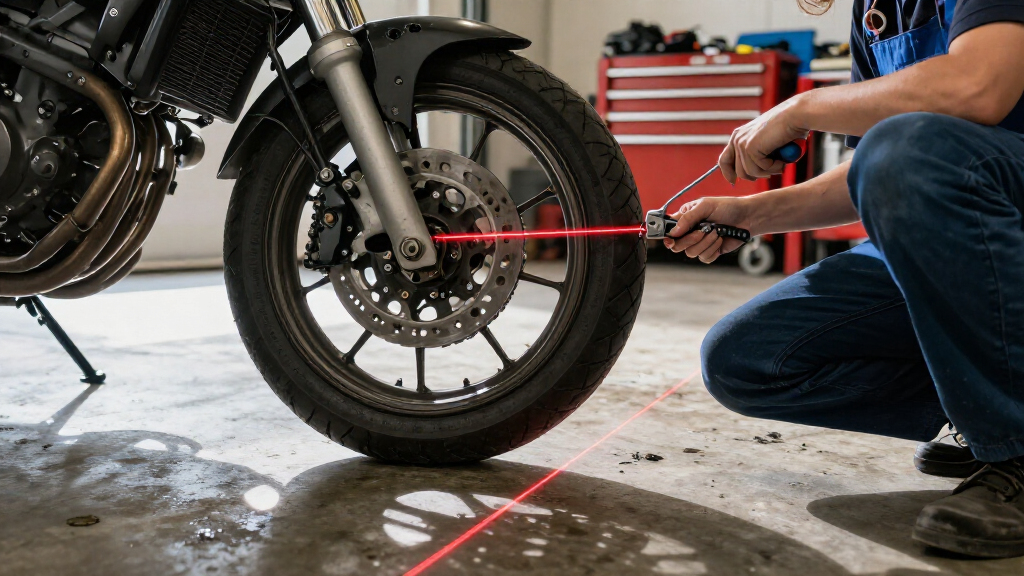
I ranked these 13 options by how directly they address motorcycle chain and sprocket alignment, then weighed the practical details a buyer can verify: alignment method, mounting approach, material, stated vehicle range, and ease of handling. A laser can make a reference line easier to see, but it is only useful if the tool sits securely and the rider can interpret the line consistently. I treated broad compatibility claims as a starting point, not proof that every tool fits every motorcycle.
The order favors products with a clearly defined alignment purpose and a distinctive role in this lineup. That puts the Tru-Tension Laser Monkey first as a dedicated laser wheel-alignment option, with named laser aligners and the Tusk mechanical tool close behind for different needs. Similar or sparsely described listings rank lower because the available product information gives buyers less basis for distinguishing fit and use. I did not infer accuracy, included accessories, or vehicle fit where those details were not stated.
Factors to Consider When Choosing Chain Alignment Tool Laser For Motorcycles
Choosing a chain alignment tool is less about picking the longest feature list and more about matching its reference method to your bike, workspace, and maintenance habits. These checks can help separate a useful laser tool from one that is awkward to mount or hard to read.
Choose a laser reference or a mechanical check
A laser gives you a visible line to compare against the chain or sprocket, which can make the alignment process easier to follow. It does not automatically make a measurement more accurate: a loose mount, misdirected beam, or poor viewing angle can undermine the result. A mechanical tool can be simpler to position and read, though it may require a more direct view of the parts. Think about whether you work in a bright garage or outdoors, where a beam may be harder to see. If possible, check how the tool defines correct alignment rather than assuming every laser uses the same reference.
Check how the tool attaches to your motorcycle
Mounting is a major source of variation between alignment tools, and a tool that cannot sit steadily is difficult to trust. Before buying, look for details about where it contacts the sprocket, wheel, or chain and whether nearby parts could block access. A motorcycle with a tight chain guard or unusual sprocket layout may need a different approach from an open dirt bike. Avoid forcing a tool into position or treating a crooked mount as a valid reading. When product details do not explain the attachment method, confirm compatibility with the seller or manufacturer instead of relying on a broad vehicle list.
Treat vehicle compatibility as a fit question, not a promise
Listings that mention motorcycles, ATVs, scooters, dirt bikes, and karts can sound universal, but those vehicles differ in sprocket size, access, and surrounding hardware. Check the tool’s stated contact range and compare it with your bike’s rear sprocket and swingarm area. If you maintain more than one vehicle, prioritize a tool with clearly described adjustment or fit limits rather than a long list of applications. A compact single-purpose tool may be easier for one bike, while a more adaptable design can make sense for a mixed garage. Do not assume a model fits simply because your vehicle type appears in its title.
Look for repeatable setup, not just a quick reading
Chain alignment checks are most useful when you can position the tool the same way each time. Stable contact points and an easy-to-read reference help reduce variation between checks, especially after adjusting the rear axle. A laser can speed up visual comparison, but a confusing setup may add steps rather than save them. Take note of whether instructions explain positioning and what the beam or indicator should line up with. For routine maintenance, a tool you can set up consistently is a better fit than one with extra features that are hard to interpret.
Decide how much versatility you actually need
A rider maintaining one motorcycle may gain little from a tool advertised for several vehicle categories if the added range makes setup less clear. Conversely, a home mechanic with an ATV and dirt bike may value a tool that can accommodate multiple sprocket layouts. Compare the stated applications with your own vehicles, not with hypothetical future projects. Also consider storage and handling: an aluminum body may suit riders seeking a lightweight tool, but material alone does not establish durability or precision. Spend more attention on clear fit information and a useful alignment method than broad claims.
Avoid treating chain alignment as the only adjustment
A laser alignment check does not replace setting chain slack, confirming axle position, or following the motorcycle maker’s service procedure. Riders can misread an alignment tool if the wheel is not positioned consistently or if the chain is adjusted unevenly. Recheck the measurement after tightening the axle, since tightening can shift the wheel. Use the tool as one part of a maintenance routine and consult the service manual for the required slack and torque values. This avoids choosing a tool on the assumption that it can diagnose every chain or drivetrain issue.
Frequently Asked Questions
Is a laser chain alignment tool more accurate than a mechanical one?
Not by default. A laser can make the reference easier to see, but accuracy still depends on stable mounting, correct positioning, and a clear method for interpreting the beam. A mechanical tool may be easier to use consistently if its contact points fit your sprocket well. Compare how each tool attaches and what it asks you to align, rather than choosing based on the laser feature alone. For either style, repeat the check after tightening the axle.
Can one alignment tool work for my motorcycle and my ATV?
Some products are marketed for both, but the vehicle list does not confirm a good fit for every sprocket or layout. Check the contact range, mounting method, and available clearance around each vehicle’s rear wheel. A tool that sits securely on one machine may be blocked by a guard or other hardware on another. If you plan to share it, look for explicit fit details for both models. When those details are missing, verify before purchase rather than assuming broad compatibility.
Should I buy a laser tool if I only adjust my chain occasionally?
It depends on whether a visible reference makes the process clearer for you, not just how often you perform the job. Occasional maintenance can favor a straightforward tool that is easy to position and understand, such as a mechanical option. A laser may be useful if you prefer a visual line, but its setup should still be simple enough that you can reproduce it after a long gap. Consider where you will work and whether the beam will be easy to see. The Tusk and laser-focused options in this roundup represent those different priorities.
What should I verify before choosing between the two KVAEY listings?
Compare the exact product details rather than relying on the similar names or wording. Check whether the listings specify different dimensions, mounting points, adjustment range, included components, or vehicle fit. The “professional” wording in one title does not by itself show a technical difference. If the details appear identical, confirm the model identifier and supplied contents before deciding. This is especially useful when choosing between closely related listings in a category with many near-duplicate descriptions.
Can I use a chain alignment laser to set chain slack too?
No; alignment and slack are separate checks. An alignment tool helps assess whether the chain and sprockets run in line, while slack must be measured using the motorcycle maker’s procedure and specified range. Correct alignment does not prove the chain has the right tension, and changing axle position can affect both. Complete each adjustment separately and recheck slack after tightening the axle. Use the service manual for the correct measurement points and values for your motorcycle.
Conclusion
For most riders, I’d start with the Tru-Tension Laser Monkey as the best overall pick for a dedicated laser-based alignment approach. The Tusk Chain Alignment Tool is my best-value style choice for buyers who prefer a simpler mechanical check, while the DOXOI is a notable alternative for shoppers specifically seeking a laser chain-and-sprocket aligner. Beginners should favor whichever option has the clearest mounting and reading instructions; an easy setup matters more than a feature-rich title. For mixed vehicle use, compare the stated fit of the DOXOI, CHARMOION, and other multi-vehicle listings against each machine before buying. A best-premium label is not justified by the available specifications alone, so I would not pay extra based only on marketing language. Choose the tool whose mounting method and reference match your bike, then use it alongside the maker’s chain-slack procedure.