For most buyers, I’d start with the Baofeng AR-5RM, which pairs 10W output claims with USB-C charging and a practical feature set. The BTECH UV-PRO is a stronger fit for buyers who want GPS, APRS, Bluetooth, and IP67 protection, while the UV-5R Mini offers a smaller, USB-C-charged alternative. The main tradeoffs are advanced features versus simpler operation, compact size versus battery capacity, and single radios versus bundled two-packs. Published power and range claims do not guarantee real-world coverage; terrain, antenna setup, and operating conditions matter. Read on for the full breakdown of all 14 handheld ham radios and how I’d choose between them.

Get business pricing on garage and car supplies
- Business-only prices and quantity discounts
- Tax-exempt purchasing
- Multiple users, one account, clear invoices
Complete the kit


Key Takeaways
- The AR-5RM is the clearest all-around starting point in this group: it combines USB-C charging and a 10W claim without the advanced digital and navigation features that add complexity to the BTECH UV-PRO.
- The UV-PRO is the feature-led premium choice because it adds IP67 protection, GPS, APRS, Bluetooth, and messaging; buyers who only need basic analog communication may not benefit from those extras.
- The UV-5R Mini stands apart through compactness and USB-C charging, but a smaller handheld may involve compromises in battery capacity or controls compared with larger models.
- Several listings are closely related Baofeng packages, including AR-5RM and UV-5RM variants, so included accessories and the exact model matter more than the product title’s long range or survival wording.
- Two-packs and accessory bundles suit paired users, while single radios make more sense for upgrading one device; neither bundle size nor a higher wattage claim guarantees better coverage.


| ham radios handheld | Channels | Charging |
|---|---|---|
| Baofeng AR-5RM Long Range Hand | 999 | — |
| Baofeng UV-5R Dual-Band Handhe | 128 | — |
| Baofeng UV-5RM Ham Radio Handh | 999 | USB-C and desktop base |
| Baofeng UV-5R Mini Two-Way Ham | Up to 999 | USB-C |
| BAOFENG 5RM Ham Radio 10W Long | Up to 999 programmable channels | USB-C cable and US base charger |
| Baofeng Radio UV-5R Mini Ham R | Up to 999 | USB-C |
| Baofeng Radio Ham Radio Handhe | Up to 999 | USB-C cable and US desktop charger |
| Baofeng UV-5RM Ham Radio Handh | 999 | USB-C and desktop charging base |
| Baofeng K5PLUS 10W Tri-Band Ha | — | — |
| BAOFENG K5PLUS Radio Ham Radio | Up to 999 | USB-C cable and US charger |
| BAOFENG UV-5R Ham Radio Handhe | — | — |
| BAOFENG DM-32UV DMR Dual-Mode | — | — |
| BTECH UV-PRO | — | USB-C rechargeable battery |
| Baofeng Radio UV-5RM Ham Radio | — | USB-C cable and desktop charging base |
More Details on Our Top Picks
Baofeng AR-5RM Long Range Handheld Ham Radio 10W with Type-C Charging
I’d choose the AR-5RM when a tougher build and 10W output matter more than a beginner-friendly setup. Its stated 3–5-mile range, high-gain antenna, and anti-drop design suit outdoor users who want more reach than a compact 5W option such as the UV-5R Mini. The larger screen also makes channel information easier to read at a glance, while USB-C charging gives it a practical edge over radios that rely only on a desktop charger.
The tradeoff is that 10W does not remove the need to understand ham-radio operation, and the supplied information gives no battery-life figure. Programming can also take patience, particularly for someone new to CHIRP or manual channel setup. I’d pick this over the standard UV-5R for its higher stated output and rugged design, but not for a first radio that needs simple setup or weatherproofing.
Pros:- 10W stated output and a high-gain antenna target greater reach than the 5W UV-5R Mini.
- Anti-drop design is suited to rougher outdoor handling.
- Large screen makes channel information easier to read.
- USB-C charging offers more flexible charging than a desktop-only setup.
Cons:- Programming may be difficult for users unfamiliar with ham-radio software or channel setup.
- Battery-life duration is not specified in the supplied product data.
- The stated range is not a guarantee of real-world communication distance.
Best for: Licensed outdoor operators who want a rugged-feeling 10W handheld with USB-C charging and are comfortable programming channels.
Not ideal for: New users seeking a simple, weather-resistant radio or buyers who need a stated battery-runtime figure before choosing.
- Communication range:3–5 miles (stated)
- Power output:10W
- Channels:999
- Frequency copy:Yes
- Antenna length:21 cm
- Charging port:USB-C
- FCC certification:Yes
Our verdict“Choose the AR-5RM if you want a rugged 10W handheld for outdoor use and can handle the programming, but skip it if easy setup is your priority.”
Baofeng UV-5R Dual-Band Handheld Two-Way Radio
The UV-5R is the straightforward pick for buyers who want a conventional dual-band handheld with a useful bundle of accessories. It stores 128 channels, offers selectable high and low transmit power, and supports CHIRP and PC programming. The included headset and desktop charger mean the basic setup is in the box, unlike more feature-heavy models such as the UV-5RM, whose appeal includes NOAA weather reception and a color display.
That simpler feature set is also the main limitation: this model has no water resistance, and its listed transmit ranges are limited to 144–148 MHz and 420–450 MHz. The stated 72-hour battery life should not be read as continuous transmitting time. I’d choose it over the AR-5RM for a basic, accessory-rich dual-band radio, but the AR-5RM offers more channels and higher stated output for users willing to manage a more involved setup.
Pros:- Dual-band VHF/UHF operation with selectable high and low transmit power.
- Includes a headset, battery, belt clip, and desktop charger.
- Supports CHIRP and PC programming for channel setup.
- Keypad lock and VOX add useful controls for routine handheld use.
Cons:- Not water resistant, limiting its suitability for wet or exposed outdoor use.
- Transmit operation is limited to the listed VHF and UHF ranges.
- Programming may require a manual or computer rather than a simple out-of-box setup.
Best for: Licensed beginners or budget-minded operators who want a basic VHF/UHF handheld, included headset, and desktop charger.
Not ideal for: People who need a water-resistant radio, weather-alert reception, or broad frequency coverage beyond the listed transmit bands.
- Frequency range:144–148 MHz / 420–450 MHz
- Channels:128
- Battery:7.4V 1800mAh Li-ion
- Battery life:72 hours (listed)
- Maximum talking range:5 km (listed)
- Dimensions:1.2 × 2.1 × 10.2 in (D × W × H)
- Water resistance:Not water resistant
- Included accessories:Antenna, headset, belt clip, hand strap, manual, adapter, desktop charger
Our verdict“Pick the UV-5R for a basic dual-band radio with included accessories, but choose a weather-featured model if outdoor alerts or water resistance matter.”
Baofeng UV-5RM Ham Radio Handheld Two-Way Radio with NOAA Weather, 999 Channels, Rechargeable Battery, Programming Cable & Earpiece
The UV-5RM is the best fit here for users who want a large channel list alongside weather monitoring. Its 999 channels, 1.77-inch color screen, and NOAA weather alerts give it a more information-focused role than the basic UV-5R, which has 128 channels and no listed weather reception. USB-C charging and a desktop base also provide more charging flexibility for home and field use.
Its wide listed receive coverage may appeal to listeners, but the transmit frequencies are specifically listed as 144–148 MHz and 420–450 MHz; broad receive coverage does not mean it can transmit across the full receive range. Programming still takes some learning, and the larger build may be less convenient to carry than the UV-5R Mini. I’d favor this model for weather awareness and organized channel storage, not for someone seeking the smallest or simplest handheld.
Pros:- NOAA weather alerts add useful information for outdoor and emergency planning.
- 999 channels provide room to organize many programmed frequencies.
- Color display makes channel information easier to distinguish.
- USB-C and desktop-base charging give users more than one charging option.
Cons:- Programming can be challenging for users unfamiliar with radio software.
- Bulkier design may be less convenient to carry than the UV-5R Mini.
- Listed transmit frequencies cover only the specified VHF and UHF ranges.
Best for: Outdoor and emergency-preparedness users who want NOAA weather alerts, a color display, and substantial channel storage.
Not ideal for: Buyers who prioritize a compact radio or need an uncomplicated setup without programming software or cable use.
- Frequency range:108–520 MHz
- Transmit frequencies:144–148 MHz and 420–450 MHz
- Display:1.77-inch color
- Channels:999
- Battery capacity:2500mAh
- Charging:USB-C and desktop base
- FCC ID:2AJGM-5RH
Our verdict“Choose the UV-5RM if weather alerts and extensive channel storage matter more than compact size or beginner-simple programming.”
Baofeng UV-5R Mini Two-Way Ham Radio with USB-C Charging
The UV-5R Mini makes the most sense for buyers who value a compact form and phone-based channel setup over maximum stated range. Its 5W output, USB-C charging, and OLA Radio app programming create a more portable, modern-feeling alternative to the larger UV-5RM. It also receives NOAA weather, and the two included antennas let owners switch between the original antenna and a longer 38 cm option depending on their setup.
The significant limitation is the listed 999-foot maximum talking range, which is far less ambitious than the 3–5 miles stated for the AR-5RM. That makes this a poor choice for anyone selecting a radio primarily for distance. It is also not water resistant, and the supplied battery details are unusual enough that buyers should check compatibility and charging needs. I’d choose it for compact carry and app programming, not for rugged or long-range work.
Pros:- Compact design is easier to carry than larger models such as the UV-5RM.
- USB-C charging can use common USB power sources.
- OLA Radio app programming offers a phone-based alternative to keypad setup.
- NOAA reception and two included antennas add flexibility for listening and setup.
Cons:- Listed maximum talking range is only 999 feet.
- Not water resistant, limiting use in wet conditions.
- The supplied battery is listed as 12V, so buyers should verify charging and compatibility details.
Best for: Licensed users who want a compact VHF/UHF handheld with USB-C charging and app-based programming for short-range use.
Not ideal for: Buyers who need long-distance communication, water resistance, or a clearly documented battery setup.
- Channels:Up to 999
- Output power:5W
- Frequency bands:VHF/UHF
- Charging:USB-C
- Weather reception:NOAA
- Programming:OLA Radio app; supports CHIRP
- Antennas:Original antenna and 38 cm antenna
- Water resistance:Not water resistant
- Included battery:One 12V battery (as listed)
Our verdict“Choose the UV-5R Mini for compact carry and app programming at short range, but skip it if communication distance is your main requirement.”
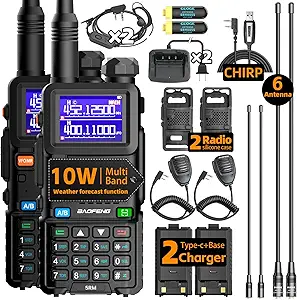
BAOFENG 5RM Ham Radio 10W Long Range Handheld NOAA Weather Receiver 2500mAh Battery UV-5R Upgrade with Programming Cable,Speaker Mic,Tactical Antenna,Type-C Charging,2Pack
This two-radio UV-5RM bundle stands out for buyers who need matching handhelds for a partner, group, or shared emergency kit. Each radio is listed with 10W output, 999 channels, NOAA reception, and a 2500mAh battery, while the package adds programming cables, speaker microphones, earpieces, USB-C cables, and both tactical and original antennas. Compared with the single AR-5RM, this is the more practical pick when having two radios and a broad accessory set matters more than keeping the kit simple.
The tradeoff is the amount of gear to configure and carry: two radios plus long tactical antennas and charging bases make for a bulky package. Programming is still part of the ownership experience, and the listing does not provide a specific range or water-resistance rating. I’d choose this over the standard UV-5R for a coordinated two-person setup with weather reception, but not for a lone user seeking a compact handheld.
Pros:- Two radios support communication between partners without sourcing a second handheld.
- Each radio is listed with 10W output, 999 channels, NOAA reception, and a 2500mAh battery.
- Package includes programming cables, speaker microphones, earpieces, and charging bases.
- Tactical and original antennas give users alternative antenna setups.
Cons:- Two radios and the included accessories create a bulky kit to transport and store.
- Programming still requires setup and familiarity with radio channels.
- No specific communication range or water-resistance rating is provided.
Best for: Two licensed operators, hunting partners, or families who want matching radios, NOAA reception, and shared programming accessories.
Not ideal for: Solo buyers or users who need a compact, water-resistant radio with a clearly stated communication range.
- Quantity:2 radios
- Power output:10W
- Channels:Up to 999 programmable channels
- Battery capacity:2500mAh per radio
- Charging:USB-C cable and US base charger
- Weather reception:NOAA, with 10 weather scan and receive features listed
- Display:1.77-inch color screen
- Included antennas:Tactical antenna and original antenna per radio
- Included accessories:Programming cable, speaker microphone, earpiece, charging base, USB-C cable, battery, belt clip, hand strap
Our verdict“Choose this bundle for two operators who want matching 10W radios and a full accessory kit, but not if portability or simple setup comes first.”
Baofeng Radio UV-5R Mini Ham Radio Long Range Handheld Two Way Radio NOAA Weather Radio Rechargeable Walkie Talkies Dual PTT APP Programming Copy Frequency 999CH with USB-C Charging Survival Radio
The UV-5R Mini is the lineup’s most appealing choice for buyers who want to adjust channels from a phone rather than depend on a programming cable. Its OLA Radio app support and frequency-copy function can simplify setup, while USB-C charging makes topping up from a power bank or vehicle convenient. The set includes two antennas per radio, letting buyers choose between a shorter option and a longer 38 cm antenna for different outings. Compared with the UV-5RM two-pack, this model is rated at 5W rather than 10W, so I’d favor the UV-5RM when higher output and its larger battery are the priority. The Mini’s compact format and large screen are useful, but it is not water-resistant, and its stated maximum range should not be treated as a dependable field distance.
Pros:- Phone-based programming and frequency copying reduce reliance on a computer and programming cable
- USB-C charging supports power banks, car ports, laptops, and other USB sources
- Includes both short and 38 cm antennas for different carrying and antenna preferences
- Receives NOAA weather broadcasts and offers a larger screen than traditional UV-5R models
Cons:- 5W output is lower than the 10W rating of the UV-5RM options in this roundup
- The radio is not water-resistant, limiting its suitability for wet outdoor use
- App-based setup and amateur-radio operation may still be challenging for newcomers
Best for: Ham operators who want app-assisted frequency setup, USB-C charging, and a compact two-radio kit for dry-weather outings
Not ideal for: Buyers who need a weather-sealed handheld, higher stated output, or reliable communications at a guaranteed multi-mile distance
- Output power:5W
- Channels:Up to 999
- Frequency bands:VHF/UHF
- Charging:USB-C
- Weather reception:NOAA
- Programming:OLA Radio app and CHIRP support listed
- Water resistance:Not water-resistant
- Included antennas:9 cm and 38 cm antennas per radio
- Package quantity:2 radios
Our verdict“Choose the UV-5R Mini if phone-friendly setup and USB-C charging matter more than higher output or weather protection.”
Baofeng Radio Ham Radio Handheld UV-5R Upgrade Long Range Rechargeable AR-5RM 10W NOAA Weather Emergency Tactical Two Way Radio with Programming Cable for Survival Gear Hunting Camping,2 Pack
This AR-5RM two-pack suits buyers who want a ready-to-equip pair for outdoor trips: each radio comes with a 2500mAh battery, USB-C cable, desktop charger, speaker microphone, and multiple antennas. Its listed 10W output and 999-channel capacity put it closer to the UV-5RM than the 5W UV-5R Mini, while the included programming cable gives a direct route to configuring channels. NOAA reception adds a weather-information option, though a handheld radio’s reception depends on location and signal conditions. Compared with the Baofeng UV-5RM two-pack, this kit spells out a particularly broad accessory bundle, including two antenna styles per radio and speaker mics. The tradeoff is a larger, more involved setup than a simple walkie-talkie; advanced amateur-radio features and frequency programming can take time to learn.
Pros:- Two radios are supplied with separate batteries, USB-C cables, and desktop charging bases
- 10W stated output and 999-channel storage provide broad configuration options
- Speaker microphones allow hands-free carrying and operation
- Multiple antenna types and NOAA reception support varied outdoor use
Cons:- Programming cable and broad frequency options can make setup demanding for new operators
- The larger body and accessory bundle are less convenient for buyers seeking minimal carry weight
- The listed output does not guarantee long-range communication; terrain and antenna placement affect results
Best for: Two-person camping, hunting, or emergency-preparedness groups who want speaker mics, charger bases, and antenna choices in one kit
Not ideal for: First-time users seeking a simple, preset-channel walkie-talkie or anyone who prioritizes a small, lightweight handheld
- Model:AR-5RM
- Output power:10W
- Channels:Up to 999
- Receive frequency range:108–136, 136–174, 220–260, 350–390, and 400–520 MHz
- Transmit frequency range:144–148 and 420–450 MHz
- Battery:2500mAh rechargeable
- Charging:USB-C cable and US desktop charger
- Weather reception:NOAA
- Package quantity:2 radios
Our verdict“Pick this AR-5RM kit when two users need a substantial accessory bundle and are willing to handle radio programming.”
Baofeng UV-5RM Ham Radio Handheld Two-Way Radio (2 Pack)
The UV-5RM two-pack is a practical pick for buyers who want two handhelds with a clear, familiar set of core extras: a color display, rechargeable 2500mAh batteries, NOAA alerts, and included programming accessories. Its receive coverage is broad, while the listed transmit ranges are confined to amateur bands; that distinction matters when choosing a radio for a particular service. Compared with the AR-5RM kit, the supplied details here specify a 1.77-inch color screen and battery capacity, but do not list its output power or antenna options. Compared with the compact UV-5R Mini, it offers more documented capacity and a larger display, at the cost of a bulkier design. Channel programming may require time and software familiarity, so I would not treat it as a ready-to-use consumer walkie-talkie.
Pros:- Two-radio package provides a matching set for partners or family members
- 2500mAh rechargeable batteries and USB-C charging offer flexible power options
- NOAA alerts add a way to monitor weather broadcasts while outdoors
- Color display and up to 999 channels support organized channel use
Cons:- The listed specifications do not state the radio’s output power
- Programming may require software familiarity and setup time
- Bulkier construction is less convenient to carry than a compact handheld
Best for: Outdoor partners or households who want two radios with NOAA reception, color screens, and included programming accessories
Not ideal for: Buyers who need a documented high-output rating, a particularly compact radio, or plug-and-play operation without channel setup
- Receive frequency range:108–520 MHz
- Transmit frequency ranges:144–148 MHz and 420–450 MHz
- Channels:999
- Battery:2500mAh rechargeable
- Display:1.77-inch color
- Charging:USB-C and desktop charging base
- Weather reception:NOAA alerts
- Included accessories:Programming cable, earpiece, and speaker microphone
- Package quantity:2 radios
Our verdict“Choose this UV-5RM pair for two users who value a color display and a documented accessory set over compact size or a specified output rating.”
Baofeng K5PLUS 10W Tri-Band Ham Radio with High Gain Antenna and Speaker Mic
The K5PLUS stands apart from the dual-band handhelds here by adding 1.25M transmission alongside VHF and UHF. That extra band is the reason to choose it, not a guarantee of better reach: useful contacts still depend on local repeaters, antenna conditions, and legal operating privileges. Its output can be selected at 10W, 7W, or 4W, giving buyers a lower-power option when maximum output is unnecessary. Reception also extends to FM, Airband, and NOAA, making it a more versatile listening tool than the UV-5RM two-packs. The tradeoff is that broader capability brings more configuration to learn, and using the highest output can draw down the 2500mAh battery faster. Buyers who only need ordinary VHF/UHF communication may find the simpler UV-5R Mini easier to manage.
Pros:- Tri-band transmission adds 1.25M capability beyond the VHF/UHF-only options
- Selectable 10W, 7W, and 4W output offers power flexibility
- Reception includes FM, Airband, and NOAA as well as VHF, UHF, and other listed ranges
- USB-C charging and CHIRP compatibility support charging and channel management
Cons:- Higher-output transmission can reduce runtime from the 2500mAh battery
- Advanced band and frequency options add setup complexity compared with the UV-5R Mini
- 1.25M capability is of limited use without compatible local activity and proper operating privileges
Best for: Licensed operators who can use 1.25M and want one handheld that also receives FM, Airband, and NOAA broadcasts
Not ideal for: Beginners who only need basic VHF/UHF communication or buyers who want long battery life while transmitting at maximum output
- Model:K5PLUS
- Output power:10W, 7W, or 4W
- Transmit bands:UHF, VHF, and 1.25M
- Reception:VHF, UHF, FM, Airband, 1.25M, 1M, and NOAA
- Battery capacity:2500mAh
- Charging interface:USB-C
- Programming:CHIRP compatible
- FCC ID:2AJGM-5RM
Our verdict“Choose the K5PLUS if you specifically need 1.25M transmission and broad scanning, rather than a simpler dual-band handheld.”
BAOFENG K5PLUS Radio Ham Radio 10W Rechargeable Walkie Talkies Long Range UV32 5RM Handheld Two Way Radio NOAA Weather Radio with Copy Frequency,USB-C Charging for Hunting Survival Gear
This K5PLUS package is aimed at outdoor users who want a long antenna and a broad set of built-in functions rather than a minimal handheld. The included 15.35-inch high-gain antenna is the main distinction from the K5PLUS listing with a speaker mic: it offers an alternate antenna setup, but its length can make carrying and storage less convenient. One-click frequency copying, USB-C and desktop charging, NOAA reception, and 999-channel storage add practical flexibility for trips. Compared with the UV-5RM two-pack, this model lists features such as Airband reception, a flashlight, and a stopwatch, but the supplied description does not specify a battery capacity or frequency ranges. Its 10 NOAA channels and feature list are useful, though more functions also mean more controls to learn.
Pros:- Includes a 15.35-inch high-gain antenna as an alternative to a shorter antenna
- USB-C cable and US charger provide two charging methods
- One-click frequency copying can simplify matching another radio’s frequency
- Includes NOAA reception, up to 999 channels, Airband, FM, VOX, and a flashlight
Cons:- The long antenna can be awkward to store and carry on a small pack
- The product details do not state battery capacity or exact frequency ranges
- The wide feature set may take time to configure and operate
Best for: Outdoor radio users who want an included long antenna, quick frequency copying, and extras such as NOAA reception and a flashlight
Not ideal for: Buyers who need clearly documented band coverage, a compact antenna setup, or a specified battery capacity before choosing
- Model designation:K5PLUS / UV32 / 5RM
- Output power:10W
- Channels:Up to 999
- Included antenna:15.35-inch high-gain antenna
- Charging:USB-C cable and US charger
- Weather reception:10 NOAA channels
- Radio features:Airband, FM, DTMF, VOX, alarm, and stopwatch
- Other feature:LED flashlight
Our verdict“Pick this K5PLUS package if the long antenna and field-oriented extras matter more than compact carry or fully specified battery and band details.”
BAOFENG UV-5R Ham Radio Handheld, 8W, 3800mAh, 2 Pack
This two-radio UV-5R kit is the most practical pick here for buyers who want a pair of programmable handhelds and accessories in one package. Its 3800mAh batteries offer more listed capacity than the 2500mAh unit in the UV-5RM two-pack, which may suit longer outings between charges. The included programming cable gives owners a path to customize channel setups, while the earpieces and tactical antennas add useful kit components without requiring separate purchases. Compared with the feature-rich BTECH UV-PRO, this model is much more basic: it lacks listed GPS, APRS, Bluetooth, and IP67 protection. Its tradeoff is complexity and regulatory responsibility; frequency programming takes care, and the stated 8W maximum does not itself guarantee longer range. I’d choose it for a budget-conscious pair that values battery capacity and customization over modern navigation and ruggedness.
Pros:- Two radios are supplied with earpieces and a programming cable
- 3800mAh battery capacity is higher than the UV-5RM two-pack’s listed 2500mAh
- High, medium, and low transmit-power settings allow power selection
- 128 channels and CHIRP-compatible programming support custom channel plans
Cons:- Programming and frequency selection require care and radio knowledge
- No listed IP rating, GPS/APRS, or Bluetooth features
- The 8W maximum output does not by itself establish real-world range
Best for: Two licensed radio users who want a programmable pair with high-capacity batteries, earpieces, and a programming cable for outdoor trips or preparedness kits.
Not ideal for: Beginners seeking simple setup, or users who need documented water protection, GPS/APRS, or app-connected channel management.
- Maximum transmit power:8W
- Battery capacity:3800mAh
- Channel capacity:128 channels
- Band features:Dual band, dual display, and dual standby
- Transmit power settings:High, medium, and low
- Programming:Included programming cable; CHIRP software on Windows listed
- Included accessories:Tactical antenna, earpiece, and USB charging cable
- Pack size:2 radios
Our verdict“Choose this two-pack if battery capacity and included programming accessories matter more than rugged protection or advanced digital features.”
BAOFENG DM-32UV DMR Dual-Mode Two-Way Radio
The DM-32UV is the lineup’s specialist choice for users who want digital DMR alongside analog and a large channel bank. Its capacity of up to 4,000 channels dwarfs the 128 in the UV-5R two-pack, making it more suitable for organized team, site, or repeater plans than a simple emergency pair. Built-in GPS/APRS, text messaging, recording, and NOAA reception add tools that the basic UV-5R does not list. The 2-inch display and USB-C connection also make its control and update setup feel more modern on paper. Those features come with caveats: the listed frequency coverage and local rules need checking before use, and the product description gives an IP67 claim without explaining its test conditions. At a listed 2 lb, it is also far heavier than a typical pocket radio, so I’d favor capability over carry comfort.
Pros:- Supports both DMR digital and analog communication
- Up to 4,000 channels suit complex or multi-site channel plans
- GPS/APRS, text messaging, voice recording, and NOAA reception add field functions
- USB-C supports charging, programming, and firmware updates
Cons:- Listed weight of 2 lb is substantial for a handheld radio
- Frequency ranges may not match every local regulation or radio system
- IP67 is listed, but the description does not state the rating conditions
Best for: Licensed operators and teams that use DMR and analog systems, manage many channels, and value GPS/APRS, messaging, and NOAA reception in one handheld.
Not ideal for: Casual users wanting a light, straightforward handheld or buyers unwilling to verify frequency compatibility and water-resistance details.
- Communication modes:DMR digital and analog
- Maximum output power:10W
- Channel capacity:Up to 4,000 channels
- Frequency range:AM 108–136 MHz; FM 65–108 MHz; UHF 400–470 MHz; VHF 136–174 MHz
- Display:2.0-inch screen
- GPS and APRS:Built-in GPS and APRS
- Battery:7.4V, 2500mAh; one battery included
- Connectivity and protection:USB Type-C; water resistant, IP67 listed
- Weight:2 lb
Our verdict“Pick the DM-32UV when DMR, extensive channel capacity, and field data features outweigh weight and setup complexity.”
BTECH UV-PRO (TAN) IP67 Dual Band VHF/UHF Two-Way Radio
The UV-PRO is the clearest choice for buyers who want a handheld radio built around app-based setup and field coordination, rather than a traditional keypad-first workflow. Its BTECH UV app can manage channel plans and keep multiple radios aligned, a useful distinction from the UV-5R kit, which relies on programming software and a cable. GPS location sharing, APRS tools, Bluetooth audio, and rapid scanning broaden its role for events, field work, and off-grid groups. The IP67 dust and water protection also gives it a more clearly defined ruggedness claim than the DM-32UV, whose listing supplies no rating conditions. There are tradeoffs: the description does not provide battery capacity, channel count, or transmit power, and Bluetooth compatibility depends on supported accessories. Buyers who want a simple, low-cost radio may find its connected feature set unnecessary.
Pros:- App supports channel management and shared channel-plan editing across radios
- IP67 protection is specified as dust-tight and water resistant up to 1m for 30 minutes
- GPS location tools and APRS support coordination and tracking workflows
- Bluetooth audio, aviation-band reception, and NOAA alerts extend its monitoring options
Cons:- The provided product data does not state transmit power, battery capacity, or channel count
- Bluetooth hands-free use depends on compatible third-party audio gear
- App-connected functions may be unnecessary for buyers seeking a basic handheld
Best for: Licensed event, field, or outdoor users who coordinate several radios and want app-managed channels, location sharing, APRS, and documented dust and water protection.
Not ideal for: Buyers prioritizing a basic radio with clearly stated battery capacity and transmit power, or those who do not want app and accessory dependencies.
- Radio bands:Dual-band VHF/UHF
- Protection:IP67 dust-tight and water resistant up to 1m for 30 minutes
- App connectivity:BTECH UV app for setup, channel management, and group coordination
- Bluetooth:HFP audio and data modes; KISS TNC workflows supported where enabled
- GPS:Built-in GPS with radio and app location tools
- APRS:APRS tracking and messaging tools with smart beaconing options
- Receive features:Aviation-band reception, NOAA weather alerts, and rapid scan
- Charging:USB-C rechargeable battery
Our verdict“Choose the UV-PRO for app-led group coordination and defined rugged protection, not for a basic radio with fully specified core hardware.”
Baofeng Radio UV-5RM Ham Radio Handheld, 999 Channels, NOAA Weather, 2 Pack
This UV-5RM two-pack makes a stronger beginner-oriented case than the 8W UV-5R kit because it adds one-touch frequency cloning, a color display, and a charging base. Cloning can simplify matching compatible radios for a small group, while the 999-channel memory offers far more room than the UV-5R’s 128 channels. NOAA reception and USB-C charging make it a practical option for camping or an emergency kit, and CHIRP support leaves room to organize channels later. Its listed transmit bands are limited to licensed ham bands, despite wider receive coverage, so it is not a general-purpose transmitter for every service. Compared with the connected BTECH UV-PRO, it lacks listed GPS, APRS, Bluetooth, and IP67 protection; in return, the UV-5RM supplies two radios and a more conventional setup path. I’d verify programming and permissions before relying on it.
Pros:- Two radios include a frequency-copy function to simplify matching compatible units
- 999 memory channels provide much more capacity than the 128-channel UV-5R kit
- USB-C cable and desktop charging base offer flexible charging options
- Color display, NOAA reception, and speaker microphone support practical field use
Cons:- Transmit operation is listed for licensed ham bands, not the full receive range
- No GPS/APRS, Bluetooth, or IP protection rating is listed
- 2500mAh batteries have less stated capacity than the 3800mAh UV-5R kit
Best for: Newly licensed pairs or outdoor partners who want two matching radios, easier frequency copying, NOAA reception, and straightforward USB-C charging.
Not ideal for: Users who need GPS/APRS, verified rugged water protection, or transmit capability across every frequency shown in the wide receive range.
- Transmit bands:144–148 MHz and 420–450 MHz
- Receive range:108–136 MHz, 136–174 MHz, 220–260 MHz, 350–390 MHz, and 400–520 MHz
- Channel capacity:999 memory channels
- Display:1.77-inch color display
- Battery:2500mAh rechargeable battery per radio
- Charging:USB-C cable and desktop charging base
- Programming:CHIRP-compatible; one-touch frequency cloning
- Weather and audio:NOAA weather receiver; speaker microphone included
- Pack size:2 radios
Our verdict“Choose this pair for easier radio matching and expanded channel storage, but not if you need advanced tracking or ruggedness features.”

How We Picked
I compared these 14 handheld radios by the details that change ownership and field use: stated band support, charging method, battery and accessory bundle, programming options, weather features, durability, and additional functions such as digital voice, GPS, or APRS. I also separated radios that appear aimed at basic analog use from models that add specialized capabilities, rather than treating every long-range claim as a performance advantage. Since listings do not provide a common real-world range test, I treat output and range wording as claims, not proof of coverage.
The ranking favors useful capability with manageable complexity for the broadest range of licensed handheld-radio buyers. The AR-5RM leads as a balanced feature set; the UV-PRO earns a higher-feature role but is not the default for everyone. Compact, entry-level, multi-radio, and digital options rank for their distinct uses, while near-duplicate bundles are separated by model details and included equipment. Before buying, verify the exact version, supported frequencies, local rules, and included accessories on the listing.
Factors to Consider When Choosing Ham Radios Handheld
I’d choose a handheld ham radio by matching it to how and where it will be used, not by comparing headline wattage alone. These four decision points help distinguish a simple analog handheld from a more specialized radio, and they can prevent paying for features that will go unused.
Match the Radio to Your License and Local Frequencies
A handheld’s band labels do not tell the whole story: the channels you may transmit on depend on your license, radio configuration, and local regulations. Check that the radio supports the amateur bands and repeater offsets you expect to use, then confirm that it can be programmed appropriately. Some listings advertise broad frequency coverage, but receive capability does not automatically mean you may transmit there. A radio with many channels is useful only if you can organize and program them. New operators should learn local repeater settings before choosing a model based on channel count. I’d treat legal, straightforward programming as more valuable than a long list of frequencies.
Treat Wattage and Range Claims as Starting Points
Higher stated transmit power can help in some conditions, but it does not turn a handheld into a guaranteed long-range link. Terrain, buildings, antenna position, repeater access, and the receiving station all shape coverage. A better antenna or a clear line of sight may matter more than a small increase in advertised output. Higher output can also use battery power more quickly and create extra heat. For hiking or emergency planning, check which local repeaters are reachable and plan for dead zones instead of relying on a range figure. I’d prioritize dependable charging and a workable antenna setup over a headline number.
Choose Charging and Battery Setup for Your Routine
USB-C can make charging easier when a phone charger or power bank is already part of your kit, but check whether the radio can charge directly or requires a particular battery or cradle. A larger battery may extend operation, while adding bulk and weight to a belt or pack. Bundled batteries and accessories can vary between listings that use similar model names, so inspect the package contents before ordering. For regular use, spare batteries or a reliable charging cradle may matter more than a feature-rich menu. For an emergency kit, test your charging plan with the cables and power source you expect to carry. I’d avoid assuming that every product titled as an upgrade includes the same battery.
Decide How Much Programming Help You Need
Programming can be the biggest early hurdle for a new handheld-radio owner. A cable, app-based programming, or frequency-copy feature may save setup time, but it does not replace learning what frequencies and settings are appropriate. Check whether the programming method works with your computer or phone and whether the required software is available. A simpler radio may be easier to operate from its keypad, while a highly configurable model can take more setup and practice. If you plan to use repeaters, organize channel names and settings before an outing rather than learning the menu under pressure. I’d favor a clear setup path over a large channel count you cannot easily manage.
Pay for Ruggedness and Advanced Features Only When They Fit
Water and dust protection matter more for paddling, wet hikes, and work outdoors than for a radio that stays in a dry vehicle. Check the stated protection rating and whether it applies to the complete radio with its ports and accessories in their intended configuration. Features such as GPS, APRS, Bluetooth, text messaging, or digital voice can add real value for tracking, data, or compatible digital networks, but they also bring setup and interoperability questions. A basic analog handheld may be the easier choice for local repeater communication and learning. Before paying for digital functions, confirm that the people and repeaters you plan to contact support the same mode. I’d spend on ruggedness or advanced tools only when the use case is clear.
Compare the Full Kit, Not Just the Model Name
In this roundup, several Baofeng listings use closely related UV-5R, UV-5RM, and AR-5RM names, while packages differ in radio count and accessories. A speaker microphone, earpiece, programming cable, or extra antenna can be useful, but only if it is compatible and suits your actual setup. Two-packs make sense when two licensed users need matching radios; a bundle is less compelling if the second unit will sit unused. Verify whether the listing names the exact radio version and spells out each included item. Similar titles and broad emergency-use language can obscure meaningful package differences. I’d compare the contents and functions line by line before treating two listings as equivalent.
Frequently Asked Questions
Do I need an amateur radio license to transmit with one of these handhelds?
In the United States, transmitting on amateur radio frequencies generally requires an amateur radio license, and operators must follow the rules for their license class and frequency. A radio’s ability to tune to a frequency does not grant permission to transmit there. Rules differ by country and by radio service, so check the regulations that apply where you live. You can usually research or listen within applicable rules before transmitting, but verify local requirements. If you are buying for a household, make sure each intended operator understands the licensing rules.
Will a 10W handheld reach farther than a lower-power radio?
Not reliably in every setting. More output may help when other conditions are similar, but antenna position, terrain, buildings, repeater location, and the receiving station often make a larger difference. A handheld radio’s range claim should not be treated as a guaranteed distance. More transmit power can also draw the battery down faster, which matters during long outings. I’d check local repeater coverage and consider antenna and battery needs before choosing by wattage alone.
Should I buy a two-pack or one radio with more features?
A two-pack is practical if two licensed users need compatible radios and will use them together. It can also provide a spare, though the spare is only useful if you keep it charged and know how to operate it. A single feature-rich model is a better fit when you need capabilities such as GPS, APRS, digital voice, or weather alerts in one device. Check each package’s contents because similar product names can describe different bundles. Compare the actual radio features first, then decide whether the extra unit or accessories fill a real need.
Is a USB-C handheld a better choice for emergency preparedness?
USB-C can simplify charging if your power bank, vehicle setup, or other gear already uses it. That convenience does not by itself make a radio dependable in an emergency; you still need a charged battery, a working antenna, and a plan for local frequencies or repeaters. Confirm how the radio charges and whether it can operate while connected to a power source, rather than assuming every USB-C listing works the same way. Keep compatible cables and a backup power plan with the radio. Practice using the equipment before relying on it outside familiar conditions.
Is the BTECH UV-PRO worth choosing over a simpler analog handheld?
It may be, if you have a clear use for its stated IP67 protection, GPS, APRS, Bluetooth, messaging, or other advanced functions. Those features can support outdoor tracking and data use, but they may take more setup and may not work with every radio or repeater. If your main goal is learning basic analog communication or using local repeaters, a simpler handheld may be easier to configure and operate. Check network and mode compatibility before paying for digital or data features. The right choice depends on whether those capabilities will be used, not on the length of the feature list.
Conclusion
For the broadest mix of everyday handheld-radio features, I’d choose the Baofeng AR-5RM as the best overall pick. The UV-5R Mini is my best-value direction for buyers who prefer a compact radio with USB-C charging, while beginners may be better served by a straightforward UV-5R package with a programming cable and a manageable feature set. For a best premium choice, the BTECH UV-PRO is the standout when GPS, APRS, Bluetooth, and IP67 protection justify the added complexity. Buyers who need two radios can compare the UV-5RM and AR-5RM two-packs by exact included accessories; users seeking digital operation should look closely at the DM-32UV and confirm compatibility with their intended system. Before choosing, verify licensing, supported frequencies, charging details, and the contents of the exact listing.