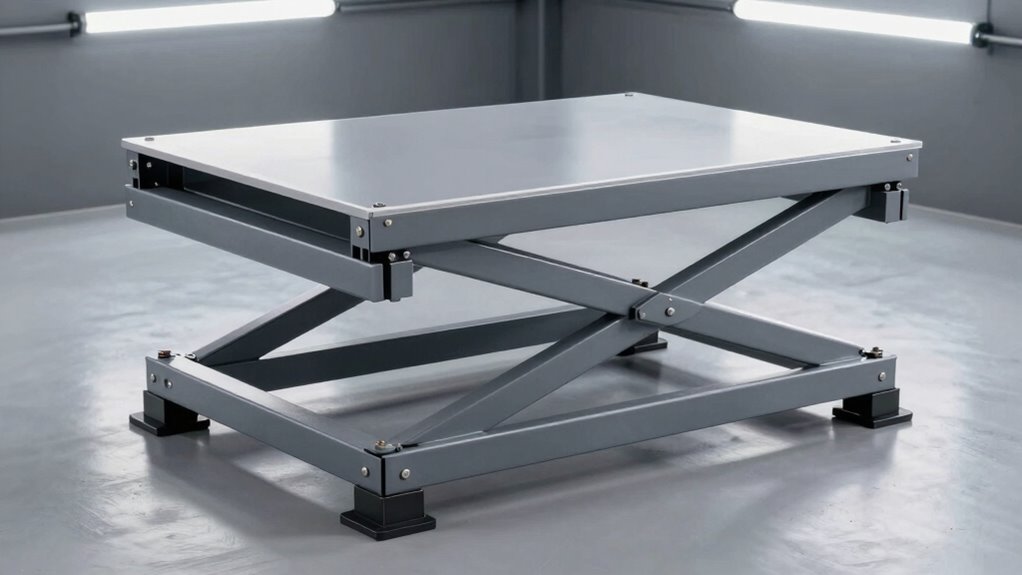

When choosing a lift table, appearances can be deceiving. To guarantee safety and stability, you need to check its load capacity and safety features like locks, overload sensors, and stabilizing arms. These elements prevent tipping and wobbling even under heavy or uneven loads. Focus on these stability dimensions, as they impact performance and safety more than looks alone. If you want to understand how to assess these factors effectively, keep going for more insights.

Get business pricing on garage and car supplies
- Business-only prices and quantity discounts
- Tax-exempt purchasing
- Multiple users, one account, clear invoices
Key Takeaways
- Load capacity variations directly affect the stability and safety of lift tables under different loads.
- Safety features like locks and overload sensors are crucial for maintaining stability during operation.
- Structural design elements, such as low centers of gravity and reinforcement, distinguish stable lift tables.
- External appearance often masks internal specifications that determine overall stability.
- Proper evaluation of safety features and load specifications ensures reliable, wobble-free lifting performance.
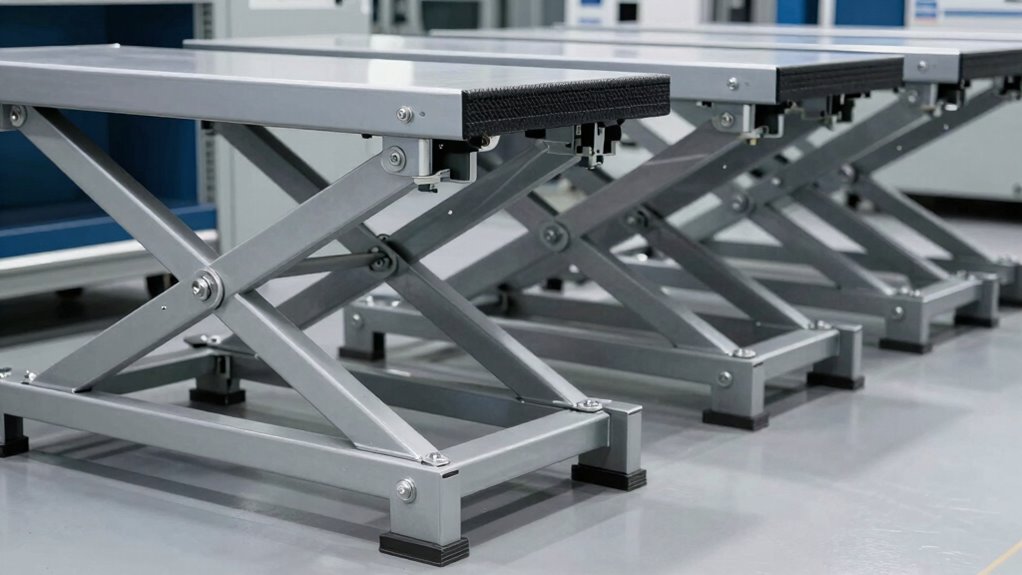
Have you ever wondered how lift tables maintain stability during operation? Even if they look similar at first glance, their ability to stay steady under load depends on more than just their design. The key factor is their load capacity, which determines how much weight they can safely lift without risking imbalance or failure. Lift tables are engineered with precise specifications to handle a specific maximum load—exceeding this limit can compromise stability and pose safety hazards. That’s why understanding the load capacity is essential when selecting a lift table for your needs. It guarantees the equipment can support your operations without wobbling or tipping, even when fully extended or loaded unevenly.
Beyond load capacity, safety features play a critical role in maintaining stability. Many lift tables come equipped with safety locks, overload protection systems, and stabilization mechanisms designed to prevent accidental falls or tilting. For example, safety locks secure the platform in place once it reaches the desired height, reducing the risk of sudden drops or shifts. Overload protection sensors automatically shut down the lift if the load exceeds safe limits, safeguarding both the operator and the equipment. Additionally, some models feature stabilizing arms or wide bases that distribute weight more evenly, preventing the machine from becoming unstable on uneven surfaces or during dynamic movements. Proper design and engineering also involve considerations like a low center of gravity and reinforced structural components, which help keep the platform steady during lifting and lowering. Incorporating structural reinforcement can further enhance stability, especially in challenging operational environments. Understanding the importance of structural integrity ensures the lift’s safety and reliability over time.
When you check a lift table’s specifications, paying attention to these safety features and load capacity details can make a significant difference in your operational safety and efficiency. Even if two models look alike, differences in these dimensions and safety measures can determine which one is truly suitable for your specific tasks. Recognizing the importance of these factors, including load capacity and safety features, helps you choose equipment that not only performs well but also keeps everyone safe during operation. Additionally, considering quality standards ensures that the lift table meets industry safety and durability benchmarks, providing long-term reliability.
In essence, while lift tables may appear similar externally, their stability hinges on these essential dimensions—load capacity and safety features—that are often overlooked at first glance. Recognizing the importance of these factors helps you choose equipment that not only performs well but also keeps everyone safe during operation. So, next time you’re comparing lift tables, take a moment to examine their load capacities and built-in safety features. Doing so will guarantee you select a stable, reliable tool tailored to your needs, preventing accidents and enhancing productivity.
heavy duty lift table with safety locks
As an affiliate, we earn on qualifying purchases.
As an affiliate, we earn on qualifying purchases.
Frequently Asked Questions
How Does Load Capacity Affect Lift Table Stability?
Load capacity directly impacts lift table stability because improper load distribution shifts the center of gravity, risking tipping or collapse. When you overload a lift table, the center of gravity moves beyond its designed stability zone, making it unsafe. To guarantee stability, you must evenly distribute loads within the specified capacity, keeping the center of gravity aligned properly. This prevents accidents and maintains safe operation during use.
What Materials Are Best for Enhancing Stability?
To enhance stability, you should focus on material reinforcement and base design. Using high-strength steel or reinforced alloys provides better support and durability. A well-designed, heavy, and wide base distributes weight evenly, preventing tipping. Incorporate cross-bracing or reinforcement in critical areas to resist deformation. These materials and design strategies work together to improve overall stability, ensuring your lift table remains safe and reliable during operation.
Can Stability Issues Cause Safety Hazards?
Yes, stability issues can definitely cause safety hazards. Poor load distribution or an inadequate ergonomic design may make the lift table unstable, increasing the risk of tipping or collapsing. To prevent accidents, it is crucial to guarantee proper load distribution and choose a table with solid ergonomic design features. Regular checks and maintenance help keep stability intact, safeguarding users from potential injuries caused by unexpected shifts or instability.
How Often Should Stability Assessments Be Performed?
You should perform stability assessments regularly, ideally according to your lift table’s maintenance schedules or at least annually. Consistent checks help guarantee safety and identify potential issues early. Incorporate operator training to recognize signs of instability and perform basic assessments. Frequent evaluations, combined with proper training, help maintain stability and prevent hazards, keeping your workspace safe and compliant with safety standards.
Do Different Industries Require Different Stability Standards?
Absolutely, different industries do require distinct stability standards—because who doesn’t love a good safety challenge? You’ll find ergonomic design and maintenance protocols vary widely, tailored to specific environments. Whether handling delicate electronics or heavy machinery, you must guarantee stability assessments align with industry norms. Ignoring these differences could turn your lift table into a questionable piece of equipment, risking safety and compliance more than a clumsy clown at a circus.
Conclusion
Don’t overlook the stability dimension when choosing lift tables; it’s what keeps your operations safe and efficient. Even if two tables look similar, a slight difference in stability can lead to accidents or damage. You might think all lift tables are equally reliable, but investing in one with superior stability saves you money and headaches in the long run. Prioritize safety and quality—your team and equipment depend on it.
Halloween Picks
halloween
As an affiliate, we earn on qualifying purchases.