Choosing an overlanding awning is a trade between coverage, setup complexity, and the space your rack can support. I rank the OVS HD Nomadic 270 LTE as the best overall for broad passenger-side shelter without the full footprint of the largest model, while the ALL-TOP 8.2-by-10-foot awning is a simpler pull-out option with generous coverage and included mounting hardware. For compact trips or a smaller rack, the OVS 4.5-foot Nomadic is easier to justify, though its modest shade area is a real limitation.

Get business pricing on garage and car supplies
- Business-only prices and quantity discounts
- Tax-exempt purchasing
- Multiple users, one account, clear invoices
The central question is how much shelter you will use once camp is set. A conventional pull-out design asks you to place and secure poles; a 180- or 270-degree model spreads around the vehicle and can reduce the gap between shade and the hatch or side doors. More coverage can also mean more load on the rack and a larger package to manage. I compare the five options by their stated coverage, included support hardware, setup approach, and how well each matches a particular overlanding routine—not by treating maximum area as an automatic win.
Complete the kit


Key Takeaways
- Best all-around coverage: I favor the OVS HD Nomadic 270 LTE with 65 square feet and a pole-free primary setup, plus supplied poles and ropes for added support.
- Largest shelter: The OVS HD Nomadic 270 offers 129 square feet, but its larger footprint and reported weight make rack capacity and deployment space more important.
- Best straightforward pull-out: ALL-TOP pairs 82 square feet with telescoping poles, reflective ropes, stakes, and rack mounting hardware.
- Best compact pick: The 4.5-foot OVS Nomadic covers 30 square feet, a more modest area than the other options but a less expansive shelter to manage.
- Check product details before choosing: The OVS 180 LTE listing gives 59 square feet and 320G fabric, but provides little installation or included-component detail.
| Overland Vehicle Systems 19689909 HD Nomadic 270 LTE Awning Passenger Side |  | Best Overall | Coverage: 65 square feet | Design: Passenger-side 270 LTE awning | Fabric: 280G poly-cotton ripstop | VIEW ON AMAZON | See Our Full Breakdown |
| ALL-TOP Vehicle Awning 8.2’x10′ Roof Rack Pull-Out Sun Shade |  | Best Straightforward Pull-Out | Expanded size: 8.2 by 10 feet | Coverage: About 82 square feet | Projection: About 7 feet | VIEW ON AMAZON | See Our Full Breakdown |
| Overland Vehicle Systems HD Nomadic 270 Degree Awning Passenger Side, 129 Sq Ft |  | Best for Maximum Coverage | Coverage: 129 square feet | Layout: Passenger-side 270-degree awning | Fabric: 280G poly-cotton ripstop | VIEW ON AMAZON | See Our Full Breakdown |
| Overland Vehicle Systems HD Nomadic 4.5-Foot Awning, Gray with Green Trim |  | Best Compact Shelter | Coverage: 30 square feet | Projection: 4.5 feet | Fabric: 280G poly-cotton ripstop | VIEW ON AMAZON | See Our Full Breakdown |
| Overland Vehicle Systems 19609917 HD Nomadic 180 LTE Awning Universal |  | Best Compact Wraparound Alternative | Coverage: 59 square feet | Design: 180 LTE universal awning | Fabric: 320G ripstop, as stated in title | VIEW ON AMAZON | See Our Full Breakdown |
| awnings for overlanding | Coverage | Fabric | Travel cover | Listed weight |
|---|---|---|---|---|
| Overland Vehicle Systems 19689 | 65 square feet | 280G poly-cotton ripstop | 1000G PVC | 31 pounds |
| ALL-TOP Vehicle Awning 8.2’x10 | About 82 square feet | 280GSM polyester-cotton ripstop | — | 13.15 kg |
| Overland Vehicle Systems HD No | 129 square feet | 280G poly-cotton ripstop | Included | — |
| Overland Vehicle Systems HD No | 30 square feet | 280G poly-cotton ripstop | 1000G PVC | 18.2 pounds |
| Overland Vehicle Systems 19609 | 59 square feet | 320G ripstop, as stated in title | Black cover included, as stated in title | 33.5 pounds |
More Details on Our Top Picks
Overland Vehicle Systems 19689909 HD Nomadic 270 LTE Awning Passenger Side
I put the HD Nomadic 270 LTE first because its 65 square feet of passenger-side shelter balance coverage and day-to-day manageability better than the lineup’s extremes. Its reinforced hinges and heavy-duty rafters are intended to let the awning open without poles in the primary setup, which can be convenient when arriving late or making a short stop. Compared with the 129-square-foot OVS 270, it claims substantially less coverage, but that smaller span may be easier to fit into campsites where trees, neighboring vehicles, or narrow pull-offs restrict the available space.
The listing describes 280G poly-cotton ripstop fabric with heat-sealed seams and a 1000G PVC travel cover. Those details speak to weather protection and stowage, though I would not treat the leak-resistance language as permission to leave the awning exposed to severe weather. Four pivoting aluminum poles and supplied ropes can be added for stability, making this more adaptable than a setup that relies only on its frame. The stated four-year limited warranty is also a useful ownership detail, provided the buyer checks the warranty terms and mounting requirements.
Compared with the simpler ALL-TOP pull-out, the LTE takes a more vehicle-wrapping approach and has no-pole setup as a headline feature; the ALL-TOP instead gives a plainly described rectangular footprint and a clear set of stakes and brackets. The OVS model’s tradeoffs are its 31-pound listed weight and the fact that extra poles and ropes may still be desirable in exposed conditions. I would choose it for a regular camp kitchen or passenger-side living area, not for a rig where every pound or inch of rack space is already spoken for.
Pros:- 65 square feet of passenger-side coverage
- Primary setup is described as requiring no poles
- Supplied poles and ropes offer added support options
- Heat-sealed seams, PVC travel cover, and a stated four-year limited warranty
Cons:- Listed at 31 pounds, which may matter on a weight-limited rack
- Its coverage is much smaller than the 129-square-foot OVS 270
- The listing does not give a detailed set of package dimensions
Best for: Overlanders who want useful passenger-side coverage around the vehicle, a quick primary opening method, and optional added pole support.
Not ideal for: Drivers prioritizing the largest possible shade area, the lightest listed awning, or a conventional rectangular pull-out with fully itemized hardware.
- Coverage:65 square feet
- Design:Passenger-side 270 LTE awning
- Fabric:280G poly-cotton ripstop
- Seams:Heat-sealed
- Frame support:Reinforced hinges and heavy-duty rafters
- Additional support:Four pivoting aluminum poles and supplied ropes
- Travel cover:1000G PVC
- Listed weight:31 pounds
- Warranty:Four-year limited warranty, as stated in listing
Our verdict“I recommend the 270 LTE for overlanders who want a useful wraparound shelter without stepping up to the largest and heaviest option in this group.”
ALL-TOP Vehicle Awning 8.2’x10′ Roof Rack Pull-Out Sun Shade
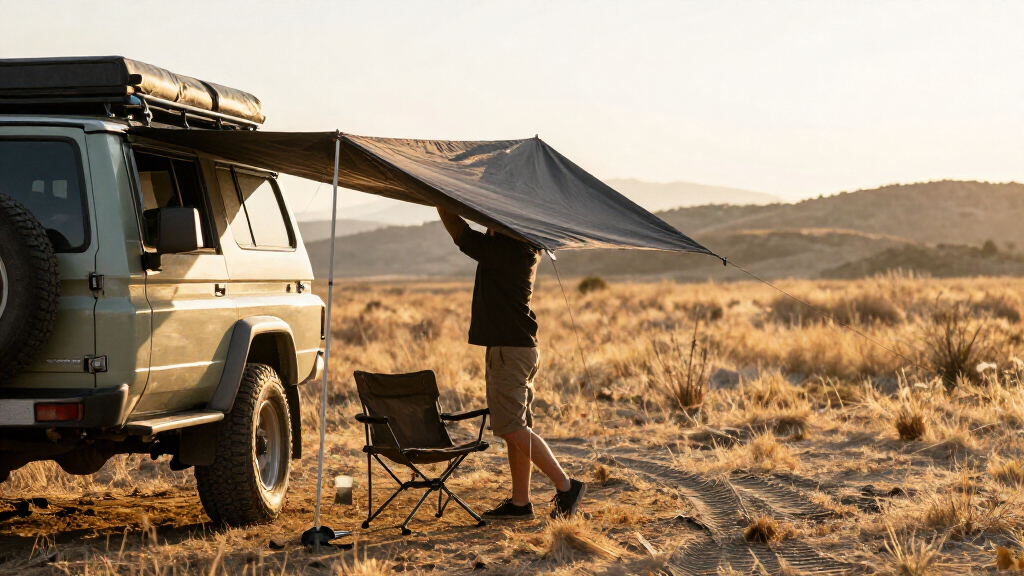
The ALL-TOP is my pick for buyers who want a conventional awning with a clearly stated rectangular footprint and a fairly complete mounting-and-anchoring package. Its 8.2-by-10-foot shade area is listed as about 82 square feet—more than the 270 LTE’s 65 square feet, though less than the large OVS 270’s 129. Unlike those wraparound designs, this model pulls out from one side of the vehicle. That makes its shape easier to plan around a campsite, but it will not shade the same area around the rear and side doors.
Setup uses telescoping roof frames and support poles with twist locks. The package description names reflective wind ropes, ground stakes, L-brackets, backing plates, and mounting hardware for racks, platforms, or cargo baskets. That level of detail gives me more confidence about what a buyer should expect in the box than the OVS 180 LTE listing does. Its 280GSM polyester-cotton ripstop fabric is described with PU 10000mm waterproofing and UV50+ protection, while the PVC storage bag is intended to protect the folded awning in transit.
The tradeoff is that the ALL-TOP’s pole-supported arrangement calls for more hands-on setup than the OVS 270 LTE’s stated no-pole primary opening. It is also not the most compact choice: the awning needs room to extend roughly ten feet, plus space for poles and tie-downs. At a listed 13.15 kg, it is not featherweight, even if the listing uses a different unit from the OVS products. I would choose it over a 270-degree model when a straightforward side canopy and a well-described hardware kit matter more than shade wrapping around the vehicle.
Pros:- About 82 square feet of stated shade coverage
- Includes mounting brackets, backing plates, stakes, and reflective ropes
- Twist-lock telescoping frames and poles allow height adjustment
- Listing states UV50+ protection and a 1000D PVC storage bag
Cons:- Pole-supported deployment takes more setup than the OVS 270 LTE’s primary opening
- Rectangular side coverage does not wrap around the vehicle
- The 8.2-by-10-foot footprint needs clear deployment space
Best for: Campers who prefer a rectangular side awning, want listed rack hardware and anchoring pieces, and can spare room for a pull-out canopy.
Not ideal for: People seeking a pole-free opening, a wraparound shelter, or an awning that needs little room to deploy.
- Expanded size:8.2 by 10 feet
- Coverage:About 82 square feet
- Projection:About 7 feet
- Fabric:280GSM polyester-cotton ripstop
- Weather details:PU 10000mm waterproofing; UV50+ protection, as listed
- Frame and poles:Anodized aluminum with twist-lock adjustment
- Storage bag:1000D PVC
- Listed weight:13.15 kg
- Warranty:Two years, as stated in listing
Our verdict“I favor the ALL-TOP for buyers who want a practical, hardware-inclusive side canopy rather than a vehicle-wrapping 270-degree design.”
Overland Vehicle Systems HD Nomadic 270 Degree Awning Passenger Side, 129 Sq Ft
If shade area is the priority, the 129-square-foot HD Nomadic 270 is the clear leader in this set. Its passenger-side 270-degree reach can shelter more of the vehicle perimeter than the 65-square-foot 270 LTE, giving a group a broader outdoor living zone. That can be useful for cooking, changing, or keeping camp gear out of direct sun while still using the vehicle as the central point of shelter. It also offers substantially more area than the ALL-TOP’s approximately 82-square-foot pull-out canopy.
The listing highlights pole-free setup, heat-sealed seams, a travel cover, and adjustable height with quick-lock aluminum poles. Those features aim to make a large awning less laborious to open and more adaptable to ground conditions. But the description is not perfectly clear about when poles are required: it mentions easy setup without poles and also adjustable quick-lock poles. I would confirm the supplied support arrangement and follow the product instructions, especially before relying on the awning in wind or rain.
More canopy is not free of consequences. The product information warns that it may be heavy, and the design needs a suitable factory or aftermarket rack. It will also need more clearance around the vehicle than the compact OVS 4.5-foot awning, and a broad fabric span can be awkward in exposed camps. This model ranks below the 270 LTE for general use because many overlanders may not need nearly twice the coverage, while still having to manage the larger installation. For groups or long stays where a wide shared shelter matters, the extra area can justify choosing it instead.
Pros:- Largest stated coverage in this comparison at 129 square feet
- 270-degree passenger-side layout shelters more of the vehicle perimeter
- Heat-sealed seams and a travel cover are listed
- Adjustable height with a quick-lock pole system is described
Cons:- May be heavy for some vehicles and rack systems
- Requires factory or aftermarket rack installation
- The setup description is not fully clear about pole use
Best for: Groups and camp-focused overlanders who want the broadest stated vehicle-side coverage and have a rack suited to a large awning.
Not ideal for: Solo travelers, weight-conscious builds, or anyone regularly parking in tight or exposed sites with limited deployment space.
- Coverage:129 square feet
- Layout:Passenger-side 270-degree awning
- Fabric:280G poly-cotton ripstop
- Seams:Heat-sealed
- Setup:Described as setup without poles
- Height adjustment:Quick-lock aluminum poles
- Travel cover:Included
- Warranty:Four-year limited warranty, as stated in listing
Our verdict“I would choose this OVS model when maximum shared shade matters more than a smaller package or simpler site fit.”
Overland Vehicle Systems HD Nomadic 4.5-Foot Awning, Gray with Green Trim
The 4.5-foot Nomadic is the most modest shelter here, with 30 square feet of coverage. I rank it as the compact pick because it avoids the commitment of a 180- or 270-degree canopy and is better suited to shading a small work area, a camp stove, or a pair of chairs than turning the whole side of a vehicle into an outdoor room. Against the ALL-TOP’s 82 square feet, its coverage is limited; the advantage is a simpler, shorter projection for buyers who do not need a broad footprint.
Its package is unusually concrete: two built-in aluminum rafters, two pivoting telescoping aluminum poles, stakes, tie-downs, two mounting brackets with hardware, and a 1000G PVC travel cover. The 280G poly-cotton ripstop fabric has heat-sealed seams, and the listing says it fits most factory and aftermarket racks. Poles, stakes, and tie-downs can help secure the canopy, but they also mean setup is not simply a matter of opening a rigid, self-supporting structure. In exposed camps, anchoring is part of using it responsibly.
Compared with the OVS 270 LTE, this model gives up wraparound coverage and the advertised pole-free primary setup, but it has a more compact 4.5-foot projection and a listed weight of 18.2 pounds. The optional enclosure shelter is not included, so buyers should not assume this awning creates an enclosed room. I would choose it for a smaller rig, brief stops, or a focused shade patch; people who regularly cook and gather under the canopy will likely outgrow its 30-square-foot area.
Pros:- Compact 4.5-foot projection and 30-square-foot coverage
- Mounting brackets, hardware, stakes, and tie-down kit are included
- Heat-sealed seams and 1000G PVC travel cover are listed
- Fits most factory and aftermarket racks, according to the listing
Cons:- Coverage is much smaller than every other awning in this roundup
- Requires poles, stakes, and tie-downs for support
- Optional enclosure shelter is not included
Best for: Owners of smaller rigs or minimalist camp setups who need a limited patch of shade and want mounting and anchoring components listed.
Not ideal for: Families, groups, or anyone expecting a large cooking and lounge area or an enclosed shelter in the package.
- Coverage:30 square feet
- Projection:4.5 feet
- Fabric:280G poly-cotton ripstop
- Frame and poles:Aluminum rafters and adjustable telescoping poles
- Travel cover:1000G PVC
- Listed weight:18.2 pounds
- Dimensions:72 x 77 x 55 inches
- Mounting:Two brackets with hardware; stated fit for most factory and aftermarket racks
- Included anchoring:Stakes and tie-down kit
Our verdict“I recommend this compact OVS awning for focused shade on a smaller rig, not as a substitute for a full camp-side shelter.”
Overland Vehicle Systems 19609917 HD Nomadic 180 LTE Awning Universal
The HD Nomadic 180 LTE sits between the small pull-out Nomadic and the broader 270-degree awnings in concept: its 180 designation suggests a half-wrap layout, while the listing states 59 square feet of coverage. That makes it an appealing middle ground for a vehicle owner who wants more shade than the 30-square-foot 4.5-foot model but does not need the 129-square-foot span of the largest OVS 270. Its universal designation may also suit shoppers comparing vehicle-side coverage without committing to the largest canopy footprint.
There is less reliable detail available here than for the other products. The title specifies 320G ripstop fabric, dark gray material, a black travel cover, twist-and-lock technology, and heat-sealed seams, but the supplied description does not provide a detailed component list, installation steps, or a warranty term. The listed weight is 33.5 pounds. That is a meaningful tradeoff for buyers trying to keep roof load down, particularly when the smaller 4.5-foot awning is listed at 18.2 pounds. I would confirm vehicle fit, mounting brackets, included poles, and the current product specifications before buying.
Compared with the 65-square-foot 270 LTE, this model lists slightly less coverage and a lighter-detail feature set, while offering a 180 rather than 270 layout. It may appeal where a half-wrap is a better match for doors, hatch access, or available parking, but the listing does not give enough information to claim a particular setup advantage. I place it fifth not because the concept is unsuitable, but because buyers have less information to judge what arrives and how it mounts. It is a reasonable shortlist option only after confirming those details with the seller or current manufacturer documentation.
Pros:- 59 square feet of stated coverage
- 180 LTE format offers a middle ground between a short awning and a 270-degree model
- Listing names 320G ripstop fabric and heat-sealed seams
- Twist-and-lock technology and a travel cover are specified in the title
Cons:- Listed at 33.5 pounds, heavier than the compact 4.5-foot model
- The provided description lacks an included-component list and installation detail
- Warranty and mounting specifics are not stated in the supplied product details
Best for: Buyers seeking a middle-size 180-degree layout who can verify rack fit, mounting hardware, and included support components before ordering.
Not ideal for: Anyone who needs a fully documented package and clear setup instructions from the available listing alone, or who is sensitive to roof weight.
- Coverage:59 square feet
- Design:180 LTE universal awning
- Fabric:320G ripstop, as stated in title
- Seams:Heat-sealed, as stated in title
- Technology:Twist and lock
- Travel cover:Black cover included, as stated in title
- Listed weight:33.5 pounds
- Color:Dark gray
Our verdict“I would consider the Nomadic 180 LTE only after confirming its rack hardware and support package, since the listed coverage is promising but key ownership details are missing.”
How We Picked
I ranked these awnings around how they serve an overlanding camp, rather than simply sorting by size. First, I compared the stated coverage with the vehicle-side shelter a buyer gets: 30 square feet can cover a small cooking or gear area, while the 270-degree models spread shade around more of the vehicle. Second, I looked at setup and support. A design that opens without poles may reduce initial setup steps, but poles, ropes, and stakes remain useful when wind or uneven ground calls for extra anchoring.
I also weighed fit and practical ownership details. Rack compatibility, mounting hardware, travel covers, stated fabric construction, and warranty information can affect whether an awning suits a specific rig. Product listings are not equally complete: the OVS 180 LTE entry, for example, identifies coverage and fabric but omits a useful component list, so I do not treat its setup package as confirmed. My ranking reflects those differences, not an assumption that all products were independently tested. I also distinguish between a listed feature and a guarantee of performance: fabric and seam descriptions help guide selection, but no fabric spec makes an awning a substitute for sound anchoring or prudent weather decisions.
| awnings for overlanding | Seams | Warranty |
|---|---|---|
| Overland Vehicle Systems 19689 | Heat-sealed | Four-year limited warranty, as stated in listing |
| ALL-TOP Vehicle Awning 8.2’x10 | — | Two years, as stated in listing |
| Overland Vehicle Systems HD No | Heat-sealed | Four-year limited warranty, as stated in listing |
| Overland Vehicle Systems HD No | — | — |
| Overland Vehicle Systems 19609 | Heat-sealed, as stated in title | — |
Factors to Consider When Choosing Awnings For Overlanding
I would choose an overlanding awning by matching its footprint and support system to the vehicle, camp routine, and weather exposure. A larger canopy can make camp more comfortable, but only if it fits the rack, opens safely at the site, and does not add more weight or setup effort than the owner wants to manage.Choose coverage for the way you camp
Start with what needs shade: a stove and work surface, two chairs, or a group spread across the vehicle side. The 30-square-foot Nomadic 4.5-foot is a focused shelter, while the ALL-TOP’s roughly 82 square feet creates a larger rectangular zone. The OVS 270 LTE lists 65 square feet in a wraparound configuration, and the larger OVS 270 lists 129. Coverage numbers alone do not tell the whole story: the shape and position of that shade determine whether it reaches the hatch, doors, or cooking area you actually use.
Pull-out or wraparound?
A conventional pull-out like the ALL-TOP offers a defined side canopy and can be easier to place in a narrow campsite, provided there is enough extension room. A 180- or 270-degree awning spreads coverage around more of the vehicle, which can help connect the side and rear living areas. That added reach may be less convenient in cramped spaces or where the vehicle parks close to trees. I would map the awning’s open footprint against the doors and hatch before settling on a layout.
Check support, anchoring, and weather limits
Listings that describe pole-free opening can make setup sound effortless, but some products also supply poles and ropes for extra stability. Those supports matter in wind or on uneven ground. Pole-supported designs take more steps, yet their adjustable legs can help fit the canopy height to a particular campsite. Heat-sealed seams and waterproof fabric descriptions are useful selection clues; they are not a reason to leave an awning deployed through unsafe weather. Follow the maker’s instructions and stow it when conditions call for that.
Match the awning to your rack and payload
Before buying, check the rack type, mounting-bracket spacing, vehicle roof-load limits, and the awning’s listed weight. The 4.5-foot Nomadic says it fits most factory and aftermarket racks and includes brackets, while the ALL-TOP lists hardware for roof racks, platforms, and cargo baskets. The 270-degree products need a compatible rack and room for their larger folded packages. Do not treat a general fit claim as confirmation that a specific rack and vehicle combination is suitable; verify dimensions and load limits.
Read the package details, not just the headline
Travel covers, stakes, ropes, brackets, and optional walls affect what must be purchased or carried separately. The ALL-TOP and compact OVS model list their hardware more explicitly than the OVS 180 LTE description. The 4.5-foot awning’s enclosure shelter is optional, not included. For the 180 LTE, confirm installation hardware and support components before ordering. Warranty language also varies across listings, so check the current terms and exclusions rather than assuming that every stated coverage applies to every kind of damage.
Frequently Asked Questions
What awning size makes sense for overlanding?
I would size the awning around the area you expect to use, not the largest number available. A 30-square-foot canopy can shade a small cooking or gear area, while an 82-square-foot pull-out or a 270-degree design may suit a longer camp setup with chairs and more than one person. Check the awning’s shape as well as its stated coverage, since the same area can land in a different place around the vehicle.
Is a 270-degree awning better than a pull-out awning?
Neither layout is automatically better. A 270-degree awning can shelter more of the vehicle’s side and rear, which may make a connected camp area, while a pull-out canopy such as the ALL-TOP has a simpler rectangular footprint and a clearly described pole-and-stake kit. I would pick the 270-degree style for broad vehicle-side coverage and the pull-out style for a defined side shelter that suits the space available at camp.
Can I leave an overlanding awning open in wind or rain?
I would not assume that any awning is safe to leave open in changing weather just because its listing describes weather-resistant fabric or sealed seams. Poles, stakes, and tie-downs can support a canopy, but actual conditions and the manufacturer’s instructions still govern. If wind increases or conditions exceed the product guidance, stowing the awning is the safer choice. Fabric specifications should inform selection, not replace prudent use.
Do these awnings fit any roof rack?
No. Some listings describe compatibility with most factory or aftermarket racks, and the ALL-TOP names racks, platforms, and cargo baskets, but fit still depends on the specific rack, bracket arrangement, vehicle, and load limits. I would compare the mounting dimensions and hardware with the rack manufacturer’s guidance before ordering. A general compatibility statement is not a vehicle-specific fit guarantee.
What should I verify before buying the OVS Nomadic 180 LTE?
The supplied listing gives its 59-square-foot coverage, 320G ripstop fabric, travel cover, twist-and-lock technology, and 33.5-pound listed weight, but does not provide a detailed component list or installation instructions. I would verify the mounting brackets, poles or other support pieces, rack fit, and current warranty information before purchase. That extra check matters more here than for models whose included hardware is spelled out in the product details.
Conclusion
For most overlanders seeking a balance of shade and deployment convenience, I would start with the OVS HD Nomadic 270 LTE. Choose the ALL-TOP pull-out if a rectangular canopy and a clearly itemized hardware kit suit your camp routine better. If your group needs the broadest shared shelter and your rack can handle the footprint, the 129-square-foot OVS 270 is the coverage leader. The 4.5-foot Nomadic makes more sense for compact rigs and small shade needs, while I would shortlist the 180 LTE only after confirming its mounting and package details. The best match is the awning whose coverage, weight, and support requirements fit the vehicle and the campsites you actually use.