For engine diagnostics, I’d choose the Fluke 62 Max as the best overall pick for its job-focused design, while the SURPEER IR-1796 stands out for its 50:1 distance-to-spot ratio and the Klein Tools IR1 for straightforward use. The right infrared thermometer can help compare temperatures across exhaust runners, hoses, brakes, and other accessible surfaces, but it measures surface temperature—not internal coolant or oil temperature. The main tradeoffs are targeting distance, temperature range, ease of use, and extra features, since a broad range or dual laser does not automatically make readings more accurate. I compare all 10 options by how well their features match practical engine checks, along with their limitations. Read on for the full breakdown and guidance on choosing one for your garage.

Get business pricing on garage and car supplies
- Business-only prices and quantity discounts
- Tax-exempt purchasing
- Multiple users, one account, clear invoices
Complete the kit


Key Takeaways
Targeting distance separates the standout models. The SURPEER IR-1796 and the other 50:1 SURPEER model are better suited to measuring small targets from farther away than basic options with less specialized targeting.
A very high maximum temperature is not the same as engine-focused performance. Several models offer wide temperature ranges, but for common engine checks, target size, emissivity adjustment, and repeatable measurement habits can matter more.
The Fluke 62 Max leads for a work-oriented choice because its industrial positioning fits frequent diagnostic use, while buyers should still check its range and measurement features against their specific tasks.
The Klein Tools IR1 and Etekcity Lasergrip 774 suit simpler routines. Their appeal is a more direct approach for occasional surface comparisons, rather than a long feature list aimed at specialized work.
The probe-equipped thermometer serves a different purpose. Its contact probe can read materials that need direct contact, while the other nine models rely on infrared surface readings and require clear access to the target.
| Etekcity Lasergrip 1080 Infrared Thermometer |  | Best Value for General Engine Checks | Temperature range: -58°F to 1130°F (-50°C to 610°C) | Distance-to-spot ratio: 12:1 | Emissivity: Adjustable, 0.1–1.0 | VIEW ON AMAZON | See Our Full Breakdown |
| SURPEER IR-1796 Infrared Thermometer Gun, 50:1 Distance-to-Spot Ratio |  | Best for Distant Engine Targets | Temperature range: -58°F to 1796°F (-50°C to 980°C) | Accuracy: ±2% on average | Distance-to-spot ratio: 50:1 | VIEW ON AMAZON | See Our Full Breakdown |
| Fluke 62 Max Industrial Infrared Thermometer |  | Best for Tough Shop Conditions | Temperature range: -22°F to 932°F (-30°C to 500°C) | Accuracy: ±1.5°C or ±1.5% of reading | Distance-to-spot ratio: 10:1 | VIEW ON AMAZON | See Our Full Breakdown |
| Klein Tools IR1 Infrared Thermometer with Targeting Laser | 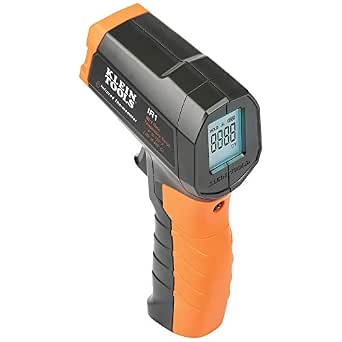 | Best for Simple, Repeatable Checks | Temperature range: -4°F to 752°F (-20°C to 400°C) | Distance-to-spot ratio: 10:1 | Emissivity: Fixed at 0.95 | VIEW ON AMAZON | See Our Full Breakdown |
| SURPEER Infrared Thermometer Gun, -58°F to 2732°F, 50:1, Dual Laser |  | Best for High-Heat Diagnostics | Temperature range: -58°F to 2732°F (-50°C to 1500°C) | Accuracy: ±2% average | Distance-to-spot ratio: 50:1 | VIEW ON AMAZON | See Our Full Breakdown |
| KNINE OUTDOORS Infrared Thermometer Gun, -58°F to 1112°F |  | Best for High-Temperature Checks | Temperature range: -58°F to 1112°F (-50°C to 600°C) | Distance-to-spot ratio: 12:1 | Laser targeting: Single laser | VIEW ON AMAZON | See Our Full Breakdown |
| TempPro TempScan Infrared Thermometer Gun |  | Best for Quick Routine Checks | Temperature range: -58°F to 1022°F | Accuracy: ±1.5% | Emissivity: Adjustable from 0.1 to 1.0 | VIEW ON AMAZON | See Our Full Breakdown |
| Infrared Thermometer Gun with Probe, -58°F to 1472°F |  | Best for Contact and Non-Contact Readings | Temperature range: -58°F to 1472°F (-50°C to 800°C) | Measurement methods: Infrared and K-type thermocouple probe | Emissivity: Adjustable from 0.1 to 1.0 | VIEW ON AMAZON | See Our Full Breakdown |
| TempPro TempScan Infrared Thermometer Gun with Dual Laser |  | Best for Targeting at a Distance | Model: TempScan PLUS TP450 | Temperature range: -58°F to 1022°F | Accuracy: ±1.5% | VIEW ON AMAZON | See Our Full Breakdown |
| Etekcity Lasergrip 774 Infrared Thermometer | 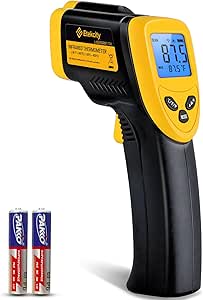 | Best for Basic Garage Checks | Temperature range: -58°F to 842°F (-50°C to 450°C) | Distance-to-spot ratio: 12:1 | Recommended distance: About 14 inches (36 cm) | VIEW ON AMAZON | See Our Full Breakdown |
| infrared thermometer for engine diagnostic | Temperature range | Distance-to-spot ratio | Response time | Emissivity |
|---|---|---|---|---|
| Etekcity Lasergrip 1080 Infrar | -58°F to 1130°F (-50°C to 610°C) | 12:1 | 0.5 seconds | Adjustable, 0.1–1.0 |
| SURPEER IR-1796 Infrared Therm | -58°F to 1796°F (-50°C to 980°C) | 50:1 | 0.5 seconds | — |
| Fluke 62 Max Industrial Infrar | -22°F to 932°F (-30°C to 500°C) | 10:1 | 500 milliseconds | — |
| Klein Tools IR1 Infrared Therm | -4°F to 752°F (-20°C to 400°C) | 10:1 | 0.5 seconds | Fixed at 0.95 |
| SURPEER Infrared Thermometer G | -58°F to 2732°F (-50°C to 1500°C) | 50:1 | 0.5 seconds | — |
| KNINE OUTDOORS Infrared Thermo | -58°F to 1112°F (-50°C to 600°C) | 12:1 | — | Adjustable from 0.1 to 1.0 |
| TempPro TempScan Infrared Ther | -58°F to 1022°F | 12:1 | 0.5 seconds | Adjustable from 0.1 to 1.0 |
| Infrared Thermometer Gun with | -58°F to 1472°F (-50°C to 800°C) | — | Less than 0.5 seconds | Adjustable from 0.1 to 1.0 |
| TempPro TempScan Infrared Ther | -58°F to 1022°F | 16:1 | 0.5 seconds | Adjustable from 0.1 to 1.0 |
| Etekcity Lasergrip 774 Infrare | -58°F to 842°F (-50°C to 450°C) | 12:1 | 0.5 seconds | 0.1–1.0 |
More Details on Our Top Picks
Etekcity Lasergrip 1080 Infrared Thermometer
The Etekcity Lasergrip 1080 covers common engine-bay checks without adding specialized modes or a long-range aiming system. Its -58°F to 1130°F range can handle cold starts and many hot components, while adjustable emissivity gives more flexibility across different surface finishes than the fixed setting on the Klein Tools IR1. The 12:1 distance-to-spot ratio is more forgiving than a short-range tool, but it cannot isolate small targets from as far away as either 50:1 SURPEER model. A 0.5-second response and maximum-temperature readout help when scanning several points, though readings still reflect surface temperature, not coolant or oil inside the system. Choose it for routine comparisons; skip it if you need stored readings or high-heat capacity beyond 1130°F.
Pros:- Adjustable emissivity offers more flexibility across different surface materials than the Klein Tools IR1’s fixed setting.
- 12:1 distance-to-spot ratio supports targeting from a practical working distance.
- Fast response and maximum-temperature readout help track hot spots during a scan.
- Backlit display, Fahrenheit/Celsius selection, and included batteries make basic checks straightforward.
Cons:- The 1130°F upper limit is lower than both SURPEER models, restricting some high-heat inspections.
- It measures surface temperature only, so it cannot report internal fluid or component temperatures.
- Accurate targeting depends on keeping the measurement spot on the intended surface.
Best for: DIY vehicle owners comparing temperatures across radiator hoses, brake components, and engine-bay surfaces during routine troubleshooting.
Not ideal for: Technicians who need to measure tiny components from a distance, record readings, or inspect surfaces hotter than 1130°F.
- Temperature range:-58°F to 1130°F (-50°C to 610°C)
- Distance-to-spot ratio:12:1
- Emissivity:Adjustable, 0.1–1.0
- Response time:0.5 seconds
- Repeatability:1% / 1°C
- Display:Backlit digital LCD
- Power:2 AAA batteries, included
- Auto-off:15 seconds
Our verdict“Choose the Lasergrip 1080 for flexible, routine engine-surface checks, but pick a 50:1 SURPEER if distant or very high-temperature targets are part of the job.”
SURPEER IR-1796 Infrared Thermometer Gun, 50:1 Distance-to-Spot Ratio
The SURPEER IR-1796 is the lineup’s stronger fit when an engine check calls for aiming at a small or awkwardly placed surface without bringing the thermometer close. Its 50:1 distance-to-spot ratio far exceeds the Etekcity Lasergrip 1080’s 12:1 ratio and the Fluke 62 Max’s 10:1 ratio, helping keep the measurement area narrower at distance. The range reaches 1796°F, which also gives it more headroom than those models for unusually hot components. MIN, MAX, AVG, and DIF modes help compare readings, though the listed average accuracy is ±2%, and a low battery can undermine results. It is a better reach-and-range tool than a straightforward scan gun, but it lacks the Fluke’s stated drop resistance and IP54 protection.
Pros:- 50:1 distance-to-spot ratio is better suited to distant targets than the Etekcity and Fluke models.
- 1796°F upper range accommodates hotter surfaces than the other three conventional-range picks in this batch.
- MIN, MAX, AVG, and DIF modes support quick comparisons among engine components.
- Includes batteries and a storage bag.
Cons:- Listed average accuracy is ±2%, so it may not suit work requiring tighter measurement specifications.
- Low battery levels can cause inaccurate measurements.
- No drop-resistance or dust-and-splash protection is specified, unlike the Fluke 62 Max.
Best for: Automotive technicians who need to check hard-to-reach or relatively small hot surfaces from a safer working distance.
Not ideal for: Shop users who prioritize ruggedized protection, or anyone who needs internal temperatures, readings storage, or tighter stated accuracy.
- Temperature range:-58°F to 1796°F (-50°C to 980°C)
- Accuracy:±2% on average
- Distance-to-spot ratio:50:1
- Response time:0.5 seconds
- Measurement modes:MIN, MAX, AVG, DIF
- Power:2 AAA batteries, included
- Weight:160 g
- Included components:Storage bag, batteries, and user manual
Our verdict“Pick the IR-1796 when long-distance targeting and high-temperature range matter more than ruggedized protection or stored readings.”
Fluke 62 Max Industrial Infrared Thermometer
The Fluke 62 Max earns its place through durability rather than the longest reach or widest temperature range. For engine diagnostics in a busy workshop, its IP54 dust and splash protection and 9.8-foot drop resistance make it a more work-ready choice than the SURPEER IR-1796, whose listed specs do not state comparable protection. The tradeoff is a 10:1 distance-to-spot ratio and 932°F ceiling: the Etekcity Lasergrip 1080 reaches higher, while either 50:1 SURPEER can better isolate a target from farther away. Fluke specifies accuracy as ±1.5°C or ±1.5% of reading, giving buyers a clear reference, and the backlit display helps in dim engine bays. Pick it for rough environments, not for maximum range or extreme heat.
Pros:- IP54 protection helps guard against dust and splashing water in workshop conditions.
- Drop resistance up to 9.8 feet adds resilience absent from the listed SURPEER IR-1796 specifications.
- Backlit LCD and laser targeting support use in dim, crowded engine bays.
- Specified accuracy is ±1.5°C or ±1.5% of reading.
Cons:- The 932°F upper limit is below the Etekcity Lasergrip 1080 and both SURPEER models.
- Its 10:1 distance-to-spot ratio offers less reach than either 50:1 SURPEER.
- Measures surface temperature only and is not intended for human temperature measurement.
Best for: Mechanics and fleet technicians who need a surface thermometer that can handle dust, splashes, and accidental drops in a working shop.
Not ideal for: Users measuring very hot parts above 932°F or aiming at small targets from farther away than a 10:1 tool comfortably supports.
- Temperature range:-22°F to 932°F (-30°C to 500°C)
- Accuracy:±1.5°C or ±1.5% of reading
- Distance-to-spot ratio:10:1
- Response time:500 milliseconds
- Protection:IP54 dust and splash protection
- Drop resistance:9.8 feet (3 meters)
- Power:1 AA battery, included
- Warranty:3 years
Our verdict“Choose the Fluke 62 Max for a more durable shop tool, but favor a 50:1 SURPEER when target distance is the main constraint.”
Klein Tools IR1 Infrared Thermometer with Targeting Laser
The Klein Tools IR1 suits buyers who want a simple point-and-read tool for ordinary engine temperatures, rather than the broad adjustment options offered by the Etekcity Lasergrip 1080. Its fixed 0.95 emissivity keeps setup simple on many common surfaces, but it limits flexibility when comparing materials with different finishes. The 10:1 distance-to-spot ratio matches the Fluke 62 Max, yet the Klein has a lower 752°F ceiling and no stated ruggedness rating to match the Fluke’s drop and splash protection. Auto-hold and a backlit display make readings easier to capture in a cramped bay; its compact, light body is also convenient to keep in a toolbox. The listing gives conflicting battery details, so verify the supplied power arrangement before relying on it for shop use.
Pros:- Fixed 0.95 emissivity keeps operation straightforward for common surface checks.
- Laser targeting and a backlit display aid readings in confined or dim engine bays.
- Auto-hold preserves the reading on screen after aiming.
- At 100 g and about 6 inches long, it is easy to carry in a toolbox.
Cons:- Fixed emissivity is less adaptable than the adjustable setting on the Etekcity Lasergrip 1080.
- 752°F upper range is lower than the Fluke 62 Max and the other three models in this batch.
- Battery information in the listing is inconsistent.
Best for: DIY mechanics who want a compact, uncomplicated thermometer for routine checks on common engine-bay surfaces.
Not ideal for: Users who need adjustable emissivity, measurements above 752°F, or a clearly specified battery setup and ruggedness rating.
- Temperature range:-4°F to 752°F (-20°C to 400°C)
- Distance-to-spot ratio:10:1
- Emissivity:Fixed at 0.95
- Response time:0.5 seconds
- Display:Backlit digital
- Features:Targeting laser, auto-hold, and auto power-off
- Dimensions and weight:6.01 inches long; 100 g
- Battery details:Battery information is inconsistent in the listing
Our verdict“Choose the IR1 for uncomplicated routine checks, but select the Etekcity for emissivity flexibility or the Fluke for tougher shop conditions.”
SURPEER Infrared Thermometer Gun, -58°F to 2732°F, 50:1, Dual Laser
For engine work involving exceptionally hot surfaces, the SURPEER dual-laser thermometer has the broadest stated ceiling in this group: 2732°F, compared with 1796°F on the SURPEER IR-1796 and 1130°F on the Etekcity Lasergrip 1080. Its 50:1 distance-to-spot ratio suits distant targets, while dual lasers help show the measurement area more clearly than a single targeting laser. The MIN, MAX, AVG, and DIF modes and storage for up to 55 readings make it more useful for recording a series of comparisons than the IR-1796, which lists modes but no memory. The tradeoffs are a stated ±2% average accuracy and the same surface-only limitation found across these guns. For ordinary engine checks, its extra range may be more capability than needed.
Pros:- 2732°F upper limit is the widest temperature range among these five products.
- 50:1 distance-to-spot ratio supports targeting from farther away than the Etekcity, Fluke, or Klein.
- Stores up to 55 readings and offers MIN, MAX, AVG, and DIF modes.
- Dual-laser targeting and a backlit display aid aiming and reading in varied work conditions.
Cons:- Listed average accuracy is ±2%, which may not fit work requiring tighter specified accuracy.
- Measures surface temperatures rather than internal engine or fluid temperatures.
- Its high-temperature capacity and memory may be unnecessary for basic DIY engine checks.
Best for: Automotive or industrial technicians checking very hot surfaces and wanting to retain multiple readings for later comparison.
Not ideal for: DIY users focused on routine engine temperatures who do not need a 2732°F range, reading storage, or 50:1 reach.
- Temperature range:-58°F to 2732°F (-50°C to 1500°C)
- Accuracy:±2% average
- Distance-to-spot ratio:50:1
- Targeting:Dual laser
- Response time:0.5 seconds
- Measurement modes:MIN, MAX, AVG, DIF
- Measurement storage:Up to 55 records
- Power and display:2 AAA batteries included; backlit digital LCD
Our verdict“Pick this SURPEER for very high-temperature surface checks and saved comparisons; choose the IR-1796 if you need 50:1 reach without the extra range and storage.”
KNINE OUTDOORS Infrared Thermometer Gun, -58°F to 1112°F
For engine work that may involve hotter surfaces, the 1112°F upper limit gives this KNINE OUTDOORS model more range than the TempPro TempScan, which tops out at 1022°F. Its 12:1 distance-to-spot ratio supports taking readings without reaching toward a hot component, while adjustable emissivity lets me account for differences between surface materials. The large LCD and selectable Fahrenheit or Celsius readings keep basic comparisons straightforward. The tradeoff is that it uses a single laser, so targeting is less visually guided than on the TempPro TempScan with Dual Laser. It also measures surface temperature only; it cannot tell me the temperature inside coolant, oil, or a component. This is a practical choice for broad-range surface checks, not a substitute for contact diagnostics.
Pros:- 1112°F upper range covers hotter surface checks than the TempPro TempScan
- 12:1 distance-to-spot ratio allows readings from a distance
- Adjustable emissivity accommodates different surface materials
- Large display and selectable Fahrenheit/Celsius units
Cons:- Single laser offers less targeting guidance than the TempPro TempScan with Dual Laser
- Surface-only readings cannot measure internal temperatures
- Requires two AAA batteries
Best for: DIY mechanics who want to compare temperatures on hot engine-bay and exhaust surfaces from a safer distance.
Not ideal for: Mechanics who need probe readings, dual-laser targeting, or internal fluid temperatures.
- Temperature range:-58°F to 1112°F (-50°C to 600°C)
- Distance-to-spot ratio:12:1
- Laser targeting:Single laser
- Emissivity:Adjustable from 0.1 to 1.0
- Temperature units:°F and °C
- Resolution:0.1°F or 0.1°C
- Display:Digital LCD
- Power:Two AAA batteries
Our verdict“Choose this model for a broad temperature range on engine surfaces, but pick a probe-equipped tool when contact readings are required.”
TempPro TempScan Infrared Thermometer Gun
The standard TempPro TempScan suits routine engine comparisons where speed and useful readouts matter more than an especially high temperature ceiling. Its 0.5-second response and MAX, MIN, and average readings help track temperature changes across repeated checks; the backlit display is useful in dim garages. Compared with the KNINE OUTDOORS thermometer, it has a lower top range of 1022°F, but it adds stated ±1.5% accuracy and keeps the same 12:1 distance-to-spot ratio. Adjustable emissivity can help when checking surfaces with different finishes, though it does not make infrared readings reliable on every reflective material. Like the KNINE and Etekcity Lasergrip 774, it reads surface temperature only. I would favor it for quick, repeatable spot checks, not for measuring coolant or verifying an internal engine temperature.
Pros:- 0.5-second response supports quick comparisons around an engine
- MAX, MIN, and average readings help track temperature changes
- Backlit display is suited to dim workshop conditions
- Adjustable emissivity and stated ±1.5% accuracy
Cons:- 1022°F upper limit is lower than the KNINE OUTDOORS model’s 1112°F range
- 12:1 distance-to-spot ratio offers less reach than the TempPro dual-laser model’s 16:1
- Measures surface temperature rather than internal or fluid temperature
Best for: Home mechanics who regularly compare engine-surface temperatures and want fast readings with min, max, and average tracking.
Not ideal for: Users checking surfaces above 1022°F or anyone who needs probe-based or internal temperature readings.
- Temperature range:-58°F to 1022°F
- Accuracy:±1.5%
- Emissivity:Adjustable from 0.1 to 1.0
- Distance-to-spot ratio:12:1
- Response time:0.5 seconds
- Display:Backlit digital LCD
- Additional readings:Maximum, minimum, and average
- Power source:2 AAA batteries, included
Our verdict“Pick this TempPro for fast routine surface checks and useful temperature tracking, provided its 1022°F ceiling covers your work.”
Infrared Thermometer Gun with Probe, -58°F to 1472°F
This is the most versatile option here for mechanics who need more than an infrared surface scan. Alongside its -58°F to 1472°F infrared range, the included K-type probe offers contact measurements, a useful complement when a surface reading is not the answer. Its upper range exceeds both the KNINE OUTDOORS thermometer and the TempPro TempScan, while a color backlit display and temperature-difference alarm can help flag unusual readings. The tradeoff is a more involved setup than a basic handheld infrared gun, and the supplied information does not state a distance-to-spot ratio, making target size at a given distance harder to judge. The probe expands measurement options, but this remains a tool for inanimate objects—not people or animals. I would choose it when probe capability matters more than a simple, quick scan.
Pros:- Combines infrared surface readings with a K-type probe
- 1472°F upper range exceeds the other listed handheld options
- Temperature-difference alarm can draw attention to uneven readings
- Color backlit display and response time under 0.5 seconds
Cons:- No distance-to-spot ratio is provided in the product data
- Extra probe and alarm functions make it less straightforward than the basic TempPro TempScan
- Not suitable for measuring human or animal temperature
Best for: DIY mechanics who want both non-contact engine-surface checks and contact measurements with a K-type probe.
Not ideal for: Buyers seeking a simple infrared-only tool with a stated distance-to-spot ratio, or anyone intending to take human or animal temperatures.
- Temperature range:-58°F to 1472°F (-50°C to 800°C)
- Measurement methods:Infrared and K-type thermocouple probe
- Emissivity:Adjustable from 0.1 to 1.0
- Response time:Less than 0.5 seconds
- Display:Color VA display with backlight
- Resolution:0.1°C or 0.1°F
- Alarm modes:Spoilage alarm and temperature-difference alarm
- Power source:2 AAA batteries, included
Our verdict“Choose this model if you want probe-based contact readings alongside high-range infrared checks and can accept less targeting detail in the listed specs.”
TempPro TempScan Infrared Thermometer Gun with Dual Laser
For engine-bay checks where the target is small or difficult to approach, this TempPro’s 16:1 distance-to-spot ratio is its clearest advantage over the standard TempPro TempScan’s 12:1 ratio. The dual lasers give a more visible guide to the measurement area, while the 0.5-second response and MAX, MIN, and average readings suit repeated comparisons across nearby components. It shares the standard TempPro’s -58°F to 1022°F range and stated ±1.5% accuracy, so it does not cover hotter surfaces as far as the KNINE OUTDOORS model or the probe-equipped thermometer. Distance and laser guides help aim, but infrared readings still depend on the target surface and emissivity setting. I would choose this over the standard TempScan when reach and targeting matter, not for a broader temperature range or contact measurements.
Pros:- 16:1 distance-to-spot ratio provides more reach than the standard TempPro TempScan
- Dual laser targeting helps guide readings toward the intended area
- MAX, MIN, and average readings support repeated diagnostic comparisons
- 0.5-second response and adjustable emissivity
Cons:- 1022°F upper range is below the KNINE OUTDOORS and probe-equipped models
- Measures surface temperature only
- Requires two AAA batteries
Best for: Mechanics who need to compare small or hard-to-reach engine surfaces without moving the thermometer close to hot components.
Not ideal for: Buyers who need readings above 1022°F or contact measurements from a probe.
- Model:TempScan PLUS TP450
- Temperature range:-58°F to 1022°F
- Accuracy:±1.5%
- Distance-to-spot ratio:16:1
- Response time:0.5 seconds
- Emissivity:Adjustable from 0.1 to 1.0
- Display resolution:0.1°F or 0.1°C
- Features:Dual laser targeting, MAX/MIN/AVG readings, backlit display, auto off, and low-battery indicator
Our verdict“Choose the dual-laser TempPro when targeting distant or compact engine surfaces matters more than maximum temperature range or probe readings.”
Etekcity Lasergrip 774 Infrared Thermometer
The Etekcity Lasergrip 774 is a straightforward pick for common garage checks, with a 0.5-second response, backlit LCD, adjustable emissivity, and a maximum-temperature display. Its -58°F to 842°F range covers many routine engine-surface comparisons, but it has the lowest upper limit among these five products; the standard TempPro TempScan reaches 1022°F, and the probe-equipped model goes higher still. The 12:1 distance-to-spot ratio is also less suited to distant, small targets than the dual-laser TempPro’s 16:1 ratio. At about 14 inches, the stated recommended distance gives a practical reference point for everyday readings. This thermometer measures surface temperatures only, so I would not use it as a replacement for a probe when checking internal fluids or components.
Pros:- 0.5-second response with a backlit LCD
- Adjustable emissivity and Fahrenheit/Celsius readings
- Maximum-temperature display helps capture a peak during a scan
- Recommended measurement distance is stated at about 14 inches
Cons:- 842°F upper limit is below the KNINE OUTDOORS and TempPro models
- 12:1 distance-to-spot ratio offers less reach than the dual-laser TempPro
- Surface-only readings cannot measure internal temperatures
Best for: Home mechanics who want a simple, backlit thermometer for routine engine-bay and workshop surface comparisons.
Not ideal for: Mechanics checking high-temperature exhaust surfaces, small distant targets, or internal fluid temperatures.
- Temperature range:-58°F to 842°F (-50°C to 450°C)
- Distance-to-spot ratio:12:1
- Recommended distance:About 14 inches (36 cm)
- Emissivity:0.1–1.0
- Response time:0.5 seconds
- Repeatability:1% / 1°C
- Display:Backlit LCD
- Power:2 AAA batteries, included
Our verdict“Choose the Lasergrip 774 for simple routine garage surface checks, but select a higher-range or probe-equipped model for hotter or contact measurements.”

How We Picked
I ranked these thermometers by how well their stated features support common engine checks: comparing temperatures across exhaust components, hoses, radiator areas, and brake surfaces. I gave weight to distance-to-spot ratio, targeting aids, usable temperature range, measurement controls, and handling. A narrow target at a practical working distance matters because engine bays are crowded; a wide temperature range helps only when the tool can reliably measure the intended surface. I also distinguished infrared-only models from the probe-equipped option, since contact measurement solves a different set of problems.
The order reflects fit for diagnostic work, not the longest specification list. The Fluke 62 Max leads as the work-oriented pick, while the SURPEER models earn attention for long-range targeting and broader stated ranges. Simpler Etekcity and Klein options suit occasional checks, but offer less reason to choose them for demanding or specialized use. Where product details do not establish a particular diagnostic advantage, I avoid treating a feature claim as proof of greater accuracy; buyers should confirm current specifications, including emissivity settings and stated accuracy, before purchase.
| infrared thermometer for engine diagnostic | Display | Accuracy |
|---|---|---|
| Etekcity Lasergrip 1080 Infrar | Backlit digital LCD | — |
| SURPEER IR-1796 Infrared Therm | — | ±2% on average |
| Fluke 62 Max Industrial Infrar | — | ±1.5°C or ±1.5% of reading |
| Klein Tools IR1 Infrared Therm | Backlit digital | — |
| SURPEER Infrared Thermometer G | — | ±2% average |
| KNINE OUTDOORS Infrared Thermo | Digital LCD | — |
| TempPro TempScan Infrared Ther | Backlit digital LCD | ±1.5% |
| Infrared Thermometer Gun with | Color VA display with backlight | — |
| TempPro TempScan Infrared Ther | — | ±1.5% |
| Etekcity Lasergrip 774 Infrare | Backlit LCD | — |
Factors to Consider When Choosing Infrared Thermometer For Engine Diagnostics
Choosing an infrared thermometer for engine diagnostics is less about chasing the biggest number on the box and more about matching the tool to your targets and working distance. I’d first decide what you plan to measure, how easily you can reach it, and whether surface readings alone will answer the question.
Match the Distance-to-Spot Ratio to Your Targets
The distance-to-spot ratio describes how large an area the thermometer reads from a given distance. If the target is smaller than the measurement spot, nearby surfaces can influence the result—an easy mistake when aiming at a narrow exhaust runner or a small section of hose. A higher ratio can help when the target is far away or access is restricted, but it does not mean every reading is more accurate. Check the size of the surface you need to measure and the distance you can safely hold the tool. For close, reachable components, a basic model may be sufficient; for tight engine bays or hot areas, more precise targeting can justify a step up.
Treat Temperature Range as a Fit Check, Not a Score
A wide temperature range can be useful if you also plan to check very hot exhaust surfaces or other high-temperature equipment. For ordinary troubleshooting, a thermometer’s maximum range may exceed what you need, so compare the lower end and stated accuracy too. Some buyers focus on the headline maximum and miss whether the tool suits the temperatures and target sizes they actually encounter. Read the manufacturer’s specifications for accuracy across the relevant range, not just a single advertised figure. If your work is limited to routine comparisons, easy repeatable readings may matter more than an extreme upper limit.
Understand Emissivity and Surface Effects
Infrared thermometers estimate the temperature of a surface, and different materials and finishes can affect the reading. Shiny metal is a frequent source of misleading measurements because it reflects surrounding infrared energy. An adjustable emissivity setting can help match the tool to a material, but it cannot make every surface behave alike or replace a consistent measurement method. When comparing components, measure similar surfaces under similar conditions and use manufacturer guidance for emissivity. If you need the temperature inside a fluid or a component, an infrared reading on the outside is not a substitute for an appropriate contact probe or diagnostic sensor.
Choose Laser Aids for Aiming, Not Accuracy
A laser indicates where the thermometer is pointed; it does not measure temperature or guarantee that the full measurement spot fits on the target. Dual lasers may help show the approximate measurement area on some models, but their usefulness depends on the instrument’s design and working distance. Avoid aiming at reflective surfaces or looking toward the laser, and follow the product’s safety instructions. In a crowded engine bay, a clear display and a comfortable trigger can matter as much as the laser arrangement. Compare the targeting aid with the target size and distance you expect, rather than assuming more lasers automatically produce better readings.
Decide Whether You Need Contact Measurement
Infrared tools are quick and useful when a surface is visible, but they cannot read through a hose, cover, or other barrier. A built-in probe changes the job: it can take a contact reading from a compatible material, though it requires touching the target and may need cleaning or careful handling. Do not assume the probe is suitable for measuring every fluid or high-temperature component; check its rated range and intended use. If your routine is mostly surface-to-surface comparison, an infrared-only model is simpler. Choose a probe-equipped tool only when contact readings answer a question that surface measurements cannot.
Balance Durability and Features Against How Often You Work
A thermometer used in a busy workshop faces drops, grime, and repeated handling that a home-garage tool may rarely encounter. A more rugged, work-oriented model can make sense for frequent use, but extra durability or advanced functions may add little for occasional checks. Look at grip, display readability, controls, battery access, and the manufacturer’s stated protection rating. Also check whether the feature you value—such as a maximum-temperature hold or emissivity adjustment—is actually included on the exact model and version. Paying more is most defensible when a feature solves a recurring measurement problem or the tool will see regular use.
Frequently Asked Questions
Can an infrared thermometer tell me whether a cylinder is misfiring?
It can help compare exhaust-runner surface temperatures, which may show that one cylinder is behaving differently from the others. It cannot diagnose the cause by itself, and readings can vary with engine load, warm-up time, surface finish, and aiming position. Take readings at comparable locations and under consistent conditions, then use the result alongside scan data and other diagnostic checks. Avoid treating one temperature difference as proof of a failed component. A contact or scan-tool test may be needed to narrow down the fault.
Will an infrared thermometer give an accurate reading on a shiny exhaust manifold?
Shiny metal can reflect infrared energy from nearby surfaces, so the displayed temperature may not represent the manifold itself. An adjustable emissivity setting may help, but it does not remove all uncertainty. Follow the thermometer maker’s guidance for reflective materials and use a consistent measurement point. Where permitted and safe, a suitable non-reflective measurement target can improve repeatability, but it must be rated for the temperature involved. If precision matters, verify the reading with an appropriate contact instrument.
Is a 50:1 distance-to-spot ratio worth choosing for a home garage?
It can help when you need to measure a small target from farther away, such as a component that is hard to reach safely. For large, accessible surfaces at close range, a 50:1 ratio may not provide a meaningful benefit over a simpler thermometer. Check the manufacturer’s measurement-spot explanation and compare it with the target size at your planned distance. A high ratio also does not correct for reflective surfaces or poor aiming. I’d pay for it when access and target size are recurring limits, not just because the number is larger.
Should I buy an infrared thermometer with a probe for engine work?
Choose a probe model if you expect to take contact readings from materials that an infrared surface reading cannot answer for you. The probe is a separate measurement method, so check its rated temperature range, intended materials, and cleaning requirements before relying on it. It does not turn the infrared sensor into a way to measure temperature through a component or inside a sealed system. If you mainly compare visible surfaces, an infrared-only model is usually simpler to handle. For fluid temperatures, use a method approved for the fluid and measurement point.
What matters more for engine diagnostics: temperature range or stated accuracy?
For routine engine comparisons, stated accuracy across the temperatures you expect to measure is often more useful than an unusually high maximum range. A broad range matters if your work includes very hot surfaces, but it does not guarantee dependable readings at every point in that range. Also check target size, distance-to-spot ratio, emissivity controls, and any conditions attached to the accuracy specification. Repeatability matters when comparing several similar components, so keep distance and measurement location consistent. Select a range that covers your work, then compare the accuracy details for that operating window.
Conclusion
For a regular workshop routine, I’d start with the Fluke 62 Max as the best overall work-oriented choice. The SURPEER IR-1796 is my best value-style pick for buyers who need 50:1 targeting, while the Klein Tools IR1 or Etekcity Lasergrip 774 make more sense for beginners who want straightforward surface comparisons. For a premium purchase, choose the Fluke only if its build and work-focused fit justify the commitment for your use; verify the exact specifications before deciding. If your priority is an unusually broad stated range or dual-laser targeting, compare the two SURPEER models, and choose the probe-equipped thermometer only when contact readings fill a real gap in your diagnostic routine.